





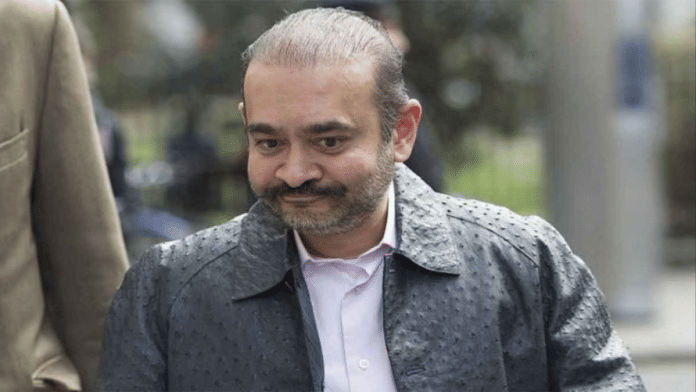



New Delhi: “Comprehensive, detailed and reliable”—this was the opinion of the United Kingdom High Court on the assurances given by the Indian government and investigative agencies that led the court to reject fugitive diamond merchant Nirav Modi’s bid to reopen his case against extradition to India.
Moreover, the court observed that the assurances, including a note verbale from the Indian High Commission in London, were “cognisable” at the diplomatic level because any breach of the assurances would be “extremely damaging” to mutual trust and confidence in their bilateral relationship.
A King’s Bench Division, presided over by Lord Jeremy Stuart-Smith and Justice Robert Jay, made these observations in the judgment rejecting Modi’s plea to reopen the case to challenge his extradition to India. He is wanted in several cases by the Central Bureau of Investigation and the Enforcement Directorate, linked to fraud orchestrated against Punjab National Bank amounting to Rs 13,500 crore.
India had submitted extradition requests in July and August 2018, months after the fraud case came to light and followed it with another in February 2020. Modi was arrested by UK authorities in March 2019 and has been in jail since.
His extradition was first approved by a district judge in the UK in February 2021, who observed that there were no bars to his extradition and sent the file to the UK’s Secretary of State, who approved it in April 2021. He appealed against the extradition orders before the High Court, which junked the appeal in November 2022.
“We have considered these assurances very carefully indeed. On the one hand, the mutual confidence and trust that exists between two friendly powers who have entered into binding treaty arrangements must be accorded considerable weight, as well concomitantly as solemn assurances proffered within the same framework,” Lord Jeremy Stuart-Smith and Justice Robert Jay observed in the judgment.
“On the other hand, we must recognise that there is some force in Mr Fitzgerald’s (Modi’s counsel) submission that some of the affidavit evidence placed before us comes from persons who, on the basis of Bhandari, have condoned or turned a blind-eye to unacceptable treatment of detainees. Nonetheless, that submission travels only a certain distance in circumstances where, as we find, these assurances have been given by the GoI in good faith and with the intention that they should be binding. They have not been given with an eye to wriggling out of them should the need or opportunity to do so arise,” they further observed.
Long list of assurances
Modi’s fresh bid to reopen the case against extradition came on the back of the UK High Court’s judgement, barring the extradition of the fugitive arms dealer Sanjay Bhandari, who is wanted in cases of money laundering and black money being probed by the ED. Bhandari’s extradition was barred by the UK court, citing the risks of torture at the hands of probing agencies and the conditions of prisons in India.
As the case opened in the High Court, Indian authorities submitted assurances, one after another, in an effort to convince the UK High Court that Modi would face only trial before the special courts and would not be interrogated by the investigating officials.
At first, the Ministry of External Affairs had in September last year, assured the UK court that there is no “intention or need to interrogate Mr Modi because these cases are ready to proceed to trial and that “neither the CBI nor the ED is empowered under Indian law to interrogate Mr Modi after he is extradited in connection with the offences for which he is being extradited.”
The Ministry of Home Affairs, the nodal ministry for extradition processes, followed up with another such assurance, adding that if any agency needs to interrogate Modi, it would not be done without the prior approval of the UK courts or authorities. Instead, he was sought only to face the judicial proceedings.
Besides, the CBI and the ED, the MHA had assured that Modi would not face interrogation even from other agencies such as the Serious Fraud Investigation Office (SFIO), Directorate of Revenue Intelligence (DRI) and Central Board of Direct Taxes (CBDT), the parent body of the Income Tax Department, in relation to any ongoing allegation or proceedings.
These assurances were followed by individual affidavits from officers of the CBI and the ED before the High Court stating that, since the trial court was already presiding over the matter against Modi, no investigative agency had any role to play.
On the other hand, Modi’s counsel relied on expert witnesses, including retired Supreme Court Judge Deepak Verma’s opinion, and argued that the investigating agencies are “independent” of the government and, hence, any assurances would not be binding on them.
Additionally, they relied on Verma’s submission that a production warrant from the courts in the DRI case in Gujarat would be binding on the prison authorities at Arthur Road prison, where Modi will be housed in the event of extradition, to which the government of India counsel confirmed that assurances given by the government is valid on all agencies that no further interrogation will take place.
“This Court’s judgment in Bhandari presents a worrying picture of the use of proscribed treatment to obtain confessions which was characterised as “commonplace and endemic”,” the UK High Court judgement said.
“Were it not for the statements made and assurances given by the GoI between September 2025 and February 2026, culminating in the note verbale to which we accord considerable weight, we would be minded to re-open this appeal in the exercise of this exceptional power,” it further said.
(Edited by Nardeep Singh Dahiya)
Also Read: Explainer: How Nirav Modi cheated PNB through fraudulent LoUs