







New Delhi: In the first week of February, Raj Kumar, a 59-year-old engineer and entrepreneur from Moti Nagar in Delhi, received a text about a “friendship club”. At first, he ignored it. Then he clicked on it, “trying to understand and explore”.
A second SMS arrived on 7 February. It contained a link to an online platform called Flirtify, which, as Kumar later told ThePrint, “falsely claimed to facilitate friendships with women near a user’s location”.
Clicking the link redirected him to a Telegram bot—Flirtify2256bot—where a person posing as a receptionist collected his personal details and showed him profiles of women to choose from.
What followed was textbook fraud.
Kumar was first asked to pay Rs 2,000 for a membership that allowed him to play games. The money was returned, building trust. He was then induced into purchasing a “VIP Platinum Membership Card” through a fake verification process.
A Telegram user calling himself Vijay Saxena, introduced as a “company certifier”, manipulated him through what Kumar describes as “deceptive and time-bound gaming tasks”, promising large refunds.
Kumar transferred Rs 1,57,999 in three transactions. When he asked for the money back, he received a letter on Flirtify letterhead—which he immediately recognised as fake. All Telegram accounts then blocked him.
“I realised the font, the letterhead, the entire document looks fake. I understood it was false inducement and misrepresentation. I was cheated,” Kumar said.
He registered a complaint on the National Cyber Crime Reporting Portal (NCRP) on 2 March. An FIR was filed under Bharatiya Nyaya Sanhita (BNS) Sections 318(4) (cheating), 319(2) (cheating by personation), and 61(2) (criminal conspiracy) at the Cyber West District Police Station.
By April, three men—Sachin Rawat, Akshay Kumar Baliyan, and Kartikey Choudhary—had been arrested from Saharanpur, Uttar Pradesh.
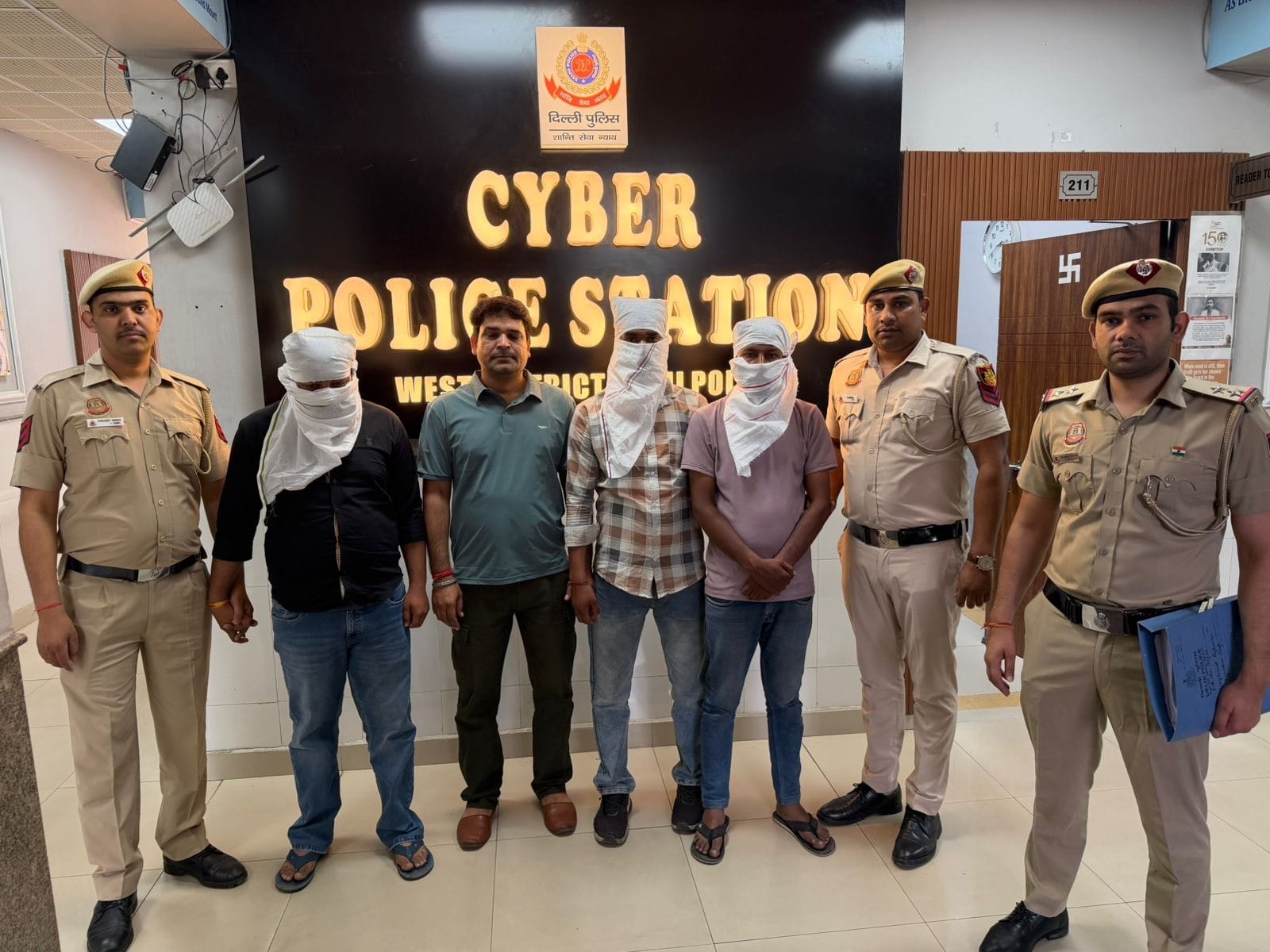
Kumar’s case is one of 28 NCRP complaints investigators have since linked to the same accused accounts.
Raj Kumar’s experience points to one end of a large and layered digital economy—one that the Delhi High Court put under formal scrutiny on 13 May, when a Division Bench comprising Chief Justice Devendra Kumar Upadhyaya and Justice Tejas Karia issued notices to Google LLC, Apple Inc., and CERT-In (Indian Computer Emergency Response Team), India’s national nodal agency responsible for handling cyber security incidents.
The court directed them to act against mobile applications promoting “obscene, vulgar, and pornographic content” on their platforms.
It was responding to a Public Interest Litigation filed by Rubika Thapa. The PIL alleged that several apps were disseminating explicit content while presenting themselves as social networking and live-streaming platforms. The petition also flagged alleged links to trafficking, deepfake-based sextortion, and routing of funds through foreign servers.
Among the apps named in the PIL: Tango.Me, Chamet, PyaarChat, StreamKar, LivHub, Vibely, Fun Party, Jalwa, Winku, Bling, Bolo Ji, MuMu, Chato, Hiiclub Pro, and others. Google, Apple, and CERT-In have been asked to file action-taken reports before the next hearing on 17 July.
The two cases—a Delhi fraud and a High Court PIL—sit at different points of the same ecosystem: apps that present themselves as platforms for connection, and whose coin-and-gift economies fund everything from loneliness to organised crime.
Also Read: Fraud and sexual exploitation prime motives for cyber crimes in country: NCRB data
How the money moves
The business architecture across these apps follows a nearly identical pattern. A user downloads an app marketed as a platform for audio or video conversations with strangers. To interact meaningfully, he purchases coins through in-app transactions.
Those coins are spent on virtual gifts sent to a host—typically a woman streaming live. On the host’s side, the gifts convert into a second virtual currency—diamonds, gems, or an equivalent—which can then be cashed out as rupees.
The closed-loop wallet structure, with real money entering as coins and exiting through an intermediary currency, operates within RBI regulations.
The platform takes a cut at every stage.
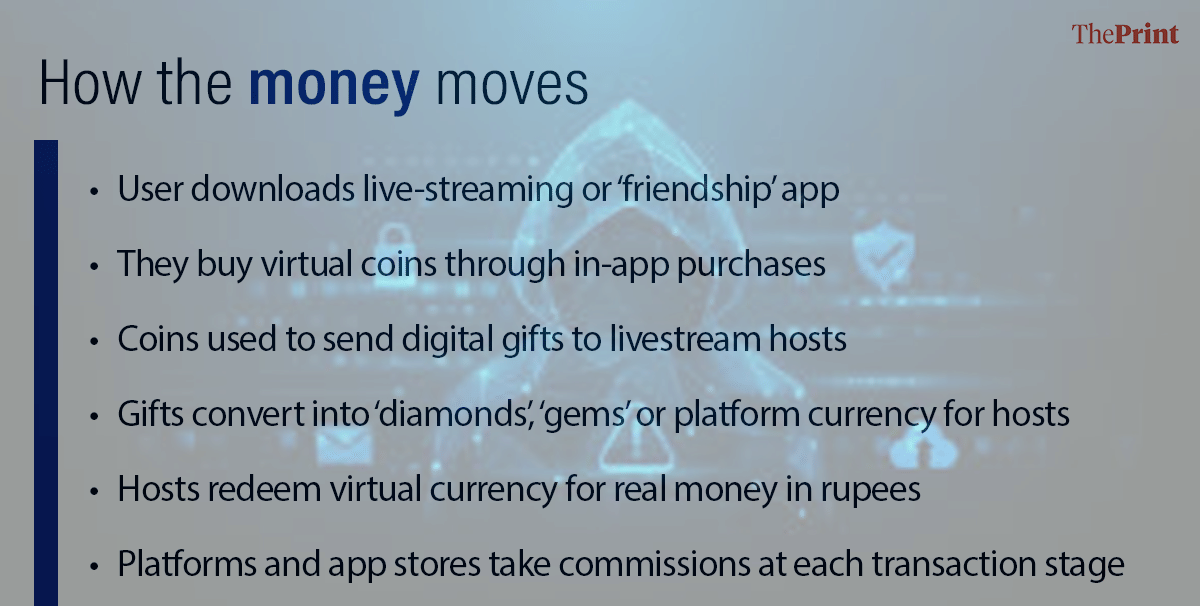
On Tango, virtual gifting constitutes around 85 percent of total global revenue, with the platform retaining 50 to 60 per cent of gift payouts. On Chamet, before it was pulled from Indian stores, the split was 60-40 in the host’s favour, with the platform taking the rest. Both Google and Apple collect a commission of up to 30 per cent on every in-app purchase processed through their stores.
Vibely, a product of Mohalla Tech—the Bengaluru-based parent company of ShareChat and Moj—calls its host-side currency Gems. According to the app’s FAQ, “Gems is Vibely currency that users can earn on the platform which can be redeemed to cash.” Gems are earned when hosts receive virtual gifts from callers; they cannot be purchased directly.
The entire economy flows one way—users paying the hosts through the platform.
Vibely’s Play Store listing pitches the feature as a way for users to “exchange cool gifts to impress new friends.”
“There is a boredom epidemic in this country, a loneliness epidemic,” says an industry expert with knowledge of the live-streaming economy, speaking on condition of anonymity. “Someone who has money but does not have a wide social circle—this is a way for him to talk to someone. It is not necessarily sexual. Many people just want to talk.”
Play Store reviews across multiple apps reflect the scale of spending. Users regularly report daily spends of Rs 5,000 to Rs 10,000, with some reviews referencing monthly spends in lakhs on a single platform.
The apps
Tango, founded in 2009 in Mountain View, California, pivoted to live-streaming in 2017 and built a concentrated user base in India. According to an investor presentation from December 2024, reviewed by The CapTable, it was pulling in over Rs 100 crore — roughly $12 million—every month from Indian users alone, primarily through virtual gifting and in-app purchases.
For comparison, Google-backed ShareChat, active since 2015, reported average monthly revenues of around Rs 60 crore in FY24. Tango has over 500 million registered users globally and has been downloaded over 380 million times on Android.
In December 2024, a New York Times investigation reported that Tango and other live-streaming apps were being used to facilitate child sexual exploitation, including parents being paid to abuse their children on camera.
Following that investigation, Tango was temporarily removed from the Google Play Store globally, alongside BIGO LIVE and LiveMe, for content policy violations. It returned to the Play Store by May 2025.
Apple’s position was more definitive—as of early 2025, the app cannot be installed on iOS devices even by users who had previously downloaded it.
Chamet had accumulated 26 million downloads and $38 million in lifetime spending from Indian users before Google removed it from the Play Store in August 2023 for violating its User Generated Content policies.
In the first seven months of 2023 alone, Indian users spent $13.4 million on the platform. The PIL flags that Chamet’s parent entity is registered abroad and operates through foreign servers.
Vibely, launched by Mohalla Tech in October 2024, markets itself as an anonymous audio-calling app for “judgement-free friendships”, with users assigned custom avatars in place of profile pictures.
The app has in-app gift purchases built into its core interaction model and is named in the PIL. It is currently listed on both the Play Store and the Apple App Store.
Other apps cited—StreamKar, LivHub, PyaarChat, among others—operate on the same model. The PIL notes that many are registered outside India, with servers in the US, Turkey, Japan, Russia, and China.
The fraud layer
Raj Kumar’s case illustrates how the surface grammar of these apps—profiles, gifts, female companionship—is replicated by criminal operations running entirely outside any platform.
Flirtify is listed on the Play Store as a live video chat app with a 2.4 rating, but the fraud Kumar fell into was orchestrated almost entirely over Telegram, with the app functioning as the initial lure.
On Google Play Store, many users have complained of frauds on the application’s reviews.
ThePrint reached out to Flirtify through email, but there was no response. The report will be updated if and when they respond.
The Delhi Police’s investigation traced the financial trail through layer-1 mule accounts at Indian Overseas Bank, Bank of Maharashtra, and Union Bank of India. Telegram was served notices for subscriber information linked to the bot and user accounts.
The IP addresses returned by Telegram were traced to Africa, pointing to international dimensions. Bank records revealed that Rs 99,500 had been credited to an account in the name of Sachin Rawat at Union Bank of India and subsequently withdrawn in cash from Bangalore—despite Rawat being a resident of Saharanpur.
“This established the existence of an interstate mule account network engaged in routing and dissipation of proceeds of cyber fraud,” a senior police officer involved in the investigation told ThePrint.
Rawat, investigators found, had opened bank accounts and handed over the banking kits — ATM cards, SIM cards, credentials—to co-accused Akshay Kumar Baliyan.
Baliyan arranged approximately 10 to 11 bank accounts from different individuals and supplied them to Kartikey Choudhary.
Choudhary, described by police as “the mastermind”, arranged roughly 40 mule bank accounts for cyber fraud operators and was found connected with syndicate members in Gorakhpur and Bengaluru.
The final step was conversion.
DCP (West) Sharad Darade Bhaskar said, “The accused used fake Telegram identities and digital platforms to emotionally manipulate victims and route cheated money through mule accounts before converting the funds into USDT cryptocurrency”—chosen specifically to avoid tracing.
Police said the syndicate had been operating for roughly three months at the time of arrest, and that Choudhary—who works as a reporter—had modelled the operation on similar scams he had seen reported in the media.
Platform accountability
Both Apple and Google collect commissions of up to 30 per cent on in-app purchases processed through their stores. The revenues from the apps named in the PIL flow through those very stores.
“Google is making money off this,” the industry expert says. “How can Google wash its hands and say it is only an intermediary?”
The court’s May 13 order addressed this directly. “The intermediaries have to play the most vital role, not only on receiving any such complaint, but also they have to exercise due diligence at the time of permitting such applications to be uploaded through them,” the bench stated.
Developers must go through a detailed review process before their apps are listed — including API integration checks, security reviews, and content walkthroughs. Under Rule 3(1)(b) of the IT (Intermediary Guidelines and Digital Media Ethics Code) Rules, 2021, platforms are required to ensure users do not share content that is “obscene, pornographic, paedophilic” or in violation of Indian law.
A 2022 amendment went further, requiring intermediaries to make “reasonable efforts by itself” to prevent such content from being hosted—not merely to act after a complaint is received. Under Rule 7, intermediaries that fail these obligations lose their safe harbour under Section 79 of the IT Act, exposing them to direct liability.
The PIL further alleges that several named apps have not appointed compliance and grievance officers within India as required under Rule 4—a measure that would give Indian authorities a domestic contact point for enforcement.
The obscenity question
The court’s direction to act against “obscene” content restates a problem Indian law has not definitively resolved: what obscenity means, and who decides.
“Obscenity has been an age-old problem,” says Deepro Guha of The Quantum Hub, a policy research organisation. “You put in vague words which impede on freedom of speech and expression, and then who gets to define those terms? Mostly the answer is: the government does.”
Indian courts have returned to the question repeatedly. The 1965 Supreme Court judgment in Ranjit D. Udeshi v. State of Maharashtra—which concerned the novel Lady Chatterley’s Lover—held that content encouraging “lascivious” thought constitutes obscenity. Subsequent interpretations have not produced a more precise standard.
“If you go through court judgments you will find all kinds of different definitions, which you can retrofit to basically anything you want,” says Guha. “Absolute definitions are not legally desirable because things might go under the radar, but too wide a discretion is also not desirable — it puts too much power in the hands of the authorities.”
The risks of that discretion have a track record. Before the Online Gaming Act, the government periodically sent batch takedown notices listing 100 to 150 apps at a time, and in several such instances, apps that were entirely legal ended up included. Between July 2025 and February 2026, the government blocked at least 30 OTT platforms under Section 69A of the IT Act for obscene content.
The scale
Tango’s India revenues—over Rs 100 crore a month—exceeded the monthly revenues of ShareChat, a platform with 350 million monthly active users built over a decade. Chamet generated $38 million from India across its years of operation here.
Vibely, less than two years old, is named in a PIL alongside globally established platforms. These numbers attach to apps that describe themselves, without exception, as social and entertainment services.
Raj Kumar’s Rs 1,57,999 sits at the other end of the same chain.
(Edited by Ajeet Tiwari)
Also Read: Cybercrime saw 24% spike in 2025. Indians lost Rs 22,495 crore, mainly in investment scams