



New Delhi: This is one western disturbance India could have done without. Meant to be a financial aid scheme for students planning to study in Canada, the Ontario Student Assistance Program (OSAP) has morphed malignantly into a scandal featuring a Chandigarh-based real estate conglomerate GB Realty and a subsequent First Information Report (FIR) the conglomerate has filed against several Canadian influencers and journalists.
This probe comes ahead of Prime Minister Narendra Modi’s visit to Canada in December, as India-Canada ties seek to move past a deep freeze under former Canadian prime minister Justin Trudeau.
On 13 October, Punjab Police registered an FIR invoking criminal defamation and computer-related fraud provisions to probe social media influencers and journalists, including some based in Canada, over posts linking the Chandigarh-based conglomerate to alleged student grant fraud in Canada.
What is the OSAP scheme, and what is its connection with an Indian conglomerate? ThePrint explains.
Also Read: ‘We won’t be silenced’: Canadian journalists lash out at Punjab Police FIR over social media posts
OSAP scheme and the ‘scam’
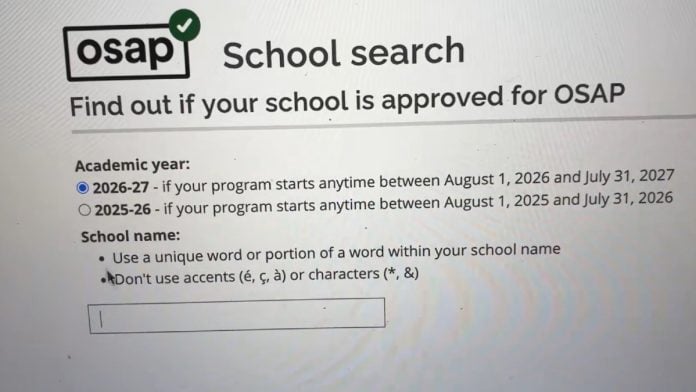
The Ontario Student Assistance Program (OSAP) is a financial aid scheme that helps pay for college or university education in Canada through grants and student loans. OSAP helps in paying for tuition, books and equipment, fees, living expenses (for full-time students only), and child care (for full-time and part-time students with children). It is open to Ontario residents of any age who are Canadian citizens, permanent residents, or protected persons.
Changes announced to the provincial share of OSAP (as opposed to the central share) on 12 February 2026 meant students would receive more of their provincial scheme funding as loans rather than grants.
Colleges, however, have remained on alert since the Ontario Ministry of Colleges and Universities earlier this year disqualified students at five private career colleges from receiving student assistance loans under OSAP, citing multiple scams targeting OSAP recipients, where they are requested for “upfront fees, promises of loan forgiveness or quick money, and demands for payment via unusual methods like cryptocurrency or gift cards”.
For example, CLI College in Canada has issued an advisory for students to be wary of unsolicited communications, and never share personal or financial information unless the contact was initiated. The scams alleged include scholarship, grant scams, loan forgiveness, repayment scams, tuition payment scams, and phishing.
What Canadian govt said
Scams like the one CLI pointed out were acknowledged on 6 October when Nolan Quinn, the minister of colleges, universities, research excellence and security in Ontario, issued a statement, saying: “In late 2024, the Ministry of Colleges, Universities, Research Excellence and Security (MCURES) began receiving an increasing number of complaints about the growing volume of OSAP applications at private career colleges.”
The statement said that on 15 January 2025, Career Colleges Ontario, which operates independently from the government, and provides financial aid processing services to its members, raised similar concerns about specific institutions.
As part of its regular oversight, the ministry actively reviews complaints and monitors OSAP application activity. As concerns grew following information provided by the federal government in May 2025 about “certain private career colleges,” the ministry expanded its review and, in July 2025, launched targeted inspections.
In December 2025, the ministry also engaged the government’s Forensic Investigation Team (FIT) to provide advice for further strengthening oversight of the sector. The ministry continued its work with Career Colleges Ontario to monitor compliance. The ministry also took corrective action and, in May 2026, issued notices of non-renewal to six campuses. The government has since suspended their OSAP eligibility.
“Given the volume and nature of the issues identified by the ministry, in August 2026 the government engaged an independent third-party auditor, KPMG, to assess the broader integrity of OSAP applications at private postsecondary institutions,” the statement said.
While that KPMG audit is ongoing, “preliminary findings have identified serious concerns about the integrity of the OSAP system in the private postsecondary sector.”
“These include common ownership, the involvement of immigration services firms and co-location between private career colleges and immigration recruitment or immigration services firms, inadequate student validation and verification of course enrolment and outcomes, and unusually high concentrations of OSAP applications submitted from the same geographic locations,” said the government statement.
As a result, the government notified the auditor general in the last week of September, and has also referred this matter to the Ontario Provincial Police. The ministry continues to investigate and gather information, with the support of KPMG.
The government has also paused all OSAP payments associated with private postsecondary institutions as the audit proceeds. Going forward, all private postsecondary institutions will have to meet stricter criteria before regaining OSAP eligibility.
2024 and 2025 grant spending in Ontario
Addressing a press conference last week, Tyler Watt, Member of Provincial Parliament of Ontario, “exposed” the real reason the “Premier gutted the OSAP”. In 2024 and 2025, Watt said, “grant spending for students at our universities and public colleges barely moved. University students actually got less. So, where was all that new money going?”
According to Watt, Ontario spent C$465 million more that year on student grants than the year before. “Ninety-five percent of it went to one place: private career colleges,” Watt added. Their grants nearly doubled, from C$554 million, to almost a C$1 billion, in just one year, he said. “That is more than every university student and every public college student in Ontario received combined,” he added.
Watt went further to say that just seven private career colleges took in C$385 million that year. “That means, out of every public college and every career college in this province, seven schools took one fifth of the pie.”
“So, who got the money?” he asked.
In 2024 and 2025, students at just three Academy of Learning campuses, “received more than C$219 million in OSAP grants,” Watt said. “In September of 2025, the government inspectors visited the Academy of Learning’s Bay Street campus and, according to court filings, the campus couldn’t demonstrate that its OSAP funded students were participating in their programmes.”
“Meanwhile, influencers and third-party agents were openly advertising OSAP as free money, online,” he said. “This was happening in plain sight. The government had the warnings, the inspectors and the numbers. But, the political connections raise even more questions,” Watt said.
Just two months after that September 2025 inspection Ontario Cabinet Minister Prabmeet Sarkaria and Progressive Conservative (PC) Member of Provincial Parliament (MPP) Amarjot Sandhu attended an Academy of Learning ribbon cutting alongside its co-founders. “The government was inspecting was inspecting an Academy of Learning with one hand and cutting its ribbon with other,” Watt said.
Alleged scam in Canada, FIR in India
It was on 8 October that Melanie Bennet, a journalist working at Juno News, an independent news organisation, posted on X: “Gurinder Bhatti, the businessman at the head of the Academy of Learning network facing a criminal investigation, also runs a study abroad consultancy in Punjab, placing his business interests both sides of an industry that promises students a better future in Canada.”
Soon, several social media accounts on Facebook, Instagram and X began posting content related to the alleged scam.
On 13 October, the Punjab Police registered an FIR under criminal defamation and computer-related fraud provisions to probe social media influencers and journalists, including those based in Canada, over posts linking the Chandigarh-based conglomerate to alleged student grant fraud in Canada and its real estate projects in Mohali.
The FIR was filed on the complaint of counsel for the real estate firm GB Realty—a group company of the Optas Group run by Gurinder Bhatti—who alleged that the posts made by the individuals on social media platforms brought the firm into disrepute and were intended to damage its real estate projects in Mohali.
The FIR has been filed under Section 356(2) of the Bharatiya Nyaya Sanhita 2023 (BNS), which deals with offences amounting to criminal defamation, and Section 66 of the Information Technology Act 2000, which deals with computer-related fraudulent acts.
Although the FIR has been filed against unknown accused, GB Realty’s counsel Paras Sharma has submitted a list of 109 social media posts by influencers and journalists allegedly defaming his client. In the police complaint, Sharma alleged that his client firm, GB Realty, is in the process of introducing “Punjab’s first branded residences” on Mohali’s airport road and in New Chandigarh, after acquiring land from the Greater Mohali Area Development Authority (GMADA).
He further alleged that the social media posts by influencers and journalists linking the firm and its managing director Gurinder Bhatti are undermining the trust of investors, buyers, banks, and business partners vital for their business interests.
“Having acquired land from GMADA, we are introducing Punjab’s first branded residences, located on Airport Road, Mohali, and in New Chandigarh. Recently, some unidentified individuals intent on tarnishing our group’s reputation have spread false rumours on social media about our company and its Managing Director, based on incorrect facts,” Sharma alleged in the complaint, which formed the basis for the FIR.
“Specifically, they (against influencers and journalists) have attempted to link our company’s name to a fraud case in Canada. This allegation is entirely false and baseless. This content is being disseminated against us via posts, videos and comments on platforms such as YouTube, Instagram, Facebook and others,” Sharma further alleged in the FIR.
The origin of the row
Among the social media handles being probed is of Chandigarh-based influencer Shivrattan Dhillon, who posted that actor Salman Khan distanced himself from the GB Realty campaign in the wake of fraud allegations in Canada. Although the FIR lodged on the complaint by GB Realty counsel does not name him, Dhillon claimed he was issued a notice by Punjab Police in connection with the case.
Similar posts were made by more than a hundred social media handles of influencers and journalists, citing Canadian media reports, alleging that the Academy of Learning Career College network in Ontario—run as a franchise by the Optas Group company Opulence Education Group—was at the centre of the misappropriations in the Ontario Student Assistance Programme (OSAP) through fraudulent enrolment. According to its website, Opulence Education Group was co-founded by Bhatti and Puneet Khanna.
According to Canadian media reports, the Ontario Ministry of Colleges and Universities earlier this year disqualified students at five private career colleges from receiving student assistance loans under OSAP for the coming year, after raising concerns about some of the schools’ course enrolment practices such as “high-risk” admission, “inadequate attendance tracking” and “compromised participation in asynchronous programmes (online learning)”.
Four of these institutions were operated by the Academy of Learning Career Colleges of the Opulence Group, according to Canadian media reports.
GB Realty’s counsel Sharma called these allegations “false and baseless” in his complaint to the police. “This campaign has been deliberately orchestrated by certain unidentified malicious elements to incite hatred and hostility toward us among the general public, with the intent of damaging our major real estate projects in Punjab,” he said in the complaint.
Adding, “This false propaganda is causing severe harm to our reputation, tarnishing our company’s image in the eyes of the public. Furthermore, it is undermining the trust of investors, buyers, banks, and business partners. We request that those responsible for creating, publishing, funding, and disseminating this content be identified. We also request that details about these accounts be obtained from platforms such as YouTube and Meta, and that the objectionable content be removed. We urge the culprits to be dealt with promptly and appropriate legal action against them.”
Punjab Police have written to social media intermediaries such as X and Instagram to take down this content, invoking section 79 (3) (b) of the Information Technology Act 2000.
In response to the takedown notice, influencer Dhillon said on X, “If this is the path they want to take, so be it!”
(Edited by Nardeep Singh Dahiya)
Also Read: Canadian opposition leader criticises the Bishnoi gang, seeks swift deportations