





India will push BRICS nations to expand the use of central bank-backed digital currencies for cross-border payments, while stopping short of supporting a unified payments network that could be seen as a challenge to the dollar, according to people familiar with the matter.
With India chairing BRICS this year, Prime Minister Narendra Modi favors using central bank digital currencies to settle bilateral trade between members, the people said, asking not to be identified because the discussions are private. An agreement on a single bloc-wide payments settlements system at the upcoming leaders’ summit in New Delhi this weekend is unlikely, they said.
The BRICS bloc — which includes China, Russia, India and South Africa — has been working toward linking members’ payment systems in ways that could reduce reliance on the global SWIFT network, which is dominated by Western nations. The initiative gained attention after several Russian banks were cut off from SWIFT following Russia’s invasion of Ukraine in 2022.
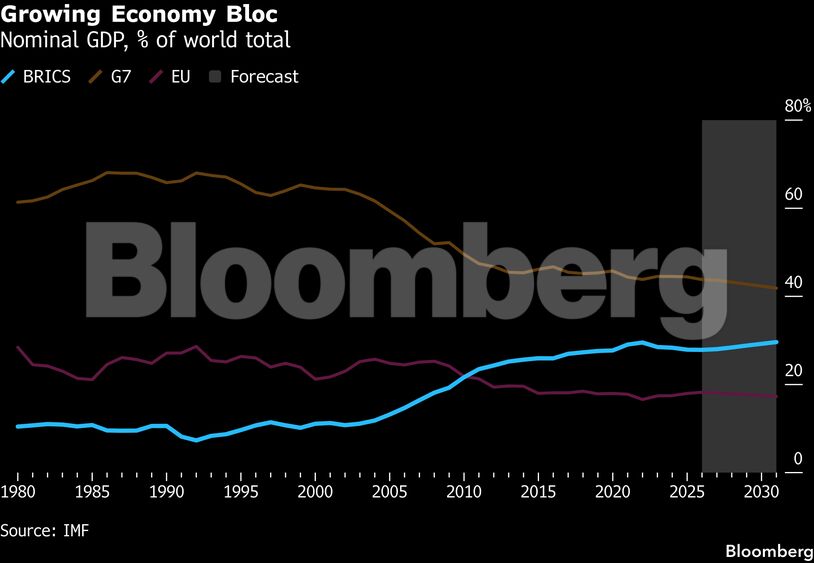
New Delhi, however, remains wary of a unified BRICS payments system that could be seen as a rival to SWIFT, people familiar with the matter said. Such a move could cast BRICS as an explicitly anti-dollar or anti-Western bloc, they said.
Instead, India is proposing BRICS countries link up their central bank digital currencies for cross-border transactions, thereby reducing reliance on banks and cutting down on costs. India is also in favor of countries using their local currencies to settle trade, instead of resorting to a third currency, like the dollar.
The RBI did not respond to a request for comment. India’s Ministry of External Affairs spokesman Randhir Jaiswal said it would be premature to conclude what is being discussed at the Finance Ministers-Central Bank Governors meetings which began on Wednesday, and urged reporters to await the joint statement.
Jaiswal added that India’s approach to BRICS cooperation, including on finance, has been “development focused,” referring to an emphasis on measures that support trade and economic ties.
The use of local currencies for trade settlement has already increased within BRICS, particularly after Western sanctions on Russia. Around 96% of India’s trade with Russia now takes place through established rupee-ruble mechanisms, according to Ivan Nosov, head of Sberbank in India. Almost all trade between Russia and China is settled in yuan and rubles, according to Russian news agency Interfax.
India already has a digital rupee in pilot testing, while China and Russia have also been experimenting with their own central bank digital currencies.
Russia’s Vladimir Putin, China’s Xi Jinping and other BRICS leaders may also discuss connecting their countries’ instant mobile payment systems — used for small-value retail transactions.
Such efforts are already advancing beyond BRICS. India recently connected its Unified Payments Interface, or UPI, with Singapore’s PayNow for remittances. Modi said at an event in Mumbai this week that such links should be expanded to countries with large Indian diaspora populations.
India has signed agreements with central banks in the UAE, Mauritius, Maldives and Indonesia to use local currencies for trade while more such agreements are being negotiated, Reserve Bank Governor Sanjay Malhotra said recently.
“We will continue our efforts to internationalize the rupee and promote the use of local currencies for cross-border payments and for trade,” the governor said.
For countries such as India, more trade in local currencies can provide a buffer against volatile global capital flows, according to Sonal Varma, a Singapore-based economist at Nomura Holdings Inc.
“Local-currency settlement can help conserve scarce dollar reserves for strategic imports while enabling routine trade financing in local currency,” she said.
Disclaimer: This report is auto generated from the Bloomberg news service. ThePrint holds no responsibility for its content.