





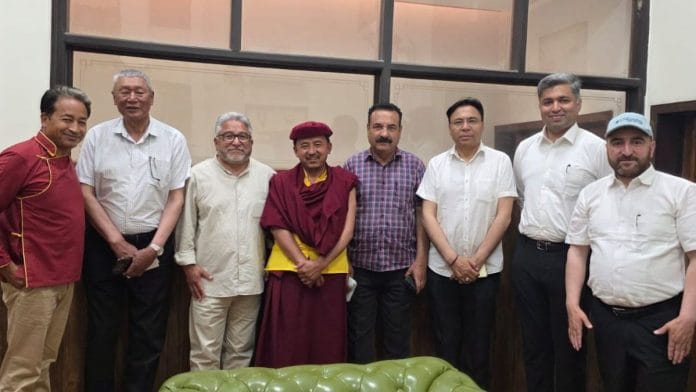

New Delhi: In a breakthrough that ended a stalemate in talks between Ladakhi groups and the Ministry of Home Affairs (MHA), the Kargil Democratic Alliance (KDA) and the Leh Apex Body (LAB) have agreed in principle to constitutional safeguards on the lines of Article 371 as well as the creation of a Union Territory-level legislative body.
Articles 371 and 371-A through J provide “special provisions and protections” for specific states, giving them autonomy over their affairs without interference from the state and Central governments. The states include Nagaland, Mizoram and Sikkim.
Sources in the government said that to politically empower Ladakhis, they were promised a “Union Territory-level legislative body” that would be above the bureaucracy and would legislate on local laws, with representatives at both the state and UT levels,
How this legislative body will be constituted, since Ladakh doesn’t have a state legislature, or how their representative will be elected still remains unclear.
The agreement is a major shift for both groups, which had initially opposed such a framework and until now demanded full statehood and Sixth Schedule status for Ladakh.
“LAB and KDA today reached an In-Principle Understanding with the Government of India on restoring democracy in Ladakh and providing constitutional safeguards on the lines of Article 371A, F, and G (as applied to Nagaland, Sikkim and Mizoram),” said a joint statement released by both groups on Friday.
“All bureaucrats of the UT, including the Chief Secretary, will come under the executive head of the UT-level elected body (proposed by the CM),” a government officer said.
Activist Sonam Wangchuk, who had spearheaded the demand for full statehood and the Sixth Schedule for Ladakh, was also a part of the delegation. Wangchuk was released from prison in March after the Union Ministry of Home Affairs revoked his 170-day detention under the National Security Act (NSA).
How this legislative body will be constituted, since Ladakh doesn’t have a state legislature, or how its representatives will be elected, remains unclear.
“How the representatives will be elected and how this body will be constituted remains to be seen, but this was agreed upon to politically empower the people of Ladakh. This legislative body will legislate on local laws and have representation both at the state and UT level,” the officer added.
The officer said that a framework has been agreed upon and further discussion will be done on how to execute it.
On statehood
The officer said the meeting was a major success, as both bodies were convinced about why their earlier demands for Sixth Schedule status and separate statehood were not feasible.
“They were explained why these structures are not feasible in a place like Ladakh, and they understood and agreed. They were assured that this does not mean their rights and interests will not be safeguarded. That remains paramount for the government, and they agreed,” the officer said.
“It was explained by the MHA authorities that only reason why Ladakh cannot be made a state at the moment is that it currently lacks adequate revenue generation to meet the revenue expenditures like salaries of employees,” said the statement by the two bodies.
It. however, that this setup will lead Ladakh towards full statehood “as when it meets the revenue criteria”.
The KDA and LAB also said that they would work out the finer operational details with the MHA in consultation with legal and constitutional experts.
The transition of Ladakh into a UT following the abrogation of Article 370 in 2019 and the bifurcation of the erstwhile state of Jammu and Kashmir (of which Ladakh was previously a part) initially elicited celebrations among residents, as they had always accused the J&K leadership of being discriminatory and ignorant towards their region.
With Ladakh becoming a UT in 2019, residents expected better administration, representation in Parliament, access to government funds and resources, and a heightened focus on development.
But soon after the central government declared Ladakh a UT without a legislature, voices in the region began to rise in protest demanding autonomy, jobs and safeguards for their land and culture, leading to a full-blown protest with over 20,000 people joining Wangchuk in his hunger strike.
The Sixth Schedule empowers tribal communities with a degree of autonomy in governance, enabling them to manage their own affairs and resources. Tribals are estimated to make up more than 90 percent of the population in Ladakh.
Under Article 371-A, which applies to Nagaland, Parliament cannot enact laws on matters that affect social, religious, or customary legal practices of Nagas, as well as the transfer and ownership of land, without the concurrence of the state Assembly.
The same provisions have also been extended to Mizoram under Article 371-G. Under Article 371-F, special provisions have been introduced to provide reservations in the Sikkim Legislative Assembly to protect the interests of different sections of the population.
(Edited by Sugita Katyal)
Also Read: ‘Statehood is as important for Ladakh as it is for any other Indian state’: Sonam Wangchuk