





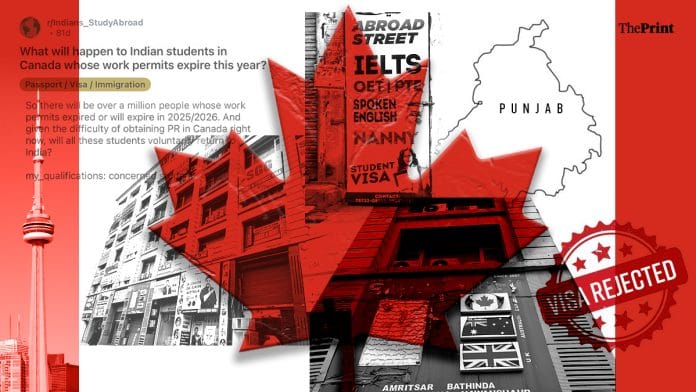



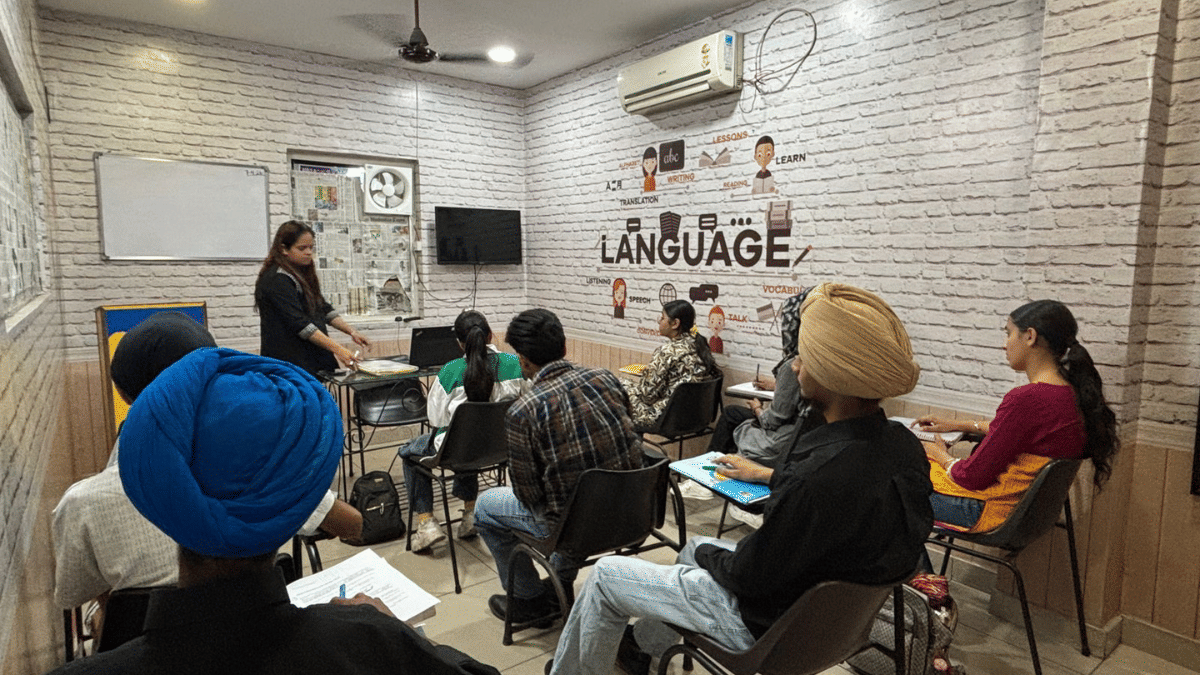
Ludhiana/Jalandhar/Chandigarh: Sheetal is 20, and tired of waiting. As she sits in the International English Language Testing System (IELTS) practice room at Capri Education in Ludhiana, students around her discuss the courses and colleges they can apply to. “London ya Sydney?” they say. Sheetal keeps out of it, for she has already spent two years chasing the Canadian dream and has no energy or enthusiasm left.
Sheetal’s plan was simple: After finishing Class 12, move to Canada for a Bachelor’s degree. But reality bit deep into simplicity, and Sheetal’s dream turned into a loop of paperwork, and finally heartbreak. “I completed my IELTS coaching. I gave the exam. I applied for a visa in 2025. I was rejected. Then, I applied in 2026. I was rejected. The reason? My profile is not strong enough,” she says. “Everyone I know has a life in Canada. Except me.”
Sheetal’s struggle is the new normal in Punjab’s Doaba and Malwa belts. For decades, the path from high school classroom to a basement either in Toronto, Surrey and Brampton was not just a dream, but a household reality. Things have changed, however.
A series of aggressive policy shifts by the Canadian government has made it difficult for students and immigration companies to enter and survive. By capping student permits and tightening the “proof of funds” requirements, Canada has signalled that the era for the “easy entry” student visa is over.
For students like Sheetal, it isn’t just a policy change, but a wall. It slows down entry, and restricts it too. With the Guaranteed Investment Certificate (GIC) cost—an investment required for international students to prove they have the funds to cover their first-year’s living expenses—almost doubling now, and the risk of refusal at an all-time high, the Canadian financial gamble has become too risky for several middle class families.
The dream to go to Canada is not dying; it’s just a whole lot more expensive now.
Also Read: Sikh separatists engaging in violent extremism a ‘threat to national security’—Canada intel report
The revelations
As per the March 2026 audit report by Canada Auditor General (AG) Karen Hogan, Immigration, Refugees and Citizenship Canada (IRCC) reduced the number of new study permits issued to control the growth of the International Student Program. The reduction in new study permits has disproportionately affected smaller provinces.
The audit, ‘International Student Programs Reform’, revealed that while the government successfully capped study permit applications, the actual number of approvals in 2024 fell “sharper than forecast”, with the IRCC approving fewer than half of the permits it had already projected.
This collapse was most visible in the Student Direct Stream (SDS), the fast-track route Sheetal likely missed.
In another key finding, the AG noted internal warnings in August 2023 that the SDS was being “targeted by non-genuine students”. “During this time, approval rates for applications from Indian nationals processed through the SDS rose from 61 percent in 2022 to 98 percent in 2024, before the program was scrapped in 2024.”
“In three investigations, the department identified 800 study permits issued between 2018 and 2023 for which applicants had either used fraudulent documentation or misrepresented information on their applications to gain entry into Canada. Most of these individuals later applied for other immigration permits once in Canada,” the audit report revealed.
Despite these being confirmed cases, the IRCC did not take any follow-up action. Many of these individuals remained in the country; 124 applied for permanent residency, and 105 secured it. “The department needs to act on the information it has to address integrity concerns,” Hogan said in the audit, describing the lack of action as a “serious concern”.
Between 2023 and 2024, the department identified over 153,000 students as potentially non‑compliant with study permit conditions, but had funding to investigate only 2,000 cases each year, the audit report revealed.
The grand old migration industry
Jalandhar’s Garha Road is like a stairway to a Western heaven. It’s lined with massive billboards, featuring white people holding books and flags of the US, Canada, the UK, Australia. Red and blue dominate these boards as they promise: ‘We Guarantee Visa’, ‘Study Abroad’, and of course, ‘Dream Big’.
For over 40 years, this particular 2-km stretch of road has been at the centre of Punjab’s migration industry. In the 1980s and 1990s, people from Doaba and Manjha region used to arrive by bus, clutching dreams and briefcases. Back then, only four to five businesses operated here. Agents would travel to distant villages, meeting the sarpanch to pitch the pros and cons of life across the borders.
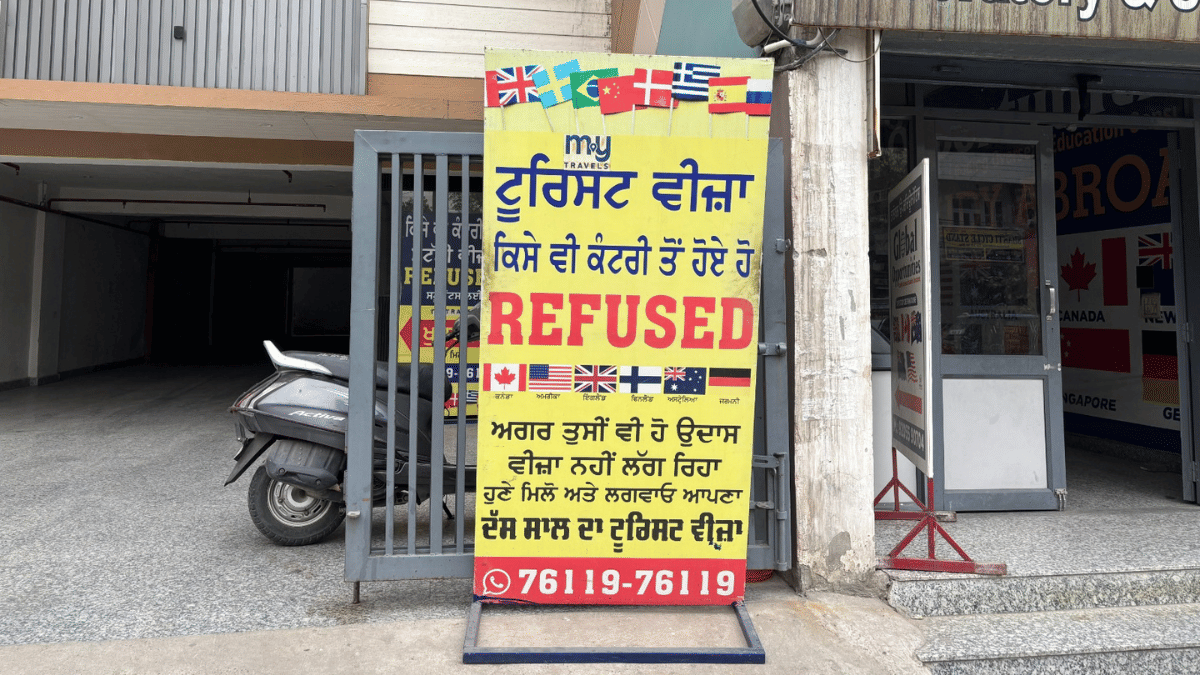
Today, the industry is a giant. Over 30 major companies and hundreds of sub-agents operate within narrow bylanes. People say, “One can find chitta (opium-based drug) and Canada waale agents in each gali.” What was once “word of mouth” advertisement, has now moved to Facebook, Reddit and Telegram. The Canadian dream is staying alive.
Across the oceans, a ‘mini-Punjab’ has taken shape in Brampton, Canada. Big names like Karan Aujla, A.P.Dhillon, Siddhu Moosewala turned the Sikh diaspora into a lifestyle brand, and now almost every household wants to fly the maple leaf red-and-white flag.
This migration machine hit a wall in January 2024. The Canadian government doubled the GIC requirement from $10,000 to over $22,000. The cost of a dream jumped from Rs 15 lakh to 32 lakh overnight. As per data by the Bureau of Immigration, the Ministry of Home Affairs, 9,08,364 students went abroad to study in 2023, and that number fell to 7,70,127 in 2024 and 6,26,606 in 2025.
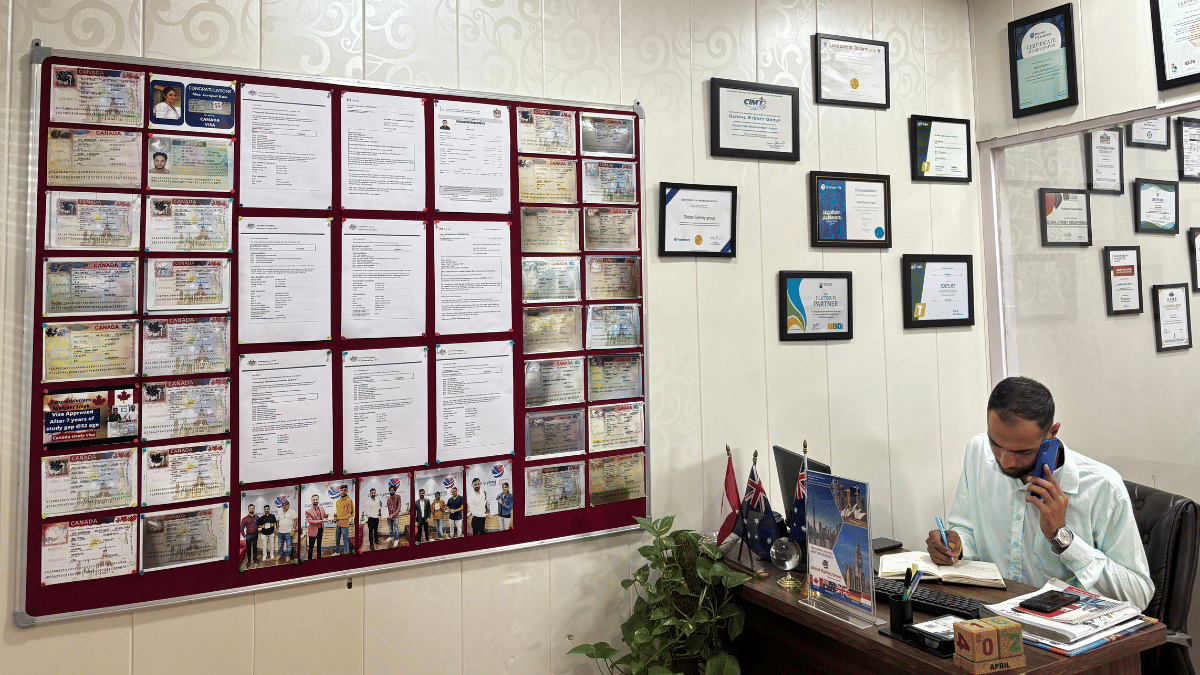
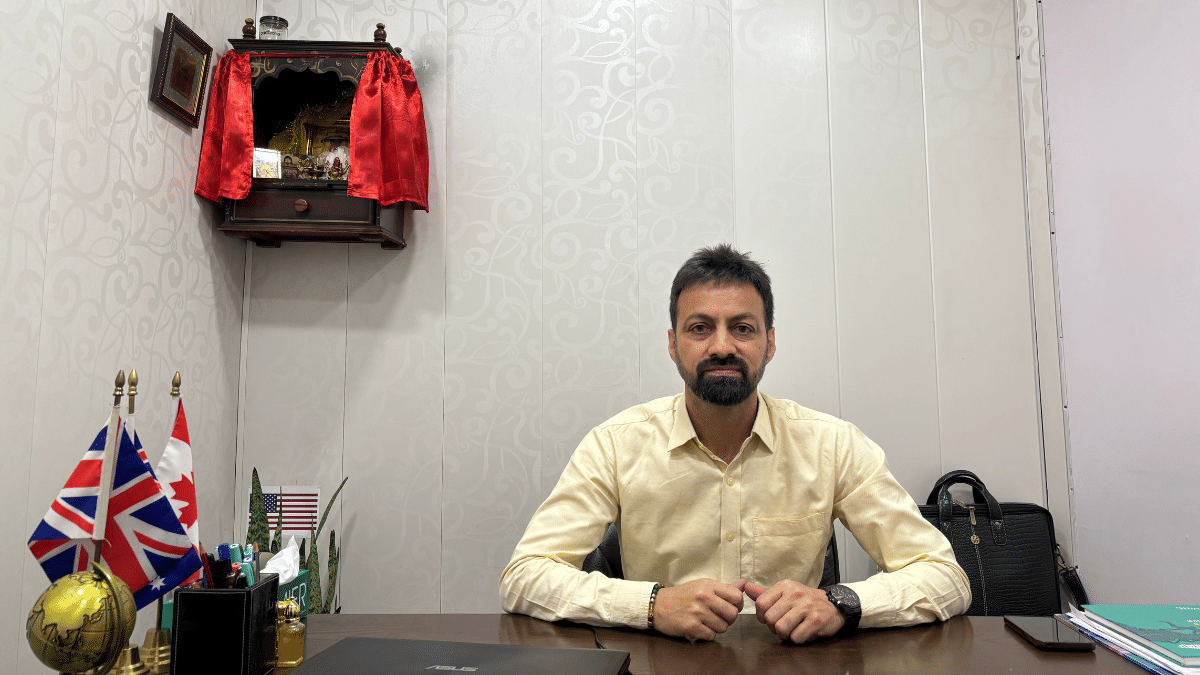
“The people don’t have the paying capacity anymore,” said Rajesh Sharma of Global Sydney Group in Chandigarh. “Earlier, IRCC didn’t check documents thoroughly. They just made decisions. Now, they are in complete strict mode. Now, only the cream of cream will be allowed to enter.”
In a way, the chaos was inevitable. “Since 2019, Canada has promoted itself as a destination for international students, highlighting education as a pathway to permanent residency. As a result, interest in studying in Canada increased, with new study permit applications rising 121 percent from approximately 426,000 in 2019 to about 943,000 in 2023,” the audit report said.
The audit report goes on to say that measures to reduce the number of international students were already underway. “The government’s 2026–2028 Immigration Levels Plan further reduced the number of international students and extended the limit on study permit applications to 2027 to help achieve a new goal of a temporary resident population below 5 percent of Canada’s population,” it said.
Based on data from IRCC cited in the audit, in 2023 India had a 51.6 percent share of incoming student population, 33.6 percent in 2024, dipping to 8.1 percent in 2025. “The Canadian policy was once to attract students at any cost, people who didn’t have an appropriate profile also managed to get a ticket,” Sharma says. “Now, that bubble has burst.”
The impact on the ground can be seen. In Ludhiana, Jalandhar, Chandigarh, the IELTS industry is cratering. Many shut businesses, others started shifting their targets to Australia, New Zealand, the UK and Germany.
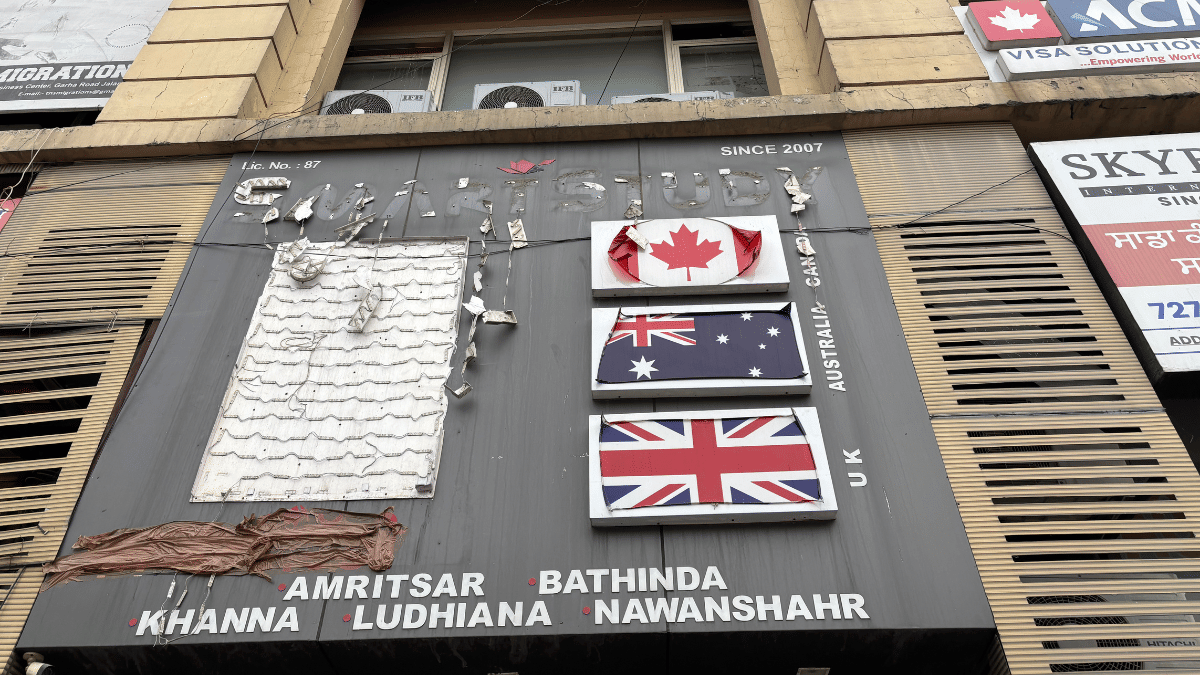
Nitin Chawla, Joint Secretary of Association of Consultants of Overseas Studies and owner of Capri Education, says, over 6,000 people would sit for IELTS every month before 2024. “Now, not even 600 come for Canada.”
“Agents and companies would have to check at least 20 enquiries a day. Now, they see only two,” Chawla adds. He says the pivot to Australia is blocked by rigid income tax laws requirements that Punjab’s agrarian families cannot meet. The UK is tightening its grip, too.
The desperation to go remains as strong as ever. “Are you looking for IELTS coaching? “Do you want to go abroad?” agents whisper in the tuition hubs.
Also Read: Red carpet for US H1-Bs, others get in line—Canada’s big immigration pivot, courtesy Carney
A history of criminality
The migration industry in Punjab has long operated both legally and illegally, with help of international oversight.
In the period specified by the audit, many student’s futures were often just a forged document away from collapse. Unauthorised agents turned scores of aspirations into police investigations. The scale of this deception has a mention in an IRCC report filed in October 2023.
The report said, “Earlier this year, cases came to light in which some current and former international students began to face enforcement action following investigations into the submission of fake letters of acceptance (LOA) when they previously applied for a study permit.”
It said that the cases were identified via tips and intelligence probes conducted by the Canada Border Services Agency (CBSA). “Over 2,000 cases were initially examined. Cases included foreign nationals from India (89 percent), Vietnam (8 percent) and Peoples’ Republic of China (3 percent).” “The cases involve unauthorized consultants providing their clients fraudulent letters of acceptance from various Designated Learning Institutions (DLIs) in Canada, in support of study permit applications,” the report added.
Of the 285 cases under review by the task force, 135 different immigration officers, across nine visa offices in Canada, India, Vietnam and China, assessed the initial applications. The same report has a mention of Brijesh Mishra, an Indian citizen and an immigration consultant, accused of duping people. “Since the last Task Force meeting, criminal charges have been laid for immigration offences against Brijesh Mishra, one of the main culprits identified in the media.”
Who is Brijesh Mishra? The people of Jalandhar know him very well. He has eight FIRs registered against him at Division 6 Police Station in Jalandhar. Mishra’s lawyer says the cases are currently at trial stage.
In June 2023, the CBSA arrested Mishra on charges including unauthorised representation and “counselling misrepresentation.” He was later arrested by Jalandhar Police in 2025.
IRCC’s documents reveal how Mishra managed. He issued fake admission letters for top institutions like Humber and Seneca. Once students landed in Canada, he would tell them their seats were full. He then forced them into “stagnant” study tracks at private, low-tier colleges to maintain their visa status while he pocketed the commission.
These colleges existed on paper, had an address, and a name, were affiliated to universities, but were located in tiny rooms. This process helped many to opt for low-cost community colleges instead of top universities, using it as a gateway into Canada. Once they reached Canada, they would take up jobs instead of attending classes, with hopes of eventually securing permanent residency.
In one of the FIRs registered by Rajbeer Singh on July 29, 2023, the complainant said: “I am from Canada and came to Canada as an international student. My family appointed Brijesh Mishra as my representative for my Canada application but he provided us with a fraudulent offer letter of which we were not aware and gave it to us without our knowledge. Later, he submitted my application for a Canadian study visa, which was granted.”
“After my arrival in Canada, Brijesh Mishra has not communicated with me or answered properly about my school schedule. Then he told me college is overbooked, so I started studying at a different college, and last year I came to know he did a fraud with me when the CBSA found that offer letter fake in their investigation.
“Please lodge my complaint against him and take steps against him. I need justice. I am facing consequences because of him. I am a victim of fraud. Not only me, but there are lots of other students who are facing the same situation because he has committed this fraud on all of us. Mishra has not communicated with me or answered properly about my school schedule.”
The FIR said that Mishra told the student that the college is overbooked, so he started studying at a different college, and the year before, he came to know he was defrauded when the CBSA found that offer letter fake in their investigation.
Mishra was granted bail in December 2025. But he is no lone case. In Ropar’s Chutamali village, the family of Lovepreet Singh fell victim to agents like Atul Mahajan. In Lovepreet’s home, a knock on the door brings back fears to his parents, and most importantly his mother, Sarabjit Kaur, who fought the battle from Punjab.
“We took loans and managed to pay over Rs 18 lakh only to send Lovepreet to Canada. We found Atul, the agent from Mohali. He showed us dreams, but did not tell us that they were fraud…” she says. All Sarabjit told Lovepreet was to have faith. “Chardi Kala (rising spirit),” she would tell her son, who was sent to Canada on student visa and got admission in Lambton College in 2017. “When he reached Canada, he got to know the agents sent him a fake admission letter. They did not even pay his fees.”
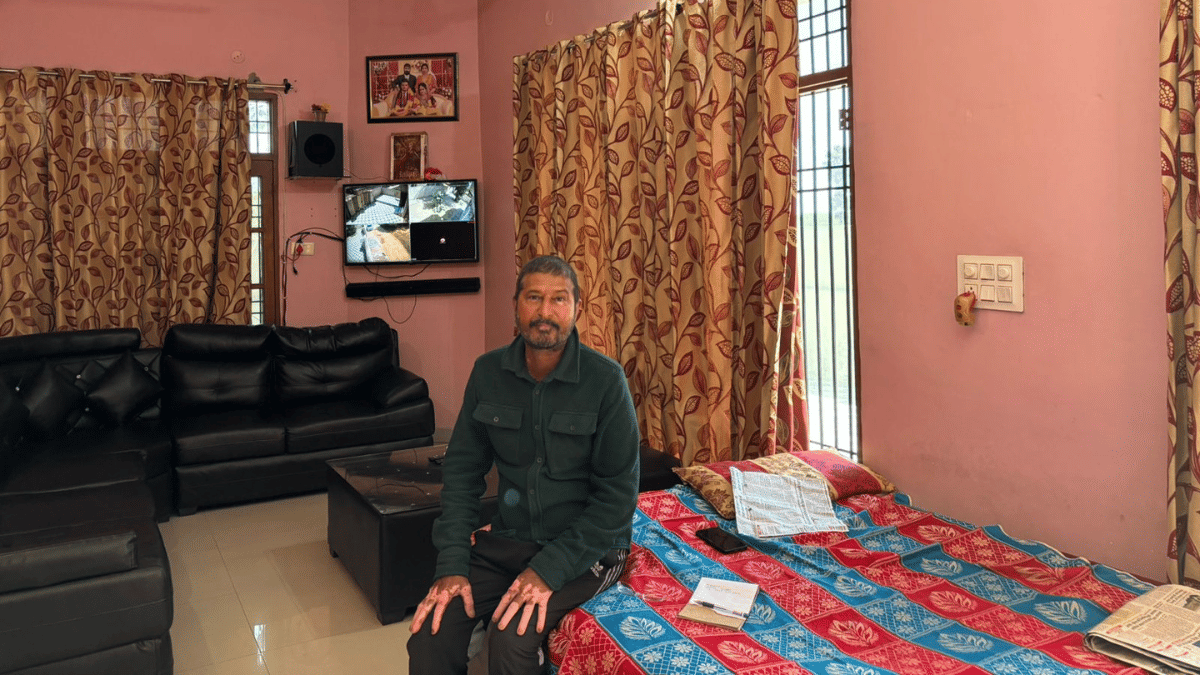
Lovepreet took admission in a different college to complete his studies. Back in 2023, Lovepreet and many other students were part of protests in Canada against the deportation letters they received. Many organisations like International Sikh Students’ Association and Naujawan Support Network amplified the protests and hit the ground to fight for the rights of students. He was eventually granted a three-year Temporary Resident Permit (TRP), after they deemed him a “genuine student” caught in the scam.
Anatomy of the scam
Police officials from Jalandhar told ThePrint that agents exploit the gap between aspirations of people wanting to reach Canada and the Canadian High Commission.
“Unsuspecting people come to agents, where they issue promise visas in 24 hours. They issue high-quality LoAs from genuine institutions. Students travel on visas that appear valid, and the embassy doesn’t cross check. Students were told by their agents ‘the seats are full’,” the police official said.
“Even the income certificates of families are forged. People just want to work in Canada, and they enter through study permits. It doesn’t matter what the degree or college is. The agents operate without a valid licence.”
Despite the Punjab Prevention of Human Smuggling Act, many such agents have lured the youth through social media. “To prevent similar situations in the future, an enhanced letter of acceptance verification process is being implemented that will have LoAs validated directly by DLIs,” said IRCC. It said that the onus remains on applicants to provide truthful information in their applications even if a third party is preparing it.
The police say they also run routine verification drives to crack down on this. “We raid unlicensed firms and agent’s offices. File an FIR as well. We have an NRI cell in Punjab that deals with such specific concerns, and the AHTU unit also keeps an eye,” said an officer from Patiala Police.
Also Read: Indian vloggers & influencers in Canada have a warning for immigrants—‘the Canadian dream is dead’
Migration vs Rozgar
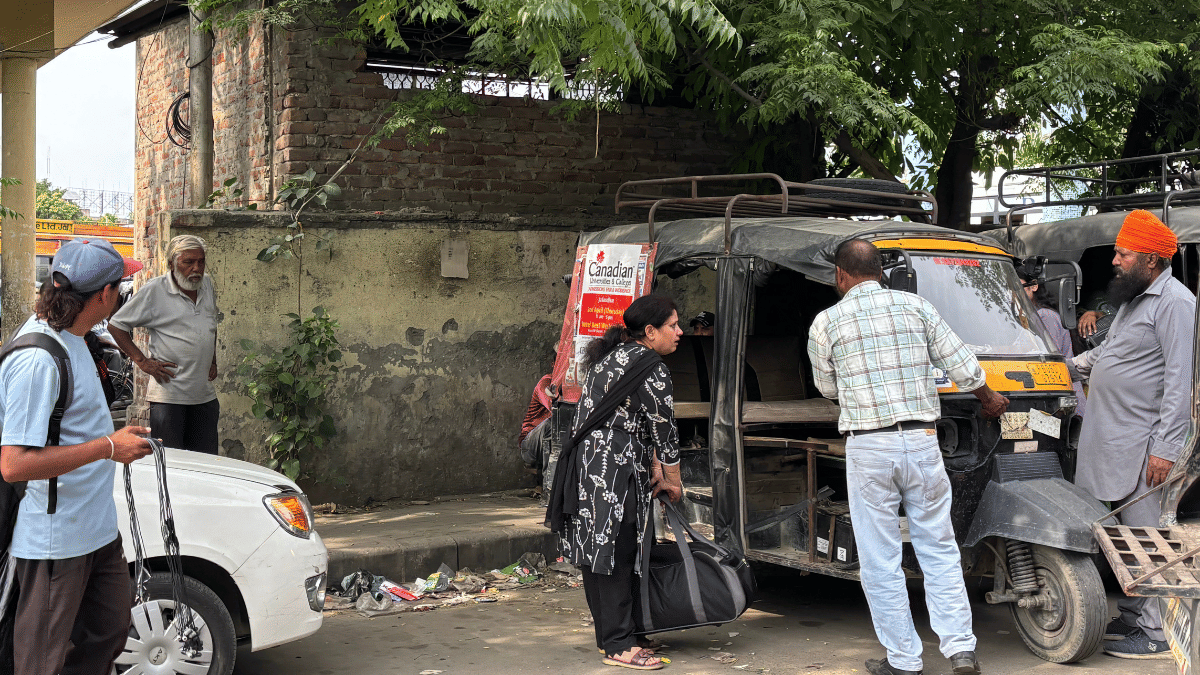
In small villages, far away from the main city’s blue-red billboards and Western flags, the dream is slowly shifting. The aspirations of Punjab’s youth are moving away from Canada. Depending on what works out, the map is expanding to Australia, New Zealand, Dubai, and the UK.
In Mianwal Arian, a quiet village in Jalandhar, 20-year-old Naval Preet Singh walks around the lanes clutching his books. He completed his Class XII with commerce, but is confused about the future. “The idea in our village is to go to Canada. No one tells us what one should do. Everybody is peer pressured into going there, and people are obsessed.”
Naval wishes to pursue a BA, followed by an MA, but wishes to do it from London. “My brother went there to work. He told me the lifestyle is better. It is not crowded like Brampton. I don’t want to stay here.”
Even for 19-year-old Siya Verma, whose original dream was to settle in Canada, the math no longer adds up. Between the expensive fee structure and the difficult to get part time work, she has made a call: Dubai. Her plan is to work as a nanny in Dubai, and staying in India is not an option Siya is considering. “Opportunities here are few,” she says. “Salaries are low as well.”
While in villages, young students have dreams and aspirations of travelling abroad, the Punjab government paints a different picture. Presenting the four-year report card, Chief Minister Bhagwant Mann claimed Punjab is undergoing a ‘Sikhya Kranti’. The administration has said that it delivered 65,264 government jobs on merit and eligibility without any bribery or favoritism—the claim says it’s the highest in the history of Punjab.
“Now, youth prefer preparing for government jobs instead of going to IELTS centres,” CM Mann had said, highlighting 12,966 jobs in police, 6,308 jobs in education department, 8,756 jobs in power department, 6,320 jobs in health and family welfare and medical education, 5,771 jobs in local government department and others.
But those with no aspirations of going abroad, now studying and moving in Punjab’s university circles, say “it’s just a claim”.
Kunwar Pratap Khanoura, a law student at Panjab University, Chandigarh and a student leader, sees a different Punjab. “The students and their families are desperate enough to get defrauded by agents. So where are the jobs going? Teachers are on dharna due to delayed salaries. Sub-Inspector exams get postponed due to cheating. No new factories have come up. Where are the startups? Why have the sports facilities been ignored completely?”
In cities like Chandigarh, the divide is even clearer. The wealthy have land and businesses, employing migrant workers for manual labour. The educated elite bypass Punjab entirely, heading to either Mumbai, Bengaluru or Delhi on corporate packages from private universities.
Fear in Canada
The atmosphere in hubs like Brampton, Toronto and Surrey have shifted from aspirations to anxiety. Media reports that claim “over a million work permits set to expire through 2026” are being shared on WhatsApp groups of Punjabis in Canada. For those on study and work permits, they say “it feels like a gamble now”.
“There is fear in everyone,” says Bikram Singh, a former student from Hoshiarpur now in Toronto, working as a car mechanic. “What if my work permit doesn’t get accepted? If we have to go back to India, how will we survive?”
Bikram says, a few people have even filed for refugee status, “without realising the consequences… that’s the kind of desperation people have… people are ashamed, they don’t want to tell their villages back home that they have filed for refugee status.”
Students in Canada say the silence from the Sikh diaspora’s political leadership has added to the isolation.
Simon Theti, 22, from Faridkot in Punjab, managed to find success in Edmonton’s healthcare sector. She admits people have crowded Toronto, Surrey, Ontario, and many are left jobless. “I was lucky to have secured a good job here. But I know many are fearful.”
(Edited By Nardeep Singh Dahiya)
Also Read: Trump effect: Canada tightens immigration screws further, new curbs announced