






New Delhi: Books on Maoism and Karl Marx, WhatsApp chats, Facebook posts and maps of villages in Noida—these are all ‘pieces of evidence’ Noida Police has coupled to put together its chargesheet in the Noida factory workers’ protest case.
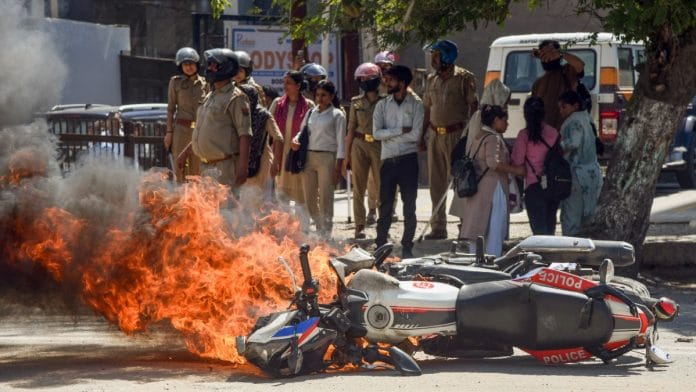
The Noida workers’ protest in April followed a similar agitation in Manesar by auto workers earlier that same month that prompted the Haryana government to hike minimum wages by 35 percent for workers across all categories. The subsequent unrest in Noida led to multiple arrests, displacement of workers, and loss of jobs.
The chargesheet in connection with the Noida protests, which turned violent, was filed after three different FIRs were registered at Noida Phase II police station against 89 people; a few of them were booked under the stringent National Security Act (NSA).
The chargesheet, filed in Hindi and submitted in the last week of June, alleged that the unrest was the result of both online coordination and on-ground mobilisation.
The investigation report, which draws on multiple case diaries, says what began as a localised labour dispute over a salary hike was weaponised by fronts like the Revolutionary Workers Party of India (RWPI), the Bigul Mazdoor Dasta, and Naujawan Bharat Sabha to incite the public to raise slogans and participate prominently in anti-government protests.
Noida Police claims to have recorded sufficient oral, digital and documentary evidence against the accused, said the investigation report, which is part of the chargesheet.
Among the accused are autorickshaw driver and trade union activist Rupesh Rai, NIT graduate and engineer Aditya Anand, journalist Satyam Verma, DU graduate and freelance data analyst Himanshu Thakur, also Akriti Chaudhary, a DU graduate and theatre artist associated with the Progressive Artists League, and artist Shrishti Gupta.
Other accused include Manisha, a worker with an industrial unit in Noida; Bhupendra alias Bhapi, a worker at Richa Global; Satish Kumar alias Siddharth, also a worker at Richa Global; Madhuresh Rai, Rupesh’s brother; DU student Yogesh Meena, as well as a social activist and a member of the Disha Students’ Organisation.
Also Read: The anatomy of an unorganised protest—How it spread from Manesar to Noida
How it all began
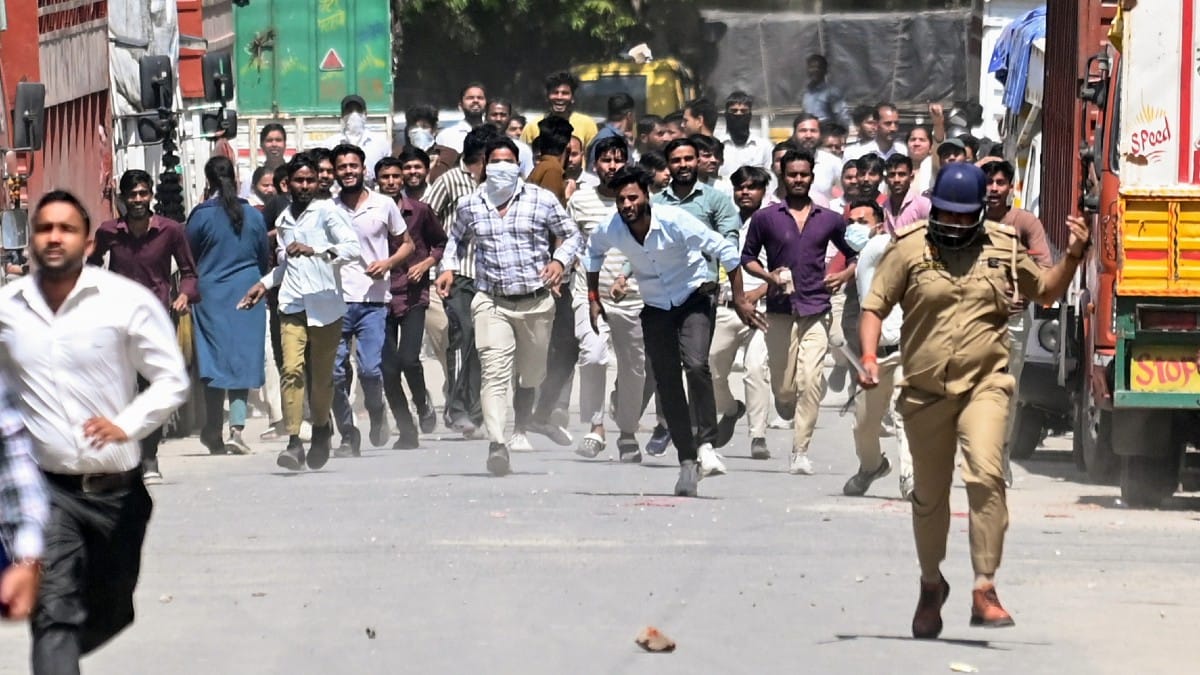
The protests first began on 9 April in Manesar before they spread to Noida where a major protest erupted between 11 and 13 April. On these days, employees of Richa Global Hosiery Complex, Richa Co Export, Paramount Export, Rainbow, Sonu Exene, Ayav Apex, Monu Creation and Classic Consent App Global Act Hosiery blocked several roads to highlight their demands.
Police claimed the administration tried to find a peaceful solution even after its efforts to convince protesters failed and the agitation took a violent turn.
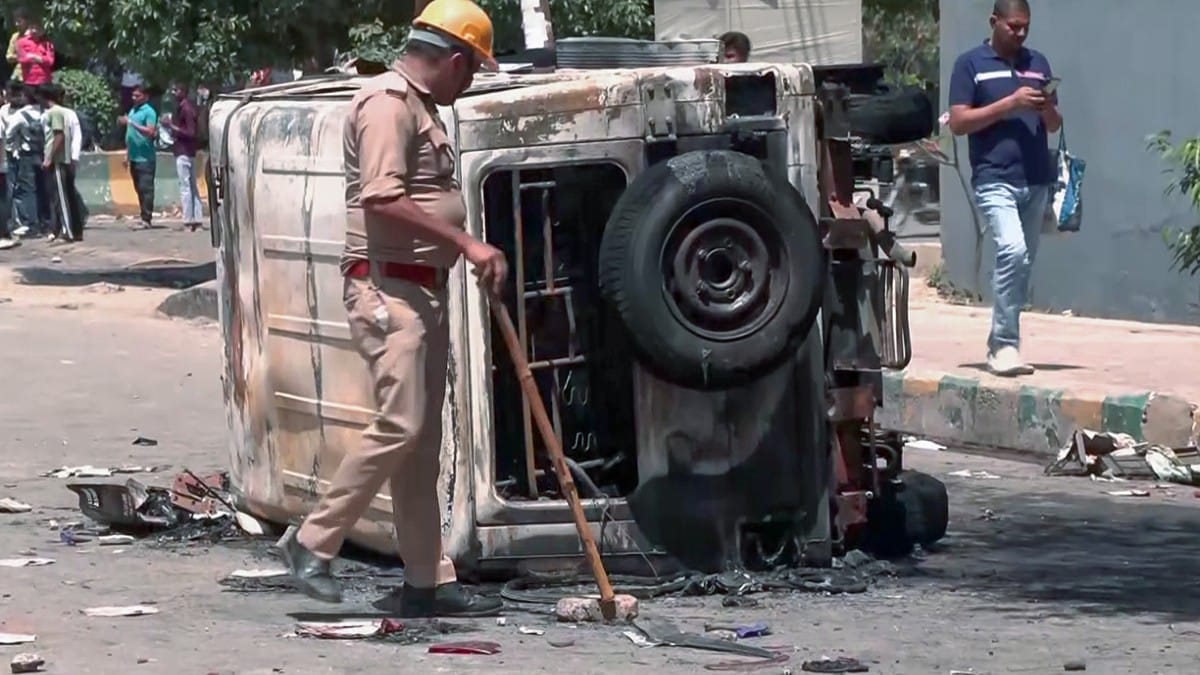
“They instigated violence due to which the crowd of protesters started rioting, whom the police repeatedly warned that their protest was against the law and if they did not disobey then force would be used on them, but the warning had no effect on the rioters and they remained at the protest sites, as a result they started vandalizing private property at various places in the area and pelted stones at the police, pushing, abusing and threatening to kill them, in which many policemen were injured,” Noida Police said in the investigation report quoted in the chargesheet.
Police also alleged that ‘outside instigators’ worked to dismantle efforts by the administration to strike a truce between the workers and the government.
A bribe and WhatsApp message
The police investigation in this case is based on multiple WhatsApp chats cited as digital evidence. According to the chargesheet, workers were added to the Richa Global WhatsApp group by Bhupendra, a Richa Global employee, and co-accused, Satish. “Bhupendra sent numerous messages and was physically involved in committing the crime in the incident along with his co-accused Satish and other conspirators and works in Richa Global,” it said.
Adding, “He (Bhupendra) had sent numerous messages on WhatsApp groups, inciting workers with slogans like ‘Man ke jeete jeet, man ke haar bin sade jo haar gaye’.”
Police further alleged Bhupendra received Rs 40,000 from Rupesh Rai, who they identified as the ‘main conspirator’. They said Rs 3,000 was recovered from Bhupendra’s house.
“Several witnesses have identified him (Bhupendra) in their statements, and his CDR records show his location in Phase 2 on the day of the incident,” police claimed.
The digital trail
Police also claimed they found sufficient oral, digital and documentary evidence against accused Akriti Chaudhary, the DU graduate who they said was connected to co-accused Rupesh Rai, a trade union activist, and is an active member of other WhatsApp groups mentioned in the chargesheet. Chaudhary, they said, was also in contact with co-accused Manisha, Aditya Anand and Srishti.
Apart from the protest, they said she had also been involved in “committing crime and criminal conspiracy,” citing other incidents in Noida on 10 and 11 April.
Police said Akriti is an active member of the RWPI and was physically present at the protests along with co-accused Aditya Anand and Rupesh Rai. They also said that the accused social activist is an active member of ‘various WhatsApp groups’.
“During the investigation, sufficient amounts of oral evidence and digital evidence are present against her. She has been involved in the conspiracy to incite violence movement by the workers in Noida,” read the chargesheet.
Police said they also relied on eyewitness accounts, including statements from Richa Global’s human resources staff, accounts of police officers present at the protest site, and the accounts of employees of other factories to corroborate who participated in the protest.
Further, their chargesheet relied on material seized from raids and search warrants, which included literature and other books, as well as oral disclosures made during the interrogation, including those of Rupesh Rai and Shrishti Gupta.
According to the digital evidence, call records show the presence of each protester at particular spots during the protests, while bulk WhatsApp chats were used to identify where they claim “the protests were organised”.
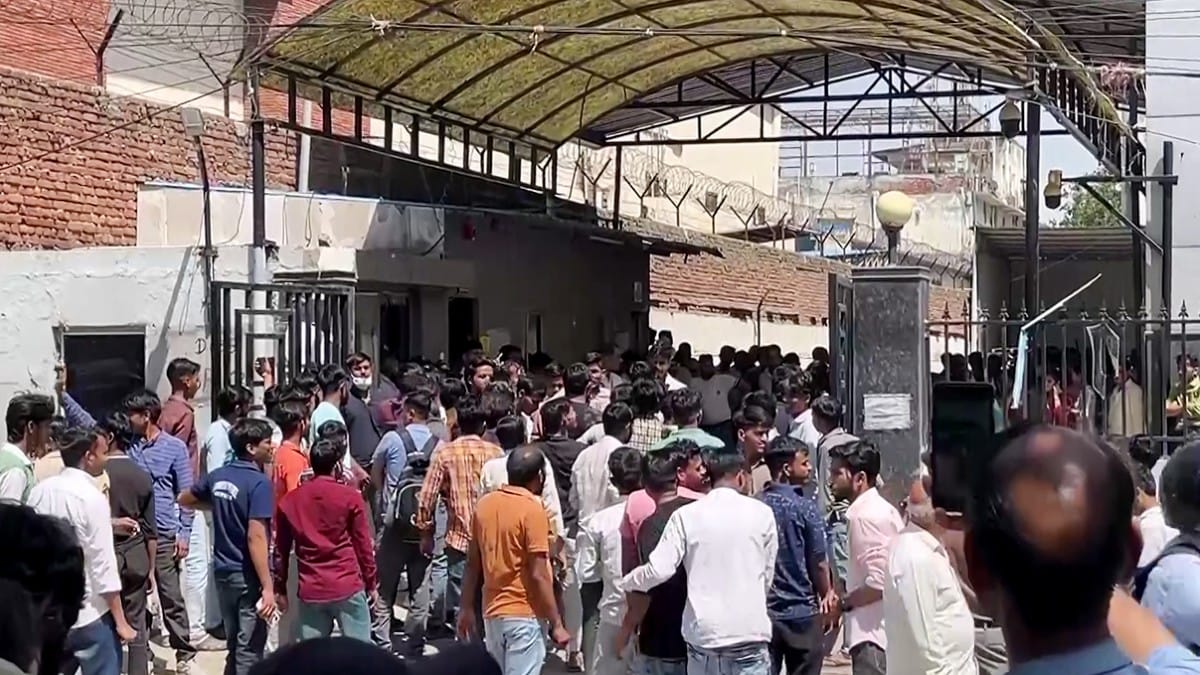
“Information gathered by the surveillance team and in the field regarding violent protests/incidents involving workers in Gautam Buddh Nagar revealed that individuals associated with the Bigul Mazdoor Dasta, Naujawan Bharat Sabha, Disha Student Organization, and the Revolutionary Workers Party of India have used inflammatory speeches and misused social media to incite protests and protests through various social media platforms,” police said in the chargesheet.
The police also relied on multimedia, including audio and videos recorded and stored on pen drives.
Police also examined activist Satyam Verma’s Facebook page. It was found that on 9 April, a post was uploaded about the violent agitation in Manesar and “Satyam Verma was doing live streaming on Facebook page during the Noida violent agitation,” says the chargesheet.
The police’s investigation also points out that Signal accounts were made to share information about and location of the protests.
Weapons, maps & Marxist literature
Noida police claimed accused Rupesh led them to a spot in Phase 2, near Green Welt Pushta Road, from where they recovered empty beer bottles, sticks, rods, iron rods and bottles filled with petrol. Police also said they recovered maps of Nayagaon, Chhijarsi, Sector 85 and village Vishanpura, where the protest was instigated, from Rupesh’s house.
The chargesheet said police recovered membership cards linked to the Naujvalan Bharat Sabha, Bigul Mazdoor Dasta and Naujvalan Bharat Sabha as well as a copy of Naujvalan Bharat Sabha’s monthly magazine from Aditya Anand’s residence. “Besides this, pamphlets, banned literature related to instigating agitation were recovered,” says the chargesheet.
From Himanshu, police seized personal diaries and electronic devices, besides small and big banners. “This accused is influenced by the Marxist thinking of the co-accused and he also donated to RWPI,” the chargesheet said.
The chargesheet said police also seized books related to Maoism, Karl Marx, pamphlets, handwritten diary pages, the Bigul Mazdoor newspaper, posters related to the Palestine attack, and labour code pamphlets from Satyam Verma’s office. “He was found to have played a key role in inciting the workers,” police said in the chargesheet.
(Edited by Sugita Katyal)