



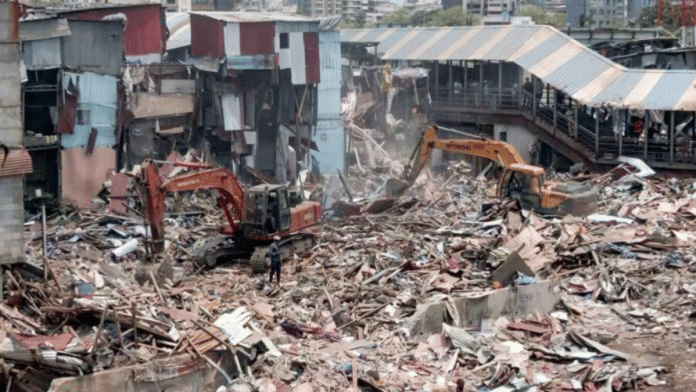
Mumbai: In a crackdown on illegal slums in Mumbai, the Brihanmumbai Municipal Corporation will start from 1 October a three month demolition drive, removing unauthorised structures measuring 14 ft and above.
The BMC said the aim is to remove these unauthorised structures across the city. The BMC also said it has asked residents to ‘voluntarily’ remove such structures, else the agency will be forced to remove them.
“The drive will begin on 1 October and will continue till 31 December. We have appealed to residents to vacate those structures that are 14 ft or higher. They can self-demolish them. And if they fail to do so, we will have to take strict action,” a senior BMC official told ThePrint.
According to the BMC data, there are 2.23 lakh slums across Mumbai. Out of these, the BMC has identified 39,111 structures which are 14 ft or higher. As per the BMC classification, 3,348 are in island city, 4,526 are in western suburbs, and the bulk i.e 31,227 are in the eastern suburbs.
Earlier this year, the BMC took action against 4,584 illegal slums across the city, the official said. Around 611 slums have been served notices already and so, “the rest of them should either act upon themselves or we will have to initiate strict action from October 1,” the official added.
However, this has residents of slum areas concerned. They are unsure about their future.
Faiyaz Alam Shaikh, an advocate and local activist from Govandi New Sangam Welfare Society in Govandi-Mankhurd area in eastern suburbs has already served a legal notice to BMC commissioner, the heads of the SRA and MMRDA, as well as the principal secretary, Housing Department on behalf of the residents from the area.
The notice, accessed by ThePrint, asks the BMC to stop the planned demolition drive, saying that large slum pockets in the area have already been discussed for a cluster redevelopment under the Slum Rehabilitation Authority programme.
“When a slum area or pocket is already earmarked for holistic Cluster Development or SRA Redevelopment, why is the BMC executing selective, coercive demolition drives against height extensions instead of expediting the formal cluster redevelopment process?” the notice questions.
Further, the notice seeks transparency from the BMC, demanding that before starting any drive, the BMC should make public among other things the methodology of determining the height, the time of inspection, and the measurement sheet.
“Many of these residents have been living here for decades and generations. As families grew, they expanded the houses vertically. But they have their domiciles and documentation to prove that their slum is legal. So, if the BMC has to carry out this drive, what about the formal rehabilitation and relocation of those living in higher floors of the same family?” Shaikh said to ThePrint.
“Mumbai’s housing challenge cannot be addressed only through the demolition of structures which fall on the wrong side of an old numerical benchmark. The real policy question is how we make existing homes safer, settlements more resilient and urban housing more sustainable while protecting the dignity and livelihood of the people who depend on these neighbourhoods,” he added.
About 50 percent of Mumbai’s population lives in slums—roughly 8 million people. A 2023 report by the state government’s Slum Rehabilitation Authority (SRA) said that of Mumbai’s total habitable area of 34,000 acres, a good 24 percent—8,333.53 acres—is covered by slums.
Faiyaz Shaikh said they are not asking for a blanket protection for unauthorised slums but a scientific, structure-specific and evidence-based assessment before irreversible action.
“Our demand is simple,” he said, “Before thousands of homes are treated as numbers on a demolition list, let every structure be assessed on evidence, let the policy be publicly explained, let residents have a meaningful opportunity to be heard, and let the administration examine whether upgradation is technically and legally possible,”
“Where demolition is unavoidable, rehabilitation must be dignified, timely and livelihood-sensitive. That is how Mumbai can move from a demolition-driven response to a genuinely inclusive, safe, resilient and sustainable housing policy.”
The BMC, meanwhile, has already started taking action ward wise. Between 24 August and 15 September, action has been taken against 128 illegal structures, and action against 140 identified structures has been planned.
(Edited by Ajeet Tiwari)
Also read: Mumbai: A Bandra demolition, and the city failing its poor