





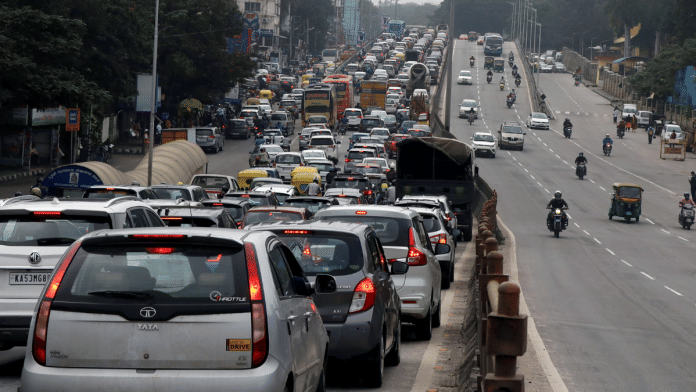



Bengaluru: For the residents of Bengaluru, a city bursting at the seams, the 2026-27 Karnataka Budget offers little respite in terms of allocations for big-ticket and other infrastructure projects to help decongest India’s IT capital.
The Budget documents show no big-ticket projects for the state’s growth engine and the emphasis remains on completing earlier announcements. Siddaramaiah announced the 40-km Tunnel Road project, estimated to cost Rs 40,000 crore under the BOOT (Build-Own-Operate-Transfer) model, for the state capital.
“In the first phase, tenders have been invited for the 17 km long North-South Corridor project at a cost of Rs 17,780 crore,” he announced Friday.
However, the previous budget document presented the same project and financial details with no additional information, barring that tenders have been invited for the same.
The government has also proposed another tunnel road and an elevated section from Hebbal Junction to Mekhri Circle–about 4 km—at a cost of Rs 2,250 crore.
In December, ThePrint reported that Gautam Adani-led multinational conglomerate has emerged as the lowest bidder for the 17-km project from Hebbal to Central Silk Board, with a bid of over Rs 20,000 crore.
The Budget has maintained that it would increase yearly grants from Rs 3,000 crore to Rs 7,000 crore but has provided no real vision to help the city overcome its apparent challenges, including congestion, collapsing infrastructure and lack of sustainable solutions, opposition leaders said.
Bharatiya Janata Party (BJP) Member of Parliament from Bengaluru South,
Tejasvi Surya, said that the government remains focused on the tunnel road and not public transport instead of “practical solutions”.
“Bengaluru urgently needs investments in BMTC expansion, faster Metro and Suburban Rail implementation, and robust last-mile connectivity — measures that can genuinely decongest the city and serve lakhs of commuters every day,” he said in a post on X.
Instead of strengthening public transport – the most practical solution to Bengaluru’s traffic crisis, the Congress Government is pushing ahead with a ₹40,000 crore tunnel road vanity project. ₹17,780 crore is proposed for a 17 km tunnel from Hebbal to Silk Board, with the rest… https://t.co/ieNkDFLr0x
— Tejasvi Surya (@Tejasvi_Surya) March 6, 2026
He added that there is no meaningful push to strengthen public transport nor any urgency to complete the long-delayed Metro lines.
Successive governments have followed a similar approach to decongest Bengaluru: building flyovers, underpasses and widening roads.
“Congress Govt’s Karnataka Budget shows a shocking lack of seriousness towards Decongesting Bengaluru. For a city where citizens spend hours stuck in gridlock, instead of bold and urgent solutions, the budget offers routine statements and distant timelines…,” he added in another post.
Congress Govt's Karnataka Budget shows a shocking lack of seriousness towards Decongesting Bengaluru.
For a city where citizens spend hours stuck in gridlock, instead of bold and urgent solutions, the budget offers routine statements and distant timelines.
– No concrete plan… https://t.co/BQrLtZvrLY
— Tejasvi Surya (@Tejasvi_Surya) March 6, 2026
But, there have been no real efforts to address the underlying problem: rise in private vehicle usage. Bengaluru has around 14 million population and around 1.23 crore vehicles on its roads, government data shows, indicating the magnitude of the problem.
Also Read: While Bangaloreans bear brunt of 2nd Bengaluru metro fare hike, Centre-state play the blame game
Revised Master plan
Siddaramaiah also announced Rs 3,000 crore for whitetopping about 450 km of roads, which is likely to add to the congestion and intensifying heat islands.
A study by the Indian Institute of Science (IISc) shows that in the 1970s, there was 68 percent green cover in the Bengaluru area and less than 8 percent of the surface was paved. In 2023- 2024, paved surfaces occupied 86 percent, while vegetation accounted for a mere 3-4 percent.
Efforts were accelerated to acquire lands for the Bengaluru Business corridor Phase-I, which, the government said, would decongest the capital by redirecting heavy vehicles around the outer periphery without having to enter the city.
But the first phase, the Budget said, would be completed in four years.
The government has also said that it will complete a total of 41 km of additional Metro lines in the 2026-27 fiscal year to help decongest the city.
The Budget has earmarked Rs 25 crore for an integrated digital platform to help decongest the city by collecting and analysing data from various traffic choke points and facilitating smooth flow of vehicles.
“To ensure future growth and sustainable land use planning, a new Revised Master Plan-2041 (RMP) for Bengaluru will be implemented by the end of 2027. Additionally, a Comprehensive Mobility Plan (CMP) will be prepared within six months,” according to the Budget.
It also states that a feasibility study will be carried out for a second airport in Bengaluru city even though the government is yet to finalise the location.
There have been demands from a lobby led by Home Minister G. Parameshwara and Deputy Chief Minister D.K.Shivakumar himself, escalating demands and competing claims within the ruling Congress party.
Making matters worse, public work contractors have threatened to go on strike over unpaid dues. Shivakumar met with the contractors Friday, assuring them to clear dues at the earliest.
“There are pending bills of around Rs 13,000 crore in my (Bengaluru development and irrigation) department, Rs 3,000 crore in Boseraju’s (minor irrigation) department, totalling to about Rs 37,000 crore,” he said.
The contractors, he said, were warned not to take up work in departments “where there is no money”. He said that under BJP’s B.S.Yediyurappa and Basavaraj Bommai, several contracts were awarded on account of which contractors were suffering.
“This needs to be resolved. We need to find bonds worth around Rs 50,000 crore or some other way. Only then, will this problem be solved,” the deputy CM said.
(Edited by Tony Rai)
Also Read: India’s Silicon Beach: As Bengaluru sputters, a new IT haven is taking shape on Karnataka’s coast