





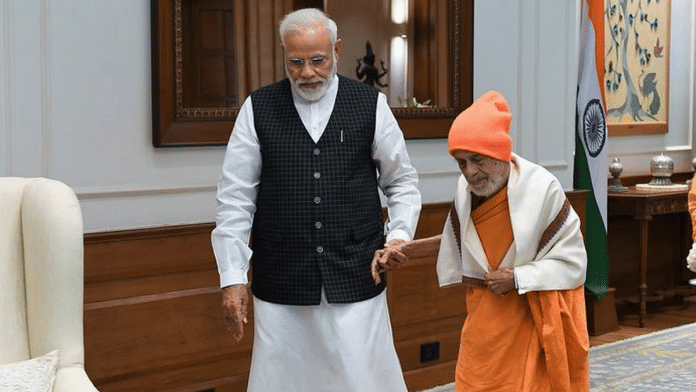



Bengaluru: Vishwesha Teertha Swami, the head of the prominent Pejavara Mutt in Udupi who passed away Sunday, is known to have influenced a number of politicians cutting across party lines, even Prime Minister Narendra Modi.
A man who never feared to take a stand, the seer had been at the forefront of the Ram Janmabhoomi and Gau Raksha (cow protection) movements.
Though the Swami had been a guide to several senior leaders from the BJP, the Vishva Hindu Parishad (VHP) and the RSS, his ties to Modi was a long and strong one. He was also closely associated with senior BJP leaders L.K. Advani and Uma Bharti.
In 1992, when he was coordinating then BJP president Murli Manohar Joshi’s 15,000 km-long Rashtriya Ekta Yatra from Kashmir to Kanyakumari, Modi had held a detailed interaction with the Swami in Bengaluru.
Thereon, he consulted the seer on several political issues including finding solutions to the Ram temple-Babri Masjid issue, the Ganga clean-up, and also the Gau Raksha campaign.
BJP sources told ThePrint that Modi held several closed-door meetings with the seer on resolving the Ayodhya standoff much before the Supreme Court verdict, which has now paved the way for a Ram Temple at the disputed site.
As an active member of the VHP, the Swami is said to have emphasised that the goal of building a Ram temple could only be achieved by taking Muslims into confidence.
He had advised that there should be a back-up plan to convince Muslims in Ayodhya if the SC order went against a Ram Temple, said a senior BJP functionary who did not wish be named.
“The delegation of Muslims that PM Modi called on before the Ayodhya verdict was on the advice of Pejavara swamiji,” explained S.A. Hemanth, a journalist closely associated with the Ayodhya movement. “During the VHP steering committee meetings, where he also served as the vice-president for several years, he would always say that today’s Muslims are not yesterday’s Mughals. He would say we should take them into confidence and that will resolve the issue amicably.”
The PM paid tribute to the departed spiritual leader Sunday morning.
Tweeting his photographs with the seer, taken in 2018 on the occasion of Guru Purnima, Modi called him “a powerhouse of service and spirituality”, who “continuously worked for a more just and compassionate society”.
I consider myself blessed to have got many opportunities to learn from Sri Vishvesha Teertha Swamiji. Our recent meeting, on the pious day of Guru Purnima was also a memorable one. His impeccable knowledge always stood out. My thoughts are with his countless followers. pic.twitter.com/sJMxIfIUSS
— Narendra Modi (@narendramodi) December 29, 2019
Spiritual and political guide
Frail, saffron-clothed and soft-spoken, Teertha Swami has been one of the most liberal seers in Karnataka. He had the rare ability to adeptly handle the temple administration and advocate social reforms while having a significant voice in politics, which made him very popular.
Senior RSS leader from Karnataka, Kalladka Prabhakar Bhat, said the seer always taught people how one should live by example.
“He was fearless and spoke his mind. He always wanted unity of society and would respect all, irrespective of caste or religion,” Bhat told ThePrint. “Even when Modi consulted him, Swamiji would not force his opinion but ensure he speaks his mind. That was his greatness — he always stood for truth.”
Union minister Sadanand Gowda, who has represented the Udupi Lok Sabha constituency in the past, said the seer treated the entire country as his mutt.
“He had a close association with Modiji and was also consulted on several matters. He was not just a representative of the Udupi Krishna Mutt (monastery) but he treated the whole of India as his mutt and worked for the people,” Gowda told ThePrint. “He was not a Swamiji for Hindus only, but for all Indians. He treated every person with respect.”
Senior Congress leader Dinesh Gundurao said the seer maintained a good rapport with Congress leaders too. “Though he was ideologically inclined to the VHP and the BJP, he would not let that influence his thoughts when he met with those from other parties,” Rao said. “He had a very balanced and forthright view of things and that made him highly acceptable and popular.”
Also read: Swami Vishwesha Teertha of Pejawar Math dies in Udupi, PM Modi condoles death
Share of controversies
Though he shared a great rapport with the prime minister, the seer criticised Modi in June 2018 for not being able to curb corruption in the country.
“Though it was promised that black money stashed abroad will be brought back, nothing has happened on that front. Despite strict rules being clamped on economic activities, much has been achieved, but with regard to curbing corruption, nothing much has been done,” he had told mediapersons in Udupi.
He was known for his outspoken views.
Earlier this year, when Prime Minister Modi and the BJP repeatedly attacked the Congress in Karnataka for celebrating the birth anniversary of Tipu Sultan, the swami said there was nothing wrong in teaching schoolchildren about the 18th-century ruler of Mysore as long as “both sides” are taught.
He did, however, oppose the state government’s celebration of Tipu Jayanti. The swami also earned praise for organising Iftar parties and taking part in them.
The seer, however, was accused of discriminating against the Dalits by encouraging a practice called Pankthi Bheda — where members of the upper caste were made to sit in separate halls for meals away from those of the so-called lower castes.
He did make efforts to end untouchability. For instance, in 2010 he walked into Dalit colonies and offered them Deeksha (religious initiation) that he thought was the best way to end the discrimination.
He also strongly voiced his opinion against the controversial temple ritual, Made Snana, in which devotees belonging to the lower castes roll over the leftover food eaten by Brahmins to rid themselves of evil and skin diseases. The seer announced a ban on the ritual in the Krishna temple he administered.
Dalits, however, claimed that his stand on uplifting them was just “lip service”. They point to his efforts to prevent religious conversions.
In the 1980s, the Swami intervened to stop the conversion of Dalits to Islam in Meenakshipuram in Tamil Nadu. He had also spoken out when a section of Dalits in Tamil Nadu announced that they would convert to Islam to avoid social discrimination.
The seer, however, defended his efforts stating he “always fought for equality and stood with Dalits at all times”.
“People from the Muslim and Dalit community love and invite me to all their programmes,” he had said in response to the controversy. “Some people, however, are trying to spoil the relationship between Brahmins and non-Brahmins.”
Also read: Students at RSS-run school re-enact Babri demolition, trustee says there’s nothing wrong