





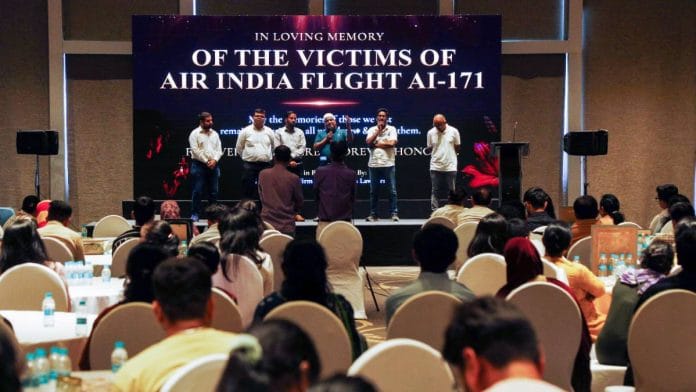


New Delhi: The Union Ministry of Civil Aviation is in the final stage of resolving the dispute over Air India’s compensation terms for families of the AI-171 plane crash victims, the ministry’s secretary has told a parliamentary committee, assuring members that the families “won’t have to face this trouble from Air India”, multiple MPs who attended the meeting last Wednesday told ThePrint.
The assurance came after Anjali Rupani—widow of former Gujarat chief minister Vijay Rupani who was among the 242 people on board the plane—appeared before the Standing Committee on Transport, Tourism, and Culture and sought intervention from the aviation ministry led by K. Ram Mohan Naidu, a leader of the Telugu Desam Party (TDP).
Anjali told the panel that families of the crash victims were being made to forgo their right to pursue legal action in return for accepting the final settlement, the MPs said.
Civil aviation ministry secretary Samir Kumar Sinha was deposing before the committee, chaired by Janata Dal (United) MP Sanjay Kumar Jha, on an appraisal of the RCS-UDAN scheme when the issue was raised. He said the ministry was close to settling it with the airline, according to the members present.
All people on board the aircraft, save one, died when the London-bound Boeing 787-8 Dreamliner went down seconds after take-off from Ahmedabad on 12 June last year, also striking the hostel of B.J. Medical College nearby. In all, 260 people died in the worst crash involving an Indian carrier in around four decades.
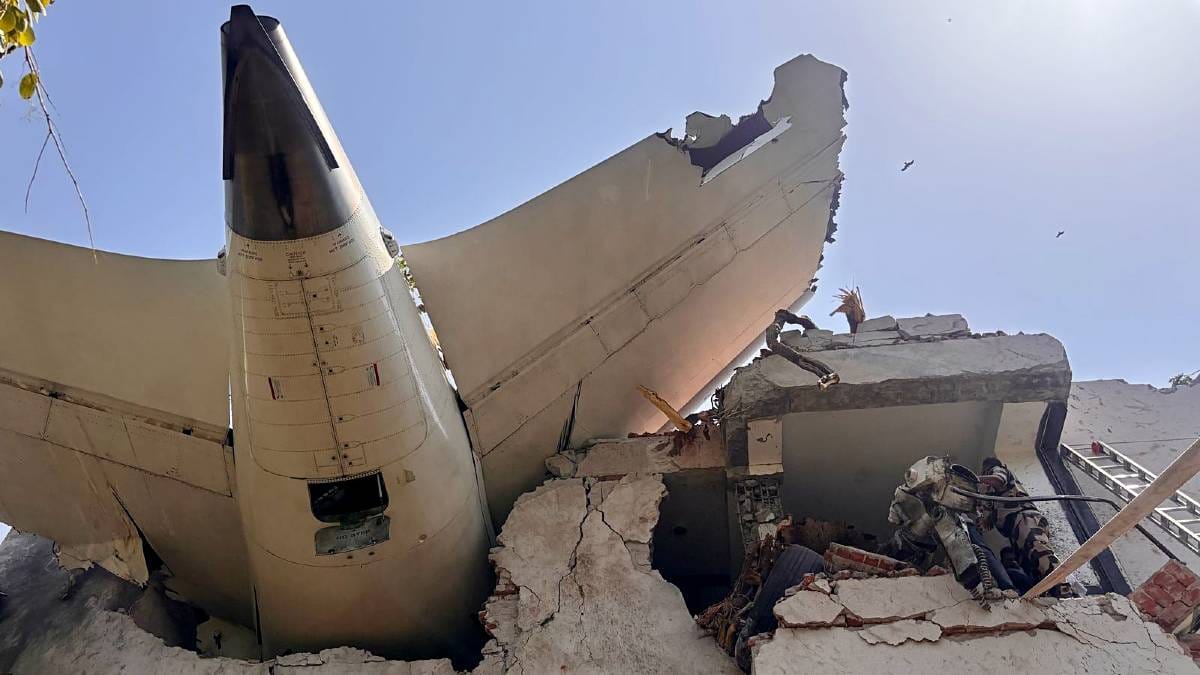
This March, the parliamentary committee had recommended setting up an independent high-level panel on aviation safety, citing the Ahmedabad crash, roughly 100 safety lapses logged in a single year and recurring technical problems. It also sought a passenger rights charter under the Bharatiya Vayuyan Adhiniyam, 2024, and faster filling of vacancies at the Directorate General of Civil Aviation (DGCA).
The compensation dispute has been simmering for months.
Air India began its final settlement process in October, offering amounts over and above an interim payment of Rs 25 lakh per victim and a Rs 1 crore ex-gratia from the Tata-run AI-171 Memorial and Welfare Trust.
Several families objected to a clause in the receipt, discharge and indemnity document, which requires them to waive off present and future claims not only against the airline but also against Boeing, engine maker GE, Honeywell, Safran, the Union of India and the Ahmedabad airport operator.
Vijay Rupani’s daughter, Radhika Mishra, had earlier written to Tata Sons chairman N. Chandrasekaran and asked the airline to drop the waiver clause, arguing that families were being pushed to choose between money and the truth before the Aircraft Accident Investigation Bureau completes its probe.
According to multiple media reports, Air India said in response: “Our offer of final compensation did not set out any timetable for acceptance. Families are entirely free to wait until the investigation report has been released, as some have chosen to do.”
Under the Montreal Convention, the airline is strictly liable up to about Rs 1.9 crore per passenger, with higher payouts possible if negligence is established.
ThePrint has reached out to Anjali Rupani, Air India, and the ministry of civil aviation for comment via text, calls and mail, but had not received a response till the time of publishing this report.
The Wednesday sitting of the committee was held to examine route operationalisation under RCS-UDAN 1.0 and 2.0 against the discontinuation of activated routes. Members also pressed the ministry on the slow rollout of the scheme’s later phases.
Of the 925 routes awarded since 2017, 327 have been discontinued, the ministry has acknowledged, citing the Covid pandemic, aircraft shortages, supply-chain disruptions and low demand. The scheme has operationalised 657 routes at a cumulative cost of over Rs 9,200 crore. The committee had previously flagged the absence of a structured exit strategy for routes that finish their viability gap funding period.
(Edited by Nida Fatima Siddiqui)