



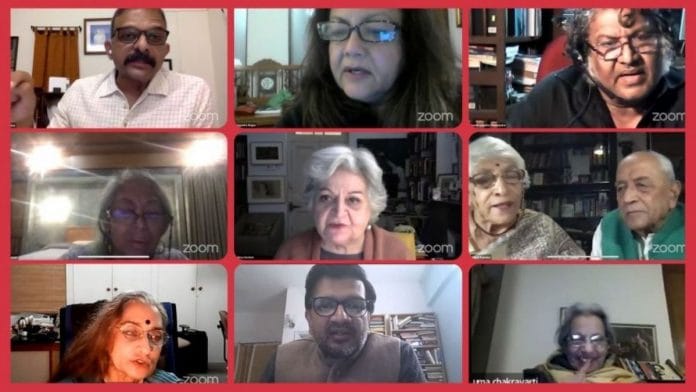

New Delhi: In an online gathering across time zones, the South Asia Peace Action Network (SAPAN) held discussions about what they described as an onslaught against art and freedom of expression.
SAPAN is a coalition of individuals and representatives of various organisations who have joined hands to work towards “freedom of trade, travel and tourism in South Asia, [and] people-to-people contact” in each other’s countries.
“The discussion highlighted how the arts and resistance shape each other, foregrounding the current onslaught on the arts and on freedom of expression by increasingly authoritarian regimes in the region,” read a report released by Sapan on 3 February about the the discussion, held last month.
According to the report, participants endorsed Sapan’s call for visa-free South Asia, a demand presented at the meeting by activist-couple Lalita Ramdas and Admiral L. Ramdas (Retd), former chief of Indian Navy. Both are founding members of Sapan.
The event was attended by artistes from India, Sri Lanka, Nepal, Bangladesh and Pakistan.
Also Read: ‘Mostly totalitarian’ — South Asian activists red-flag ‘floundering democracy’ in region
Power-packed presentation from Pakistan
Salima Hashmi, the daughter of the late revolutionary poet Faiz Ahmad Faiz, attended the event from Lahore, and presented photographs from a public exhibition — ‘Hum Jo Tareek Rahon Main Mare Gaye (We who were killed in dark alleys)’, by the Awami Arts Collective.
From Nepal, the director of Siddhartha Art Gallery and founder-chair of the Kathmandu Triennale, Sangeeta Thapa, contextualised the development of the country’s art scene within the broader socio-political landscape. “We are an old culture but we are also new nations, and that comes with its own trials and tribulations,” she was quoted as saying in the report.
Sri Lanka’s Chandraguptha Thenuwara, founder-director of Vibhavi Academy of Fine Arts and professor at the University of the Visual and Performing Arts, talked about the challenges in his country. He said Sri Lanka’s 30-year-long civil war had physically ended, but many issues remained unsolved.
“Artistes must respond to the politics of hate, religious extremism and militarisation,” Thenuwara said at the event, calling for “a more conscious struggle against the politics”.
Challenges faced by artistes
In Dhaka, artist and cultural activist Lubna Marium talked about the difficulties of surviving as an artiste “without ever subscribing to any political party or any regime”. She runs one of the largest dance companies in Bangladesh.
From Chennai, eminent vocalist T.M. Krishna highlighted the problem with focusing only on resisting the state, often at the expense of important and difficult internal conversations.
The event featured a brief clip from a poem by Ghani Khan, the late prominent Pashto poet, in solidarity with the Afghans.
Since its inception in March 2021, on the last Sunday of every month, Sapan has held regional discussions on shared concerns. The report from Sapan said this was the tenth monthly webinar organised as part of a series titled ‘Imagine! Neighbours in Peace’.
(Edited by Manoj Ramachandran)
Also read: Border disputes? Let’s make boundaries irrelevant without changing them: Shivshankar Menon