





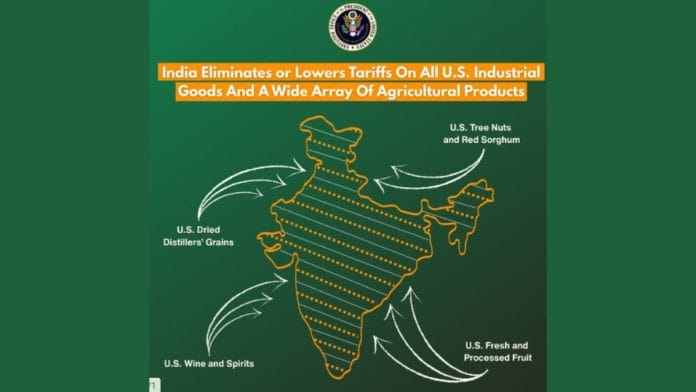



New Delhi: A map posted by the US Trade Representative (USTR) depicting all of Jammu and Kashmir as part of India was quietly removed from its social media accounts days later following protests by Pakistan, which said it had approached Washington over the matter.
The change is significant given that Washington has typically demarcated the Line of Control (LoC) with dotted lines in maps depicting the South Asian region. The map also showed Aksai Chin, which China claims, as Indian territory.
“Yes, this map was put up at certain handles. We contacted the US authorities, and they realised that this map is illegal. The international map on Jammu and Kashmir and as a result the international map delineating Pakistan and Indian territories is legally sanctified by the United Nations,” Tahir Andrabi, spokesperson for Pakistan’s Ministry of Foreign Affairs, said Thursday during a press briefing in Islamabad.
“We note with satisfaction that the US side made the requisite correction to highlight the legal UN sanctioned map of our region, which clearly delineates Jammu and Kashmir as disputed territory, whose settlement is to be done through a UN administered plebiscite in accordance with the UN Security Council resolutions,” he added.
The post, made last week, was not visible on the US Trade Representative’s X account Friday.
There was no official comment from Washington and New Delhi regarding the map or its removal. The USTR had used the map to highlight gains for American manufacturers and farmers in the interim trade deal with India announced on 2 February.
New Delhi has maintained since 1947 that the entire territory of Jammu and Kashmir is an integral part of the country. India and Pakistan have fought multiple conflicts over the territory, as Islamabad refuses to recognise the instrument of accession signed by the former ruler to accede to India in 1947.
The two countries agreed to resolve all disputes bilaterally following the Simla Agreement signed in 1972 after the third India-Pakistan conflict—the Bangladesh Liberation War of 1971. India has consistently objected to Islamabad’s position on Kashmir.
China has also historically depicted Aksai Chin, the northeastern portion of the erstwhile state of Jammu and Kashmir, as part of its own territory. Beijing has consistently played cartographic politics by laying claim to both Aksai Chin and the Indian northeastern state, Arunachal Pradesh.
New Delhi has rejected all claims made by Islamabad and Beijing on its territory, declaring that Jammu and Kashmir, and Arunachal Pradesh are “inalienable” parts of India.
Also Read: Modi government’s trade deal with US resembles an IMF bailout
Trump’s mediation claims
US President Donald Trump has previously offered to mediate the Jammu and Kashmir dispute, which India rejected, maintaining that the issue will be resolved bilaterally.
Trump recently claimed credit for mediating an end to the 87-hour India-Pakistan conflict that occurred in May, a position that irritated New Delhi. Prime Minister Narendra Modi clarified in a June 2025 call with Trump that the US played no role in ending the conflict.
The US also claimed at the end of Operation Sindoor that Indian and Pakistani leaders would meet at a neutral venue for further talks, another claim rejected by New Delhi.
Trade deal context
The map was part of a package of social media posts prepared by US authorities to explain the gains for American producers following the announcement of the trade deal with New Delhi.
The deal, announced on 2 February by Prime Minister Narendra Modi and Trump, will see the US reduce its reciprocal tariffs on Indian goods to 18 percent from the current rate of 25 percent, while the punitive tariffs of 25 percent imposed on New Delhi due to purchases of Russian oil were removed as well.
Also Read: India-US trade deal is just like Union Budget. Sycophants are forced to praise both