







New Delhi: In 2025, 19-year-old Aasim had plans to appear for Class XII Board exams and prepare for the National Eligibility-cum-Entrance Test (NEET) in Jammu. Everything looked set. The family had saved up for Aasim’s future studies as well.
It was then that the Pahalgam terrorist attack struck, shattering the dream of the Pakistan-born teen whose father is settled in Rajouri, Jammu and Kashmir. He was forced to return. Aasim, his father Sajjad Ahmad, said, has quit studies.
He stays inside a boxed room in Gujranwala after deportation. “The few times I have managed to speak to my son, and have heard his voice, I have only given him hope that I will do everything I can to bring him back to me. Mera beta hai woh (He is my son),” Sajjad, a government school teacher, told ThePrint. “Aasim cries a lot. He feels lonely. I have not seen his face. All he tells me is ‘papa, please bring me back’.”
Aasim is among those individuals with Pakistani citizenship, who were asked to leave India after terrorists killed 26 people in Pahalgam on 22 April, 2025. The Resistance Front (TRF), an offshoot of Pakistan-based Lashkar-e-Taiba (LeT), claimed responsibility for the deadly attack at Baisaran Valley.
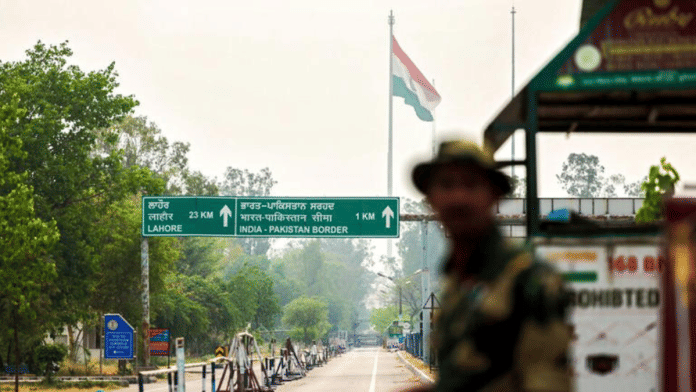
In a prompt response, India ordered Pakistani nationals to leave the country, initiating a repatriation process at the Attari-Wagah border in late April. Those who had crossed over with valid papers were told to return before 1 May, 2025. Pakistani nationals were not permitted to travel to India under the SAARC Visa Exemption Scheme (SVES) visas. Any such Pakistani national was given 48 hours to leave the country.
Of the many who could not bid goodbyes to family members, a few of them took to courts, to bring their family members, both young and old, back. All is not lost for Aasim, as the Jammu and Kashmir High Court, in March last week, asked the Ministry of Home Affairs (MHA) to consider his application for an extension of long-term visa (LTV) and Indian citizenship.
A father’s fight
Sajjad Ahmad’s fight for his son and late wife’s citizenship began long ago. Twenty-one years ago, he had gone to meet relatives in Pakistan and got married to Shabnum Kouser, a resident of Rawali, Gujranwala on 11 December, 2005.
Kouser delivered a baby boy, Fardin Sajjad aka Aasim Sajad, on 26 October, 2006, at Gujranwala. She and the baby arrived in India on 9 October, 2007 for a period of 90 days. On expiry of visa, she applied for one-year extension on the grounds of marriage and was granted permission to stay along with her baby.
This cycle continued till June, 2013 when Kouser died of illness in Rajouri. After her death, Sajjad sought the extension of visa for his minor son and was granted extension till 20 April, 2015.
Subsequently, Sajjad had moved several applications seeking declaration of his son as a citizen of India and extension of visa on compassionate grounds. Neither of the requests were accepted. The Pahalgam attack complicated the situation further.
The dreadful night
For the Rajouri family, the early hours of 29 April, 2005 brought a turbulence hitherto unimaginable. At around 4 am, J&K Police raided his house and took away Aasim without a copy of the deportation order, Sajjad alleged.
“We were sleeping at home—me, my ailing mother, my sons Aasim and Hanan, when suddenly, the police entered without any notice or paper. They just told me that they will deport my son to Pakistan…,” the middle-aged man said, adding that Aasim was forcibly bundled into a police van and was taken to the Wagah border.
“I could not even speak to my son, touch him one last time…or, hug him…in that moment, I felt a part of me was being snatched away.”
Sajjad said he then decided to take the matter to court and fight for his son, legally.
“Earlier, I had applied for citizenship multiple times, both online and offline. But the process got delayed. Government officials told me once Aasim turns 18, it can be easy…but the moment he was taken away, nothing made sense. I knew I had to get my son back.”
He had earlier submitted applications thrice in September and May 2015 and January 2019, seeking citizenship for his son. He had also applied for registration through the MHA web portal in May 2024 but to no avail.
There is some hope after the J&K High Court ordered the MHA in March that Aasim should be brought back to India.
“The petition is, thus, disposed of with the following directions to the respondent-MHA to consider: to retrieve the petitioner’s son, namely Aasim Sajjad aka Fardin Sajjad pursuant to ‘Leave India Notice’ dated 25 April, 2025 served upon him, so as to pursue his application for extension of long term visa and the application for citizenship filed under Section 5 (1) (d) of Citizenship Act; and to grant of citizenship in favour of petitioner’s son having been applied by him as claimed by the petitioner,” the court said.
“The aforesaid exercise shall be carried out by the respondent expeditiously, having human aspect of the matter, preferably within a period of eight weeks.”
The father is not sure whether the HC order would lead the way for reunion. “I did not know if I should have felt happy or sad…I heard my son cry on the phone call…asking me to just bring him back. For this day to come, I keep counting days on the calendar mounted on my wall.”
Of late, Sajjad has managed to speak to his son on phone calls. “For a long time, when we were fighting the case legally, I did not know how to promise my son that I would bring him back. I could not hurt him. I just told him, ‘I am trying…’ It was so painful to see my son break every other day,” he said.
Aasim stays at his maternal aunt’s house in Gujranwala, he said, adding that the aunt is a widow who doesn’t make a living of her own.
“Pakistan is a different ‘mulk’ (nation). My son had his entire life in India.”
Back at Rajouri, Aasim’s room stays as is. His books and clothes are locked in cupboards. “When my son returns, I will hug him. I will be thankful to God that we fought this fight, and that I brought him back,” Sajjad told ThePrint.
‘No one to care for’
Like Sajjad who is fighting for his son, Jammu resident Sheikh Zahoor Ahmed is on a mission to get Indian citizenship for his wife Rakshanda Rashid, a Pakistani national from Islamabad. Zahoor though is in a better situation: Rakshanda is now with him and the family for the past eight months after the intervention of the J&K High Court.
The Pakistani national was living in Jammu for nearly four decades on a LTV that was renewed every year. The couple has four children.
In June 2025, the J&K HC noted that Ahmed submitted his wife is suffering from multiple ailments and that she has nobody in Pakistan to take care of her. Human rights, it said, are the most sacrosanct component of a human life.
“This court is bearing in mind that the petitioner was having LTV status at relevant point of time which per-se may not have warranted her deportation but without examining her case in better perspective and coming up with a proper order with respect to her deportation from the authorities concerned, still she came to be forced out,” the judge said.
Given the exceptional nature of facts and circumstances of the case, the court said, it was constrained to direct the MHA to bring her back to J&K.
In a brief conversation with ThePrint, Zahoor said that while Rakshanda returned eight months ago, the case pertaining to her citizenship is currently pending. “Currently, she is on visa extension.”
‘No where left to go’
Unlike the two cases from Jammu province wherein the HC intervened, Karachi resident Sheena Naz did not find any succour from the Delhi High Court. Worse, she had cut-off ties with her family while moving to marry a Delhi man in April 2025, according to her brother-in-law I.A.Hashmi.
Sheena, Hashmi said, had arrived on 5 April on a short-term visa to solemnise her love marriage with his younger brother.
“After she decided to marry my brother, her family in Karachi cut ties with her. She chose to stay in India. When she came here, she got married on 8 April,” he said.
The Pakistani national applied for LTV on 23 April to the Bureau of Immigration, MHA, but by then the Ministry of External Affairs (MEA) released a statement that citizens from the neighbouring country had to return immediately post Pahalgam terror attack.
“The police came knocking at our doors on 26 April and informed us that she has to return to Pakistan within 24 hours, or else face action,” Hashmi said.
The family applied for a writ petition before the Delhi High Court the same day but the judge said that the government’s decision could not be challenged, as it was made due to “serious national security considerations”.
“In the circumstances, this court has expressed its disinclination to entertain the present petition. At this stage, learned senior counsel for the petitioner, on instructions, seeks leave to withdraw the present petition. The petition is accordingly dismissed as withdrawn. Pending applications also stand disposed of,” the HC said.
Sheena, Hashmi said, had no choice but to leave. “At that moment, nothing made sense. The writ petition was dismissed. We did not know what to do, and we all went to Wagah border…I can never forget what I saw. Families were crying…all because of these terrorists. ‘Parivaro ko beghar kar dia itne’ (So many families were separated).”
She stays separately from her maternal house in Karachi, he said, adding that her family doesn’t speak to her anymore.
“We send her money for survival, everything is so expensive. We don’t know how and when we can bring her back. I don’t know for how long Sheena can survive like this…she got married with dreams of setting up a home in Delhi. She wanted to live in India, with all of us. The terrorists ruined our lives…only Allah, Waheguru, and Bhagwan can save us,” Hashmi lamented.
(Edited by Tony Rai)
Also Read: ‘Why go to Switzerland when we have our own’—Pahalgam victim’s words ring in Bengaluru family’s ears