





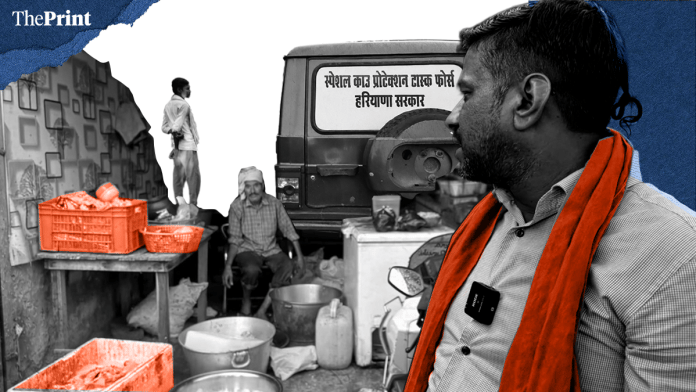


Faridabad: Dhanraj Sharma received a phone call last Monday. “Kanwar yatris are coming to the Press Colony Road. Make sure no meat shops are open,” he was told. “Let me take the boys and go see myself,” replied the self-proclaimed gau rakshak without hesitation.
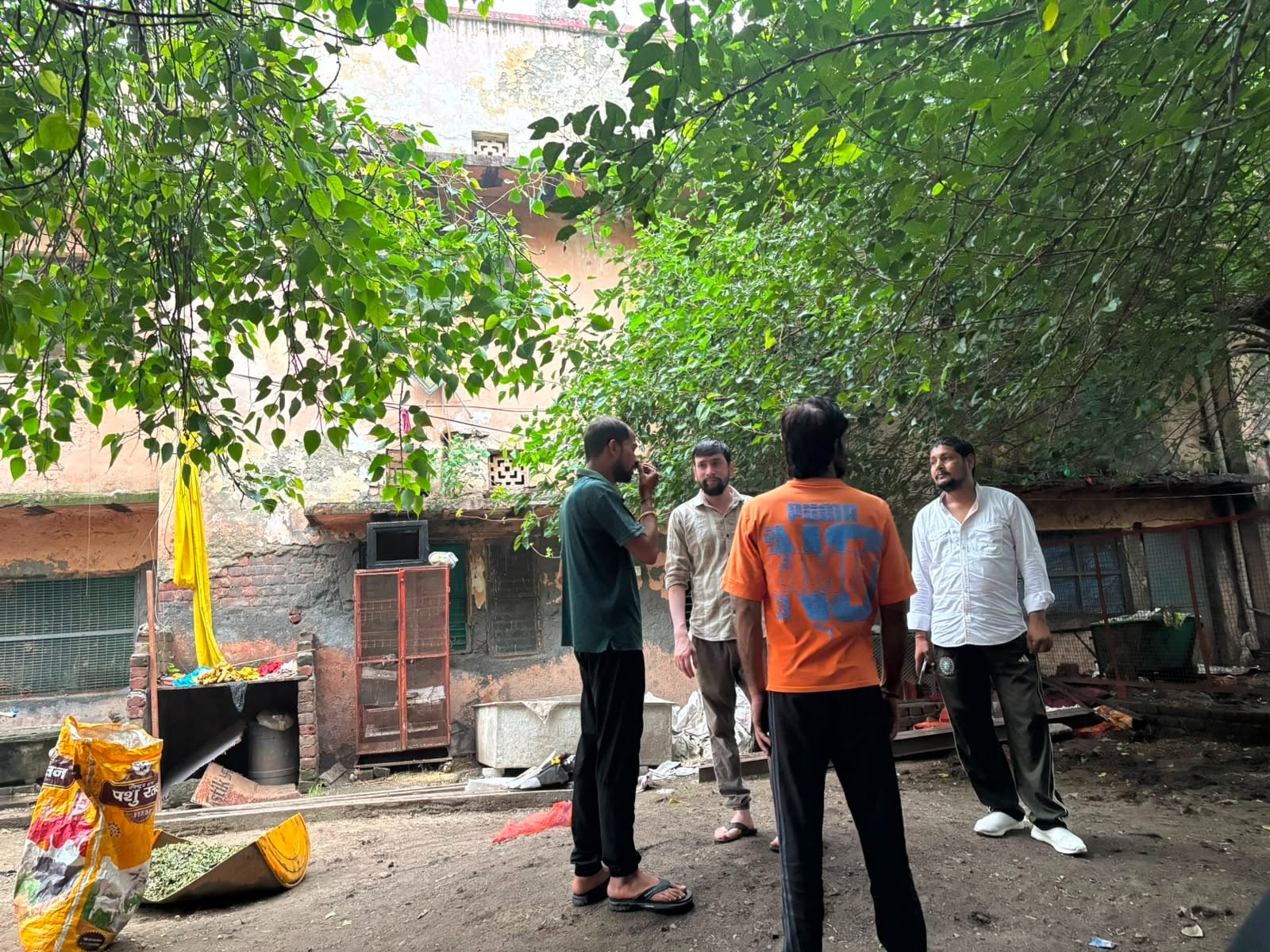
It is 5 PM in a dusty industrial pocket near Old Faridabad. Inside a local gaushala (cow shelter), the humid air is made heavier by the smell of cow dung, mud and damp walls. A huddle of five men breaks into action as Dhanraj disconnects the call.
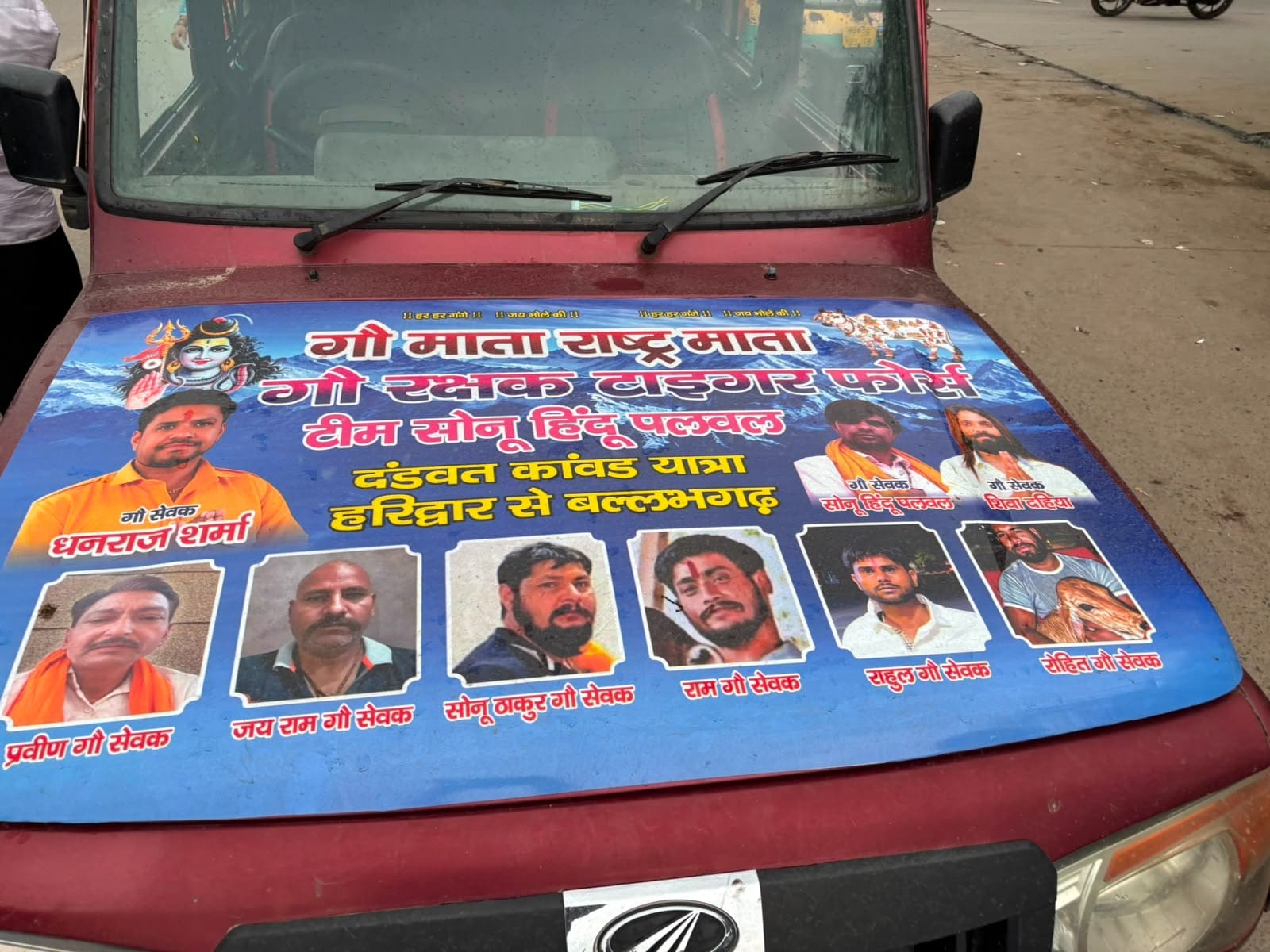
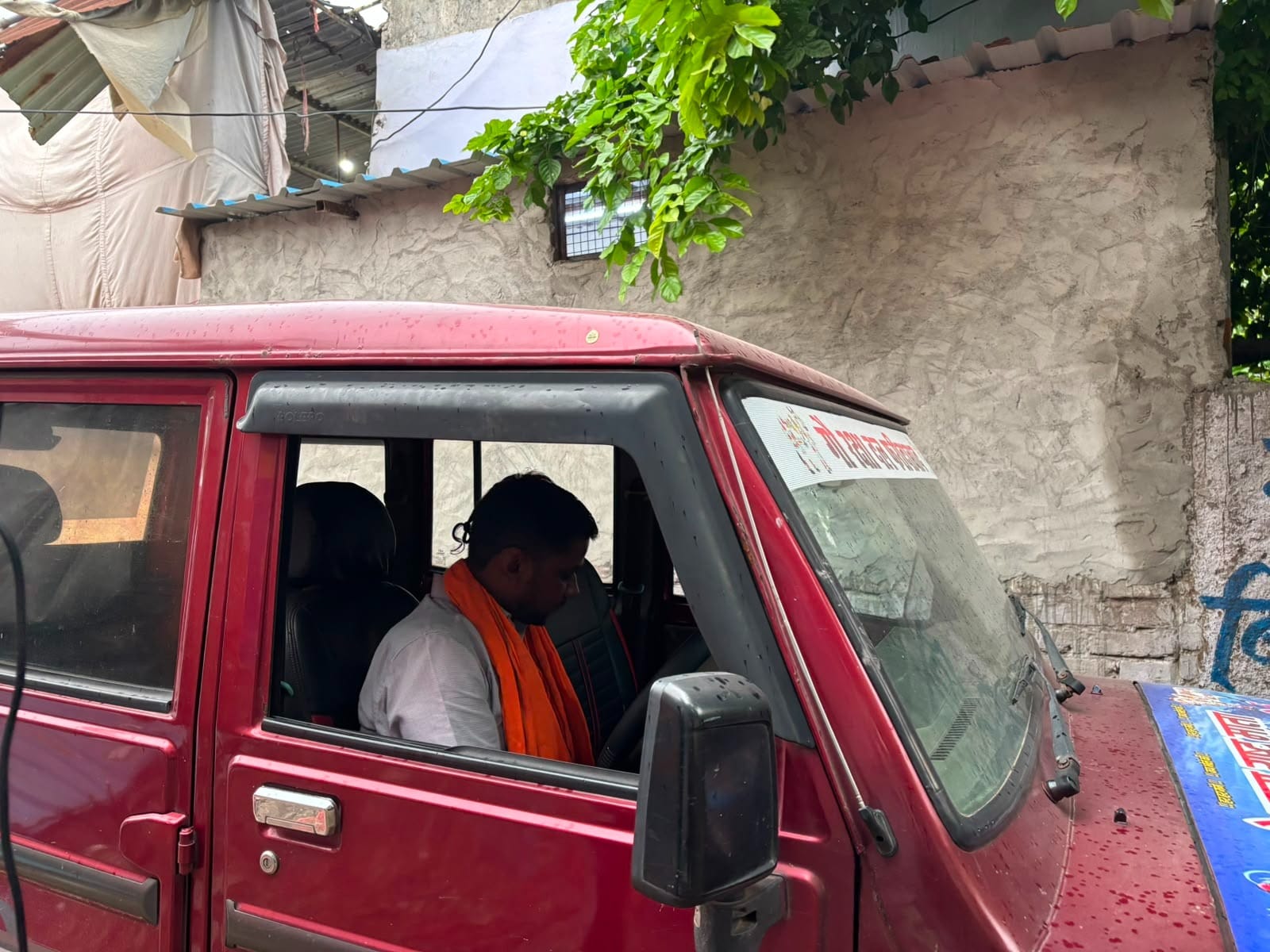
One man wraps a saffron gamccha around his neck, another rolls a bidi between his fingers, a third quickly wipes a maroon-coloured Mahindra Bolero with a piece of cloth, clearing dust off the stickers of faces of popular gaurakshaks of Haryana whose photos have been put on the car on display.
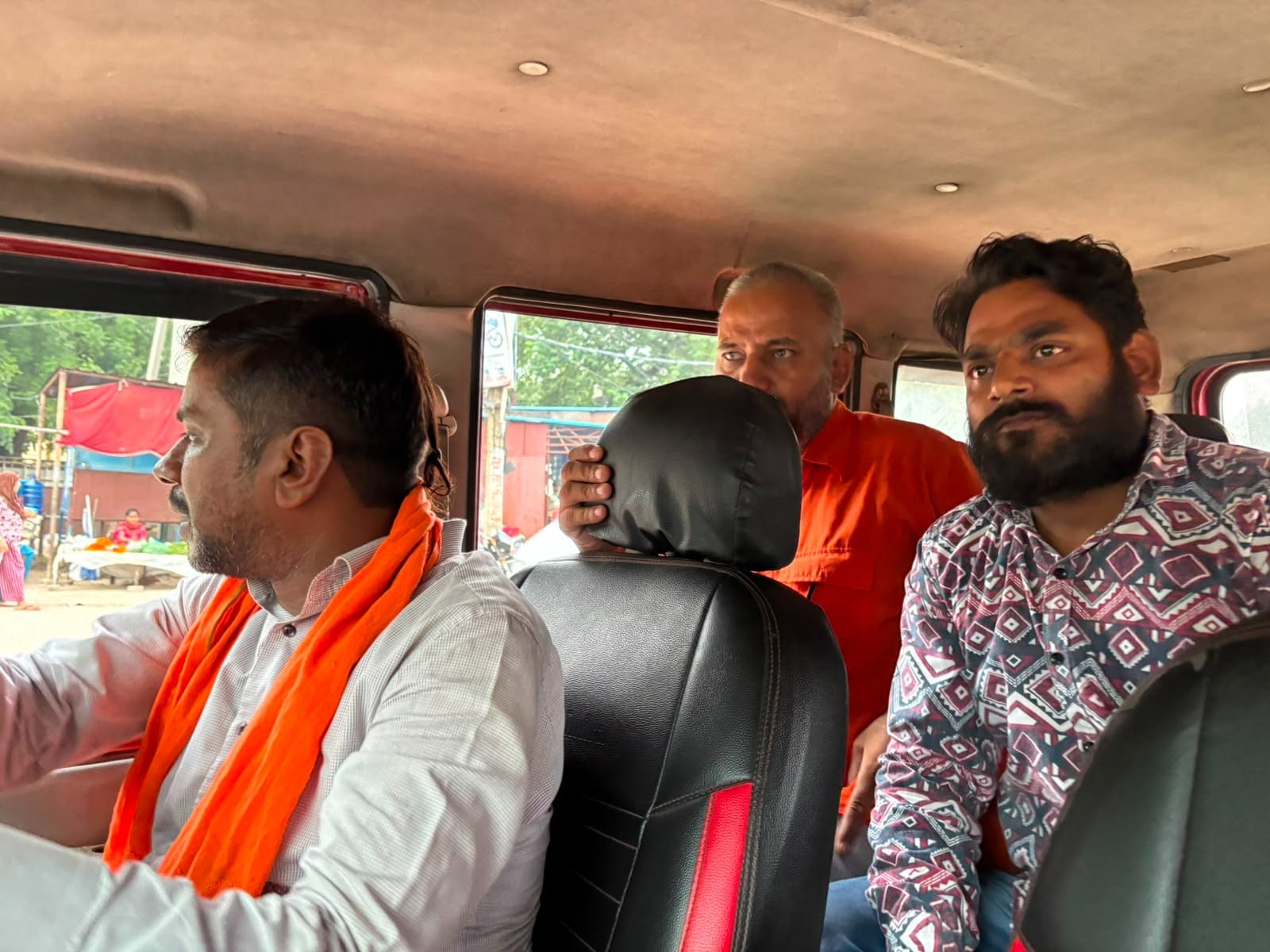
The men sit in the car. Every single phone call is answered. The men share live tip-offs, discuss target locations and track WhatsApp groups to see which meat shops might still be operating during the Hindu holy month of Sawan.
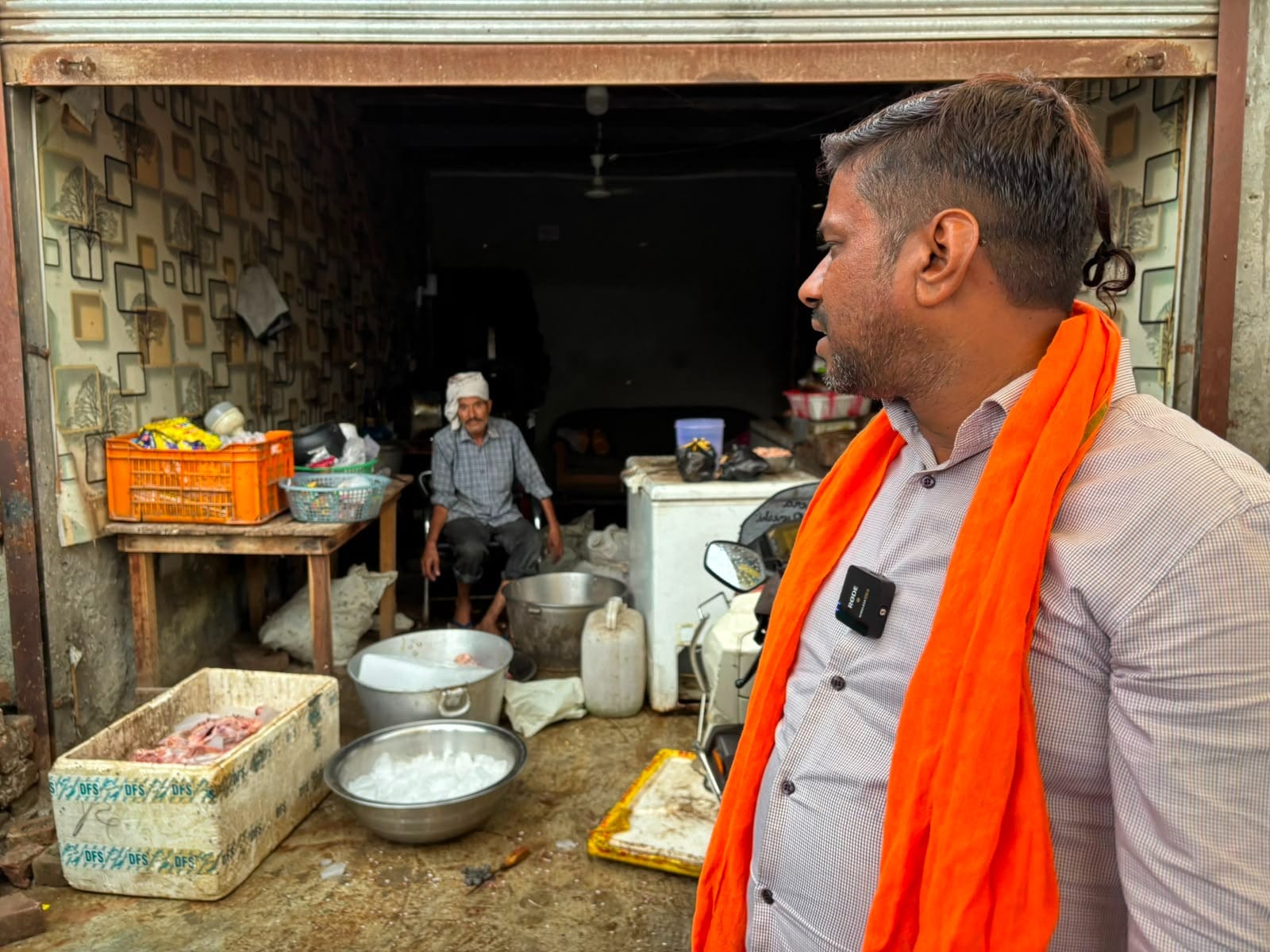
“Udhar dekh, dukaan khuli hai,” (look there, the shop is open) one of them yells, pointing to an open meat shop just metres down the road. “Now see the action,” Dhanraj tells ThePrint.
The Bolero stops instantly. The men step outside, their saffron scarves visible from a distance. Inside, the shopkeepers who were washing their stock leave everything unattended and stand with folded hands—almost frozen, visibly afraid.
One of them starts lowering the shutters. There is no commotion. Bystanders continue to watch. Some of them record videos on their camera phones.
Dhanraj delivers his judgment. “You know the holy month of Sawan is going on. You still decided to keep your shop open. Why? This hurts our religious sentiment.” Bystanders respond with hoots, some witnessing the commotion with a smirk.
Scenes like these play out almost every day in parts of northern India—especially in Haryana, Uttar Pradesh, Rajasthan. It defines the routine of gaurakshaks.
What began merely as a cow protection task for groups like Dhanraj’s has now expanded across sectors. Some groups enforce meat bans during the Hindu holy months, while others tackle cases of alleged ‘love jihad’ or speak on Hindutva and Sanatan.
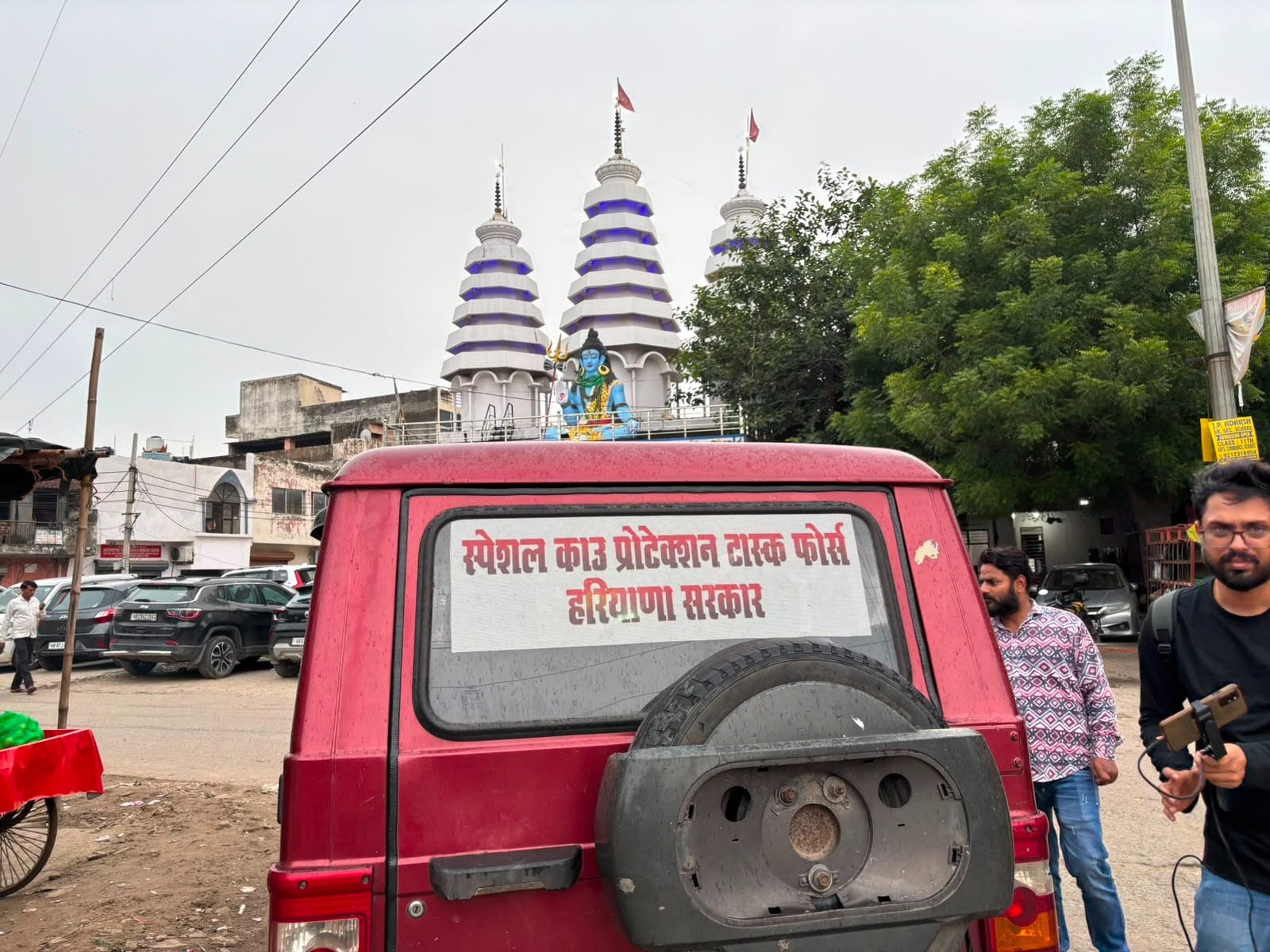
These issues keep them busy throughout the day as part of operational units, especially across Haryana. Dhanraj belongs to the Gau Rakshak Dal, which features Sonu Hindu and Shiva Dahiya, and is a member of the Cow Protection Special Task Force, notified as part of the Haryana government’s initiative in 2021.
In Faridabad alone, a group of 100-150 men and women—who work as autorickshaw drivers, daily-wage labourers, masons, factory workers, bike mechanics and private company employees by day—turn into self-proclaimed vigilantes by night. They use the money they earn from their day jobs to pay for fuel needed for their night patrols.
A spate of recent incidents in Haryana involving gau rakshaks has drawn criticism from the Opposition in the state and humanitarian organisations about the human costs of such cow protection practices, whether State-sanctioned or carried out by non-State actors.
Among the infamous cases are the killings of Nasir Hussain and Junaid Khan in 2023, whose charred bodies were found inside a vehicle in Bhiwani, and the car chase and murder of Aryan Mishra in 2024.
ThePrint followed gau rakshaks across their shifts to document how they track down each complaint shared on their WhatsApp groups.
Not just about cows
The gaushala near Press Colony Road, which houses around 15-20 cows, is strewn with garbage, both inside and outside its premises. Cows and buffaloes roaming the streets often feed on discarded polythene. But for many, that is not their primary concern.
They want Kanwar yatris to be allowed to play music at full volume. They worry about Hindu girls being “wooed” by Muslim men, which they associate with so-called “love jihad”. And they want a blanket ban on the sale of meat during Hindu holy months.
The group is a mix of generations: children as young as 12 who return from school to learn the ropes, alongside men who have decades of experience.
The one who rolled a beedi was Jai Thakur, in his 50s. He used to work as a construction worker earlier, but then he realised that he wanted to do more for his community. So, he began working as a cow protector. Dressed in all saffron, Thakur says, “I wake up at 8 AM. The first thing I do is to check all my 15-20 WhatsApp groups.”
Thakur shows how the group remains active during the day, with tip-offs ranging across issues. “This is not only about cows,” Thakur asserts. “We have to ensure all Hindus are safe.”
Thakur is part of the vigilante group that roams the streets at night. “The smugglers take to the highways late at night. We have to remain vigilant. During the day, our teams are deployed across the city. We have units with whom we coordinate in other districts of Haryana. Everybody is one call away.”
“If there is a young girl in love with a Muslim man, we go and counsel her. We explain to her about the many cases where Hindu girls were chopped up by their Muslim partners. We tell them this is what happens,” Thakur says.
Asked about Hindu girls being killed by their Hindu partners, Thakur switches the topic instantly.
Seasons change, so does the work
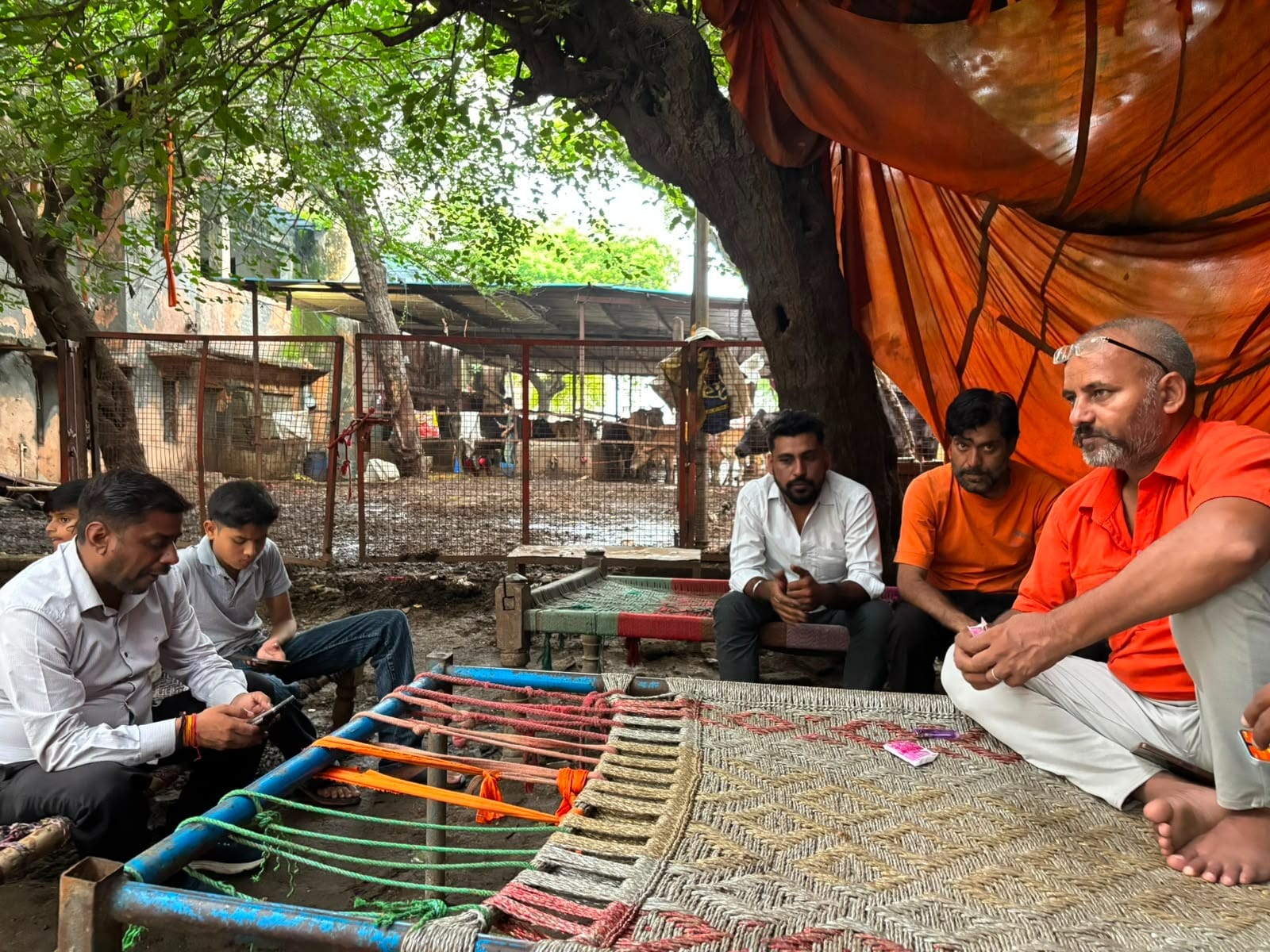
Flies swarm the gaushala, with thick piles of cow dung around. Sunlight barely filters through the trees, and when it rains, the conditions become almost unbearable. The gau rakshaks sit gathered around wooden cots. Their attire is unremarkable: plain T-shirts and faded trousers, knockoff shirts, and saffron gamchas.
Their phones are always in their hands. This shelter lacks funds, but serves as an “operational hub” for most gaurakshaks. The men claim 24 hours prove too little for the amount of work they need to do.
July and August are very busy for the cow protection groups. At times, they sleep in their cars, parked on the side of busy highways. They hardly get to see their family members.
“But this is the sacrifice that we are expected to make,” said Balwant Singh, a 38-year-old worker dressed in saffron. He hasn’t seen his family for days now.
Singh, and many others like him, become particularly busy during August and September, when the holy month of Sawan coincides with Muslim festivals, as well as in October and November, especially around Diwali.
“Our networks actively increase highway patrols and night ambushes on suspicion of illegal cattle transport,” said Balwant. “During the months of November-December-January, it is very foggy at night, and that is the time when smuggling primarily happens.”
They do not rest during the wedding seasons either.
During those months, there are cases of inter-caste marriages, or ‘love jihad’ cases that they have to track down, he says. “Women who work with us, work as counsellors.”
Balwant works at the factory for 10-12 hours, and dedicates most of his salary “for this greater good”.
Cow protection laws
Back in July 2021, the then Manohar Lal Khattar-led BJP government in Haryana notified the establishment of a state-level Special Cow Protection Task Force Committee, comprising several senior officials, to prevent the smuggling and slaughter of cows, rehabilitate stray cattle, and initiate legal action against those found to be involved in such activities.
Under this committee are Special Cow Protection Task Forces (SCPTFs) for every district, which include some nominated gau sevaks/rakshaks.
These gau rakshaks have also cultivated networks of informants. They have been issued special IDs that help them bypass police checkposts, especially while “chasing” cow smuggling suspects.
In a 2023 interview, a deputy superintendent of police (DSP) had told ThePrint that when a vehicle transporting cattle is held by gau rakshaks or the police, the district-level SCPTF members usually arrive at the spot to assess the situation. “The SCPTFs are duly functional,” he added.
And, it is not limited to enforcement. Gau rakshaks have been felicitated on a number of occassions in the past by the police for helping check the smuggling and slaughter of cows, which are crimes under the Gauvansh Sanrakshan and Gausamvardhan Act, implemented by the Haryana government in 2015.
Shravan Kumar Garg, chairman of the Haryana Gau Seva Aayog (Cow Service Commission) and the de facto head of the SCPTF committee, had told ThePrint that gau rakshaks were doing a commendable job, whether or not they were direct members of the SCPTFs.
When the state-level Special Cow Protection Task Force Committee was notified by the Haryana government in 2021, it was supposed to have six members—the chairperson as well as the secretary of the state Gau Seva Aayog, the special secretary of the Revenue and Disaster Management Department, the special secretary of the Animal Husbandry and Dairying Department, the additional director general of police (ADGP), and the additional legal remembrancer (ALR) of the Department of Legal Affairs, ThePrint had reported.
At the district level, each special cow protection task force has 11 members. Six of these are government officials—the deputy commissioner, the superintendent of police, the municipal corporation commissioner, the zilla parishad chief executive officer, the district attorney, and the deputy director of Animal Husbandry and Dairying.
The remaining members include three people nominated by the state Gau Seva Aayog and two gau sevaks nominated by the deputy commissioner.
The Gau Seva Aayog is a commission set up by the state government to look after the interests of cattle. Its ex-officio members include the principal secretaries of several departments—Revenue and Disaster Management, Urban Development, Agriculture, Finance, Animal Husbandry, and Development and Panchayat—as well as the director general of police and the director general of the Animal Husbandry and Dairying Department.
In August 2017, Haryana had announced that the state would have certified gau rakshaks.
While the government has dedicated teams, the gau rakshaks are happy with the response. But, they say, more needs to be done. “Our request for the government is to give dedicated land for gaushalas, cow should be declared the national animal, and stricter laws should be put in place to curb cow smuggling,” Thakur reiterated.
In this space, there is no salary. For gau rakshaks like Sharma, Singh and Thakur, the motivation is their devotion to cows and their long-standing commitment to Hindutva. Much of the enforcement rests on fear and intimidation, meted out with impunity.
Of fear and intimidation
For Balwinder Singh, 2 August was a regular Sunday afternoon. He was serving hot egg and chicken rolls to his daily customers around his food cart on the KC Road in Old Faridabad. He recalls the moment two Boleros, carrying 15 cow vigilantes, pulled over to this market; they had identified Singh’s shop as their latest target.
Singh was forced to clear his stall. “My shop has been here for over 50 years,” he told ThePrint. “This has never happened before. Nobody has come to my shop, hounded me. and left only after I shut my shop.”
“Earlier, we used to keep our shops shut during Navratris and Tuesdays. Now, the Gau Rakshak Dal men have told me to keep my shop shut during the entire month of Sawan,” he told ThePrint.
Adding, “They misbehaved with me and my staff. People are already struggling with jobs, and whatever small work we do, that is also being shut. This is just fear and intimidation.”
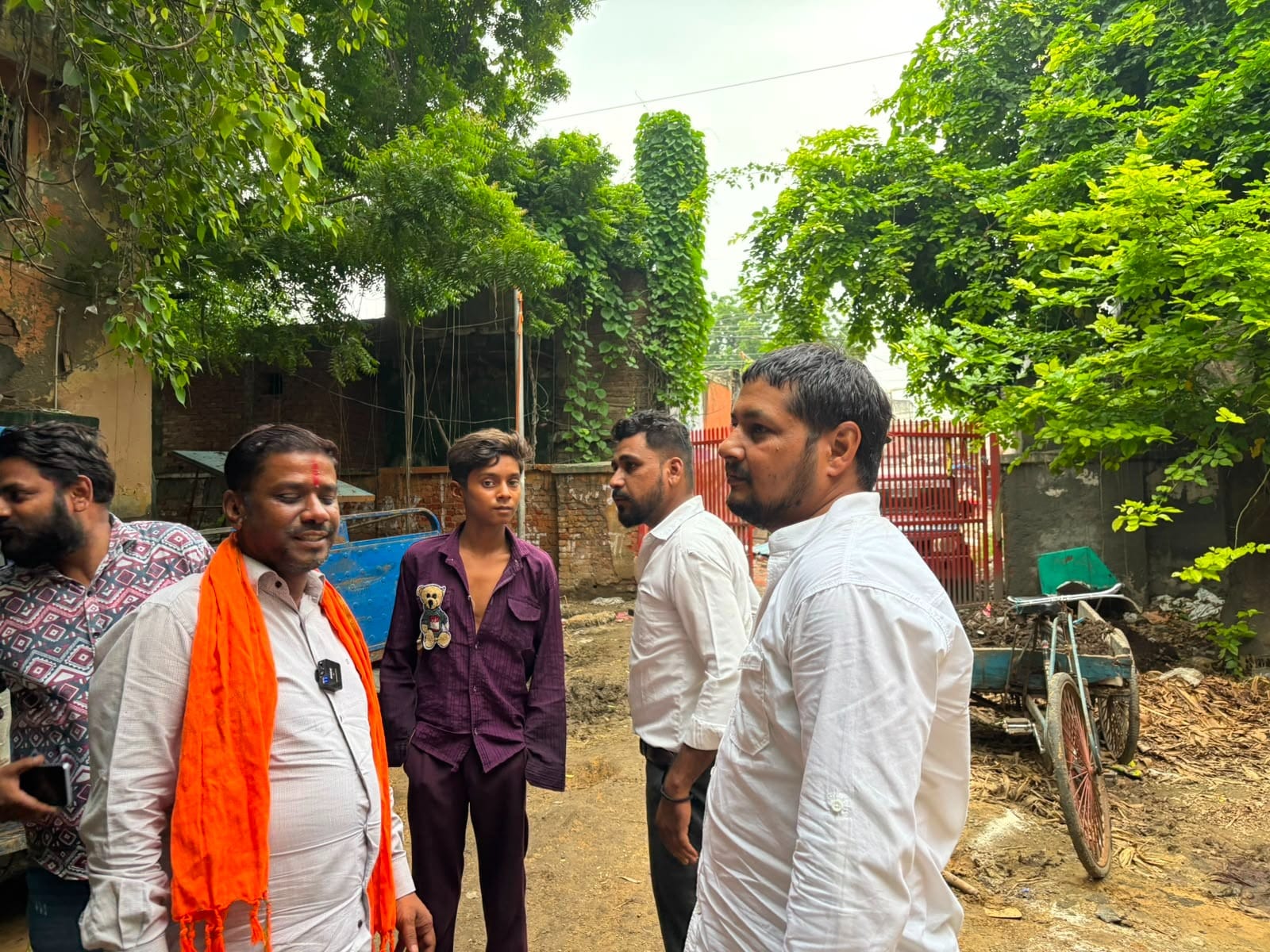
A video of the incident was widely shared on social media.
“Our main goal was to ensure all shops selling eggs, chicken, or meat be closed immediately,” says Dheeraj, one of the 15 men.
Across the market, other biryani and chicken sellers also faced the same situation.
To run their operations across districts, the gau rakshaks rely on an extensive network of local informants. “Tip-offs come from both Hindus and Muslims,” Thakur says. “Our sources are deployed across neighbourhoods, villages, shops, trucks, and guards. They tell us if a cow is being smuggled, or if any meat shop is selling any meat.”
Every alert on WhatsApp receives almost an immediate response.
(Edited by Ajeet Tiwari)
Also Read: Not just vigilantes: How gau rakshaks like Monu Manesar fuel Haryana govt’s cow protection drive