



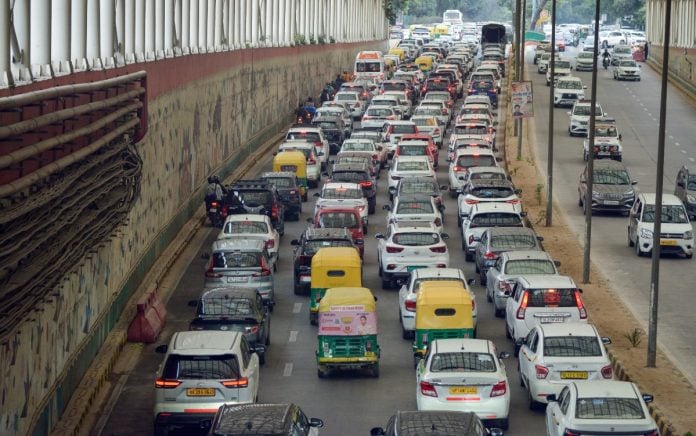
New Delhi: The Delhi Police will in the coming days start using a new AI-based traffic network, approved by the Union Cabinet Wednesday, to detect crime, flag stolen and “hot-listed” vehicles, and trace vehicles linked to hit-and-run cases. The number of AI-enabled cameras will also go up from 209 to around 2,500, and existing cameras across the Capital will be connected to AI tools.
Approval for the Rs 1,789.52-crore Intelligent Traffic Management System (ITMS) by Delhi Police, which reports to the Ministry of Home Affairs (MHA), came more than a decade after the project was first planned.
“In CCTV cameras, we have to detect AI-based violations. If there is a crime, we have to detect it immediately,” Union Minister Ashwini Vaishnaw said Wednesday at the press briefing on Cabinet decisions. He said the project would add “a brain” to the city’s traffic management system.
Shive K. Singh, Deputy Commissioner of Police (Traffic), said the system would be used to track not just traffic violations, but also crime. He said the police had held talks with Google and Apple, which run map services, on sharing traffic information. The government’s press statement says information “may also be shared with navigation service providers”.
The ITMS has been on the Delhi Traffic Police’s agenda since at least 2014. In January 2019, the traffic police said they would finally begin work on it after a wait of almost five years. In May 2023, then Special Commissioner of Police (Traffic) Surender Singh Yadav had said that the system would be in place within 18 months at a cost of around Rs 1,400 crore. All the deadlines were missed.
Under the project, AI-based analytics will identify stolen, hot-listed and blacklisted vehicles, repeat violators and vehicles linked to hit-and-run incidents.
The cameras will also detect red-light violations, speeding, wrong-way driving, riding without a helmet, driving without a seat belt, and phone use while driving. A presentation shown at the briefing said there is currently no city-wide system that “uses AI to flag wanted vehicles”.
Asked about the use of AI, Vaishnaw cited a project at a railway station launched seven to eight years ago, where AI cameras were installed. “There was a significant crime reduction… there was a 95 percent reduction,” he said. “When AI-based cameras will be installed across the city, this will have a very good impact on the crime rate.”
The project will cover 42 corridors in three phases over 24 months, followed by five years of operation and maintenance. The first phase, over 12 months, will cover five corridors, 250 smart signals and a main command centre. The second and third phases, spanning six months each, will cover 37 corridors and 842 signals, along with a disaster recovery site. In all, the project covers 1,092 adaptive signal locations and 1,029 enforcement locations.
A Master System Integrator will be chosen through competitive bidding. The Centre for Development of Advanced Computing (C-DAC) will be the technology partner and project management consultant. Three committees will oversee the project, headed by the Union Home Secretary, the Delhi Police Commissioner and the Special Commissioner of Police (Traffic). According to the statement, the system will follow “open standards and APIs to enable future integration and scalability”.
On the traffic side, the government said Delhi’s 1,529 traffic signals run on fixed timings with manual intervention. The Capital has around 71 lakh active registered vehicles. “If we vary the duration of the traffic light, then the traffic flow can increase substantially,” Vaishnaw said.
Asked how the system would work across Delhi and the NCR, Vaishnaw said the project did not require any regulatory change. “Instead of changing the rules and regulations, this is more of a technological intervention,” he said. Asked what operating rules would govern the system, he said: “Those operating rules will basically take care of the citizens.” He did not give details.
The ITMS cameras will add to a network already in place under the home ministry’s Safe City Project. Its latest phase was inaugurated by Union Home Minister Amit Shah in February. The project is anchored by an Integrated Command, Control, Communication and Computer Centre (C4I) at Delhi Police headquarters. At the launch, the police said 2,100 AI-enabled cameras were operational, with 10,000 more planned on top of more than 15,000 older cameras. The network runs facial detection, number plate recognition and crowd density monitoring.
The government did not say whether ITMS cameras would feed into the C4I or the police’s facial recognition system. It also did not say how long data would be retained or on what terms it would be shared with private companies.
To be sure, India does not have a law specifically governing facial recognition technology.
Replying to a question in the Rajya Sabha in 2025, the home ministry said Delhi Police’ss facial recognition system operates under a police order dated 9 June, 2022. The Digital Personal Data Protection Act, 2023, allows government agencies to process personal data without consent for functions authorised by law.
The Internet Freedom Foundation has previously said, citing replies to Right to Information (RTI) requests, that no privacy impact assessment was carried out for the Safe City Project.
(Edited by Amrtansh Arora)
Also Read: Bengaluru may be stuck in traffic, but its AI future has already arrived