





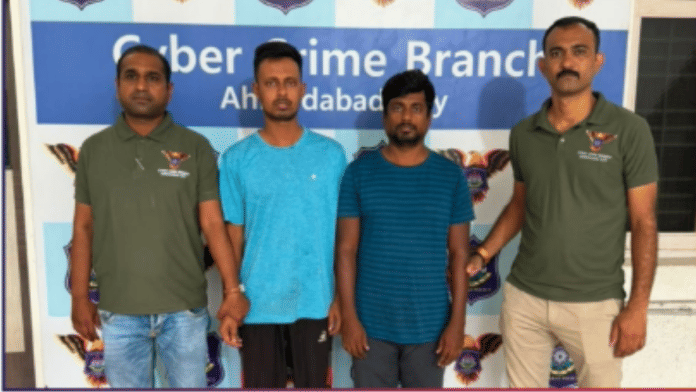


New Delhi: The Ahmedabad Cyber Crime Branch and the Indian Cyber Crime Coordination Centre (I4C) have busted an international cybercrime network operating across 26 Indian states, with infrastructure linked to China and Pakistan, police said Tuesday.
The crackdown led to the arrest of two men from North 24 Parganas in West Bengal, who helped run the operation by allegedly supplying fraudulently obtained one-time passwords (OTPS) used in cybercrime.
Police sources in the Ahmedabad Cyber Crime Branch said that 251 cybercrime complaints were registered on the National Cybercrime Reporting Portal (NCRP). They included cases of cyber fraud known as the “Boss Scam”, in which fraudsters impersonate Reserve Bank of India (RBI) or government officials and send malicious ZIP files via WhatsApp or email.
Ahmedabad City Commissioner of Police Anupam Singh Gehlot said they began investigating the matter following the complaints, some of them registered by Ahmedabad residents.
Police data shows that 194 complaints were registered for online financial fraud, three for the “Boss Scam”, 29 for online and social media-related crime, five related to sexually explicit acts, four of hacking, seven related to sexually obscene material, eight as ‘any other type’ of cybercrime, and one related to child sexual exploitative material.
ચીન, પાકિસ્તાન અને ભારત સાથે સંકળાયેલા સાયબર “BOSS Scam”નો પર્દાફાશ: 10,000 જેટલા ડિવાઈસીસ સુરક્ષિત કરી કરોડોની "BOSS Scam” સાયબર છેતરપિંડીથી ભારતીય નાગરિકોનું રક્ષણ
અમદાવાદ સાયબર ક્રાઇમ ટીમે ટેકનિકલ તપાસના આધારે પશ્ચિમ બંગાળમાંથી આંતરરાષ્ટ્રીય બોસ સ્કેમ આચરતી ગેંગના ૨ શાતિર… pic.twitter.com/0hb2Ij4lHC
— Ahmedabad Cyber Crime (@cybercrimeahd) August 18, 2026
Also Read: The test of Gujarat’s Operation Mule Hunt is not 55 arrests. Count the money instead
Multi-country infrastructure
Police sources said that the gang used a type of cyber fraud known as the “Boss Scam”, among other cybercrimes.
The malicious ZIP files sent via WhatsApp or email in this scam allowed hackers to hijack WhatsApp accounts, pose as company bosses, and trick finance teams into transferring large sums of money.
According to the technical and network analysis conducted by the I4C and Ahmedabad Cyber Crime Branch, the malware used by the accused is suspected to have been developed by cyber criminals associated with China. It was used to target Indian citizens through a call centre located in Islamabad, Pakistan, a senior police officer said.
The officer said the bank accounts involved in the cyber fraud were accessed via a China-based VPN service.
“Based on these findings, it has preliminarily emerged that the accused used a multi-country cyber infrastructure associated with China, India, Pakistan and Hong Kong to conceal their identities and actual locations,” said the officer.
Police said the coordinated action helped secure more than 10,000 infected devices and rescued Indian citizens from potential losses worth crores of rupees due to cyber frauds such as the Boss Scam. Additionally, the malware identified through the Sahyog Portal is being regularly blocked.
21,000 OTPs sold
To run these scams, the gang needed local Indian phone numbers. They got them from the two arrested operatives in West Bengal: Imran Ali Piyada and Injammul.
Piyada, a telecom sales agent, used customers’ biometric data to activate dummy SIM cards, without their knowledge. He put these SIMs into phones to generate OTPs and forwarded them to cybercriminals to activate fake WhatsApp, shopping and gaming accounts.
The investigation revealed that over five years, Piyada sold around 21,000 OTPs for e-commerce sites like Amazon and Flipkart at Rs 100 each, earning over Rs 21 lakh. He also sold 900 OTPs for WhatsApp activations at Rs 250 each, making another Rs 2.25 lakh.
Injammul, a BA graduate, coordinated directly with the overseas criminals.
Police’s analysis of 4,500 fake SIM cards linked the suspects to 251 official complaints across 26 states.
(Edited by Sugita Katyal)
Also Read: IDFC First Bank scam: Pardeep Kumar, IAS officer under scanner, ‘on the run’ as CBI closes in