






New Delhi: Robotic assistance made knee replacement more precise, but this did not translate into better patient outcomes in the first year after surgery, a UK trial has found.
Patients who underwent robot-assisted surgery had similar recovery, mobility and pain levels as those who had conventional knee replacement, the RACER-Knee trial published in The Lancet on 20 August found.
The findings are important because robotic systems are increasingly being used in knee replacement surgery on the premise that more precise positioning of the implant could improve recovery and potentially provide better longer-term results.
The trial involved 339 patients with advanced knee osteoarthritis, across 10 National Health Service (NHS) hospitals in the UK.
The patients were randomly assigned to undergo robot-assisted or conventional knee replacement, where a surgeon directly performs the surgery.
The robotic procedure took an average of 10.5 minutes longer, cost around £950 more per patient, and was more precise in reproducing the planned alignment of the knee.
At 12 months, there was no clinically meaningful difference between the two groups in how patients experienced their artificial knee, pain or mobility.
“Technology such as this could really help the care we give for patients, but for robot-assisted knee replacements, there is still work to do before we see benefits such as less pain or better movement,” said Andrew Metcalfe, professor at Warwick Medical School in the UK and one of the trial’s chief investigators.
Professor Anthony Gordon, director of the National Institute for Health and Care Research Health Technology Assessment Programme, which funded the study, said the findings show that robot-assisted knee replacement is not yet improving patient outcomes but could offer opportunities to use its precision to improve care.
Total knee replacement is a common procedure for treating knee arthritis. Traditionally, surgeons use their experience and standard surgical instruments to operate.
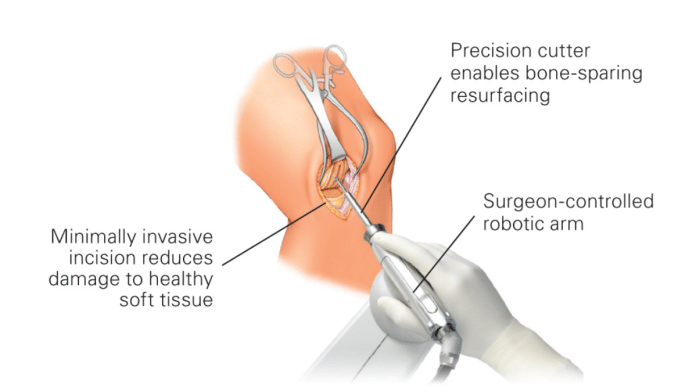
Robot-assisted systems, which are controlled by the surgeon, can position instruments more precisely and allow surgeons to adjust cutting angles and depths based on the patient’s individual anatomy, enabling a more personalised approach than conventional surgery.
In the RACER-Knee trial, surgeons used Mako, a robotic-arm system made by US-based medtech company Stryker, for the robot-assisted procedures.
The trial found that, at least during the first year, greater surgical precision did not give patients an additional clinical benefit.
Researchers will continue to follow participants for 10 years to determine whether the difference in precision could eventually affect the need for further surgery or other longer-term outcomes.
Also Read: Allahabad boy makes brain-controlled prosthetic hand for friend from scratch
The trial
Patients were recruited between December 2021 and December 2023. Of 807 people screened, 339 were randomly assigned to the two groups. A total of 168 received robot-assisted knee replacement and 171 underwent conventional surgery.
The trial involved 33 surgeons across 10 hospitals. Patients and researchers assessing outcomes were masked, meaning they were not told which type of surgery they had received when assessing the trial outcomes. Measures were used during the operation and afterwards to help keep patients and outcome assessors unaware of the treatment group.
The main outcome was the Forgotten Joint Score, which measures how aware patients are of their artificial knee during everyday activities. A higher score means patients are less aware of the artificial joint.
At 12 months, the average score was 49.2 in the robotic group and 50.2 in the conventional surgery group.
After statistical adjustment, the difference was -1.5 points, with a 95 percent confidence interval of -7.5 to 4.5. The p-value was 0.62, meaning there was no statistically significant difference. The difference was also far below the 12-point improvement that the researchers had previously defined as clinically meaningful.
Pain and mobility outcomes were also similar, including pain while in hospital, during the first three months and at 12 months. Serious adverse events occurred in 16 patients in each group.
The main advantage seen with the robotic system was precision.
The Mako system uses imaging to help surgeons plan the knee replacement and assists them in carrying out that plan. In the trial, robot-assisted surgery was better at reproducing the planned alignment of the knee and leg.
Why the findings need to be interpreted carefully
According to Dr Sandeep Wasnik, consultant in joint replacement and orthopaedic surgery at Kokilaben Dhirubhai Ambani Hospital, Mumbai, which performs around 3,000 robotic joint replacement surgeries every year, the findings need to be interpreted carefully.
“These are important findings. But saying that they prove robotics has ‘no benefit’ creates a fundamental problem in how the technology is being judged,” he said.
He noted that the trial’s primary outcome was the Forgotten Joint Score at 12 months, which measures how often patients are aware of their artificial knee during daily activities.
Robotic systems, however, are primarily designed to improve surgical precision by helping surgeons plan bone cuts, position implants accurately, assess ligament balance and reproduce the surgical plan.
Dr Wasnik said similar patient-reported outcomes at one year do not necessarily mean that the added precision of robotic surgery has no value.
He pointed out that the RACER-Knee trial itself found robotic surgery to be more precise. The question, he said, is whether this greater precision could translate into benefits that become apparent only over several years.
Knee replacements are expected to function for 15 to 20 years or longer, Dr Wasnik said, meaning a 12-month outcome may not fully capture the technology’s long-term value.
A 2025 systematic review and meta-analysis of 21 randomised controlled trials involving 2,692 patients also found that robotic knee replacement reduced major mechanical alignment errors.
Patients who underwent robotic surgery were about 67 percent less likely to have the knee implant positioned outside the desired alignment range than those who underwent conventional surgery.
Referring to the review, Dr Wasnik said, “This study also found similar short- to medium-term patient scores—again showing the same interesting message: better precision is proven; whether that precision produces better long-term outcomes remains uncertain.”
According to Dr Ravikumar T, HOD and consultant in orthopaedics at Ramaiah Memorial Hospital, Bengaluru, the trial’s sample size was large and, therefore, results can be extrapolated for the population.
But he cautioned against drawing conclusions about revision surgery from only one year of follow-up.
“Many complications of TKR occur many years after the surgery and, therefore, a 12-month follow-up may not be enough to comment on the need for revision surgery. Many patients develop pain or loss of function much later,” he said.
Robotic knee surgery gains ground in India
The findings come as robot-assisted surgery is expanding in India, beyond a small number of specialised private hospitals.
Robotic systems are increasingly being adopted for procedures including knee and hip replacement, with the technology also entering government hospitals and smaller centres.
Delhi’s Safdarjung Hospital recently performed its first robot-assisted total knee replacement, bringing the technology into one of the capital’s major government hospitals.
The expansion has been driven partly by the promise of greater precision and more predictable implant positioning. But robotic systems are substantially more expensive than conventional surgical instruments, making the question of whether the additional precision translates into better outcomes particularly important in India.
Dr Wasnik said robotic knee replacement technology is evolving and its long-term benefits remain to be established.
“Robotics clearly improves surgical precision. What has not yet been proven is whether this greater precision and ability to personalise knee replacement will translate into better function, satisfaction and implant survival over the next 10–20 years,” he said.
He added that robotics is not a substitute for an experienced surgeon. It is an advanced tool that allows an experienced surgeon to measure and execute surgery with a level of precision that conventional instruments cannot always reproduce.
“The final verdict on robotic knee replacement, therefore, should not be written after one year,” Dr Wasnik said.
(Edited by Sugita Katyal)
Also Read: Vet is the hot new job in India. No longer step-sister of MBBS