





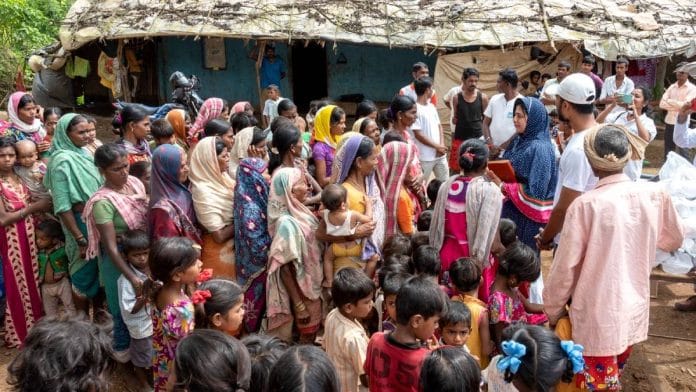



Mumbai: Pooling resources from across the world, the affluent Dawoodi Bohra community has quietly taken on one of Maharashtra’s most persistent crises—malnutrition in the poorest tribal regions.
Through sustained nutritional and health interventions, the community’s flagship initiative, Project Rise, has helped reduce severe and moderate malnutrition by up to 53 percent in a cluster of tribal villages in Nandurbar district where it piloted the programme. The community now hopes to replicate the results in Chandrapur’s remote Vidarbha belt.
The initiative is being implemented in collaboration with the non-profit Association for Nutrition and Development Action (ANNADA), Chandrapur Zilla Parishad and Integrated Child Development Services (ICDS) Commissionerate under Maharashtra’s Women and Child Development (WCD) Department.
The Chandrapur project, which began last year, will support 915 mothers and children across 27 anganwadi centres, providing fortified daily meals at home, behaviour-change communication and holistic health support.

The model closely mirrors the one in Nandurbar, where Project Rise members and ANNADA have worked intensively with tribal communities since September 2023.
“Project Rise was conceptualised in 2018, and the first effort was in Mokhada, Roha and Govandi areas. It initially took shape because of the malnutrition issue in the state. The initiative is a global philanthropic arm of the Dawoodi Bohra community, with six other streams focusing on environmental conservation, healthcare and sanitation, and water security,” Murtaza Sadriwala, an official of Project Rise, told ThePrint.
In Nandurbar, the intervention through Project Rise, ANNADA and local anganwadis covered multiple tribal villages and focused on pregnant women, lactating mothers and children under six.
According to the project report from September 2023 to March 2025, over 3.3 lakh fortified meals were distributed in the period, alongside home counselling sessions, health awareness workshops and stakeholder meetings.
The results were tangible: cases of moderate acute malnutrition dropped by 35 percent, severe underweight cases reduced by 18 percent, and the number of children moving into the “borderline to normal” health category rose by over 50 percent.
It was following this mix of nutritional support, trust-building and behaviour change that Project Rise launched the effort in Chandrapur’s Jiwati taluka in September 2025, targeting undernourished mothers and children in a region marked by high tribal populations, seasonal migration, anaemia among women and poor dietary diversity.
According to National Family Health Survey (NFHS-5) data, undernourishment remains widespread in Chandrapur region, while in the Global Hunger Index, India registers a score of 25.8, placing the country in the “serious” category and ranking 102 out of 123 countries.
“Our task is to get them from severe malnutrition stage to medium malnutrition and then natural food intake would eventually get them to normalcy,” Murtaza told ThePrint.
Also Read: Code red on malnutrition: Why half the kids in 3 poorest UP districts are stunted, many ‘wasted’
Battling malnutrition
Under Project Rise, the Dawoodi Bohra community follows a methodical, ground-up approach that blends data with lived realities.
Each intervention begins with a needs assessment, mapping gaps on the ground while ensuring alignment with the community’s core values. In 2018, this process first led the community to Jawhar and Mokhada, neighbouring predominantly tribal areas in Palghar district, where early research pointed to alarming levels of child malnutrition.
Food and nutrition, members said, are causes close to the community’s heart, making these neighbourhoods a natural starting point for sustained engagement.
Before any formal partnership was finalised, community members undertook a detailed on-ground recce to understand everyday challenges firsthand. They spent time with families, spoke to local residents about health concerns, and engaged with government and civic authorities to understand how any intervention would have to dovetail with existing systems.
In Govandi—part of the Jawhar-Mokhada cluster—residents flagged how proximity to one of Mumbai’s largest dumpyards had compounded health issues, alongside low awareness and poor attendance at anganwadi centres.
“It was important for us to see, listen and understand before designing solutions,” a Project Rise volunteer told ThePrint, recalling those early visits.
Implementation, the members said, is anchored in collaboration. The community partnered with ANNADA, which conducted baseline surveys to identify malnourished children and mothers, using both field data and government reports.
In regions like Nandurbar, where ANNADA already had a presence, the groundwork was laid through existing surveys and national malnutrition data, allowing interventions to begin without delay. Daily operations are handled by ANNADA in coordination with anganwadi centres, ensuring continuity within the public health system.

To improve acceptance among families, ANNADA developed micro-fortified food in an accessible form: laddoos made from ragi, jowar, bajra and pulses. Prepared by simply mixing a ready blend with water, the laddoos deliver essential nutrients without disrupting household routines.
“The idea was to remove friction,” Murtaza told ThePrint. “If nutrition is easy to prepare and easy to eat, it stands a better chance of becoming part of daily life.”
Alvin D’Souza, programme head at ANNADA, said it provided safe, micro-nutrient-fortified nutrition to children and mothers and an array of community-based interventions.
“These focus on capacity-building through training of field officers and workers, awareness sessions for caregivers and other stakeholders, and periodic impact assessment across scale and geographies through comprehensive health and nutrition programmes, like the project to support vulnerable children and mothers in Chandrapur,” he told ThePrint.
The Nandurbar, Jawahar, Mokhada and Govandi projects are now run by local anganwadi centres. “We undertake some health-related education and water security activities from time to time,” Murtaza said.
Also Read: Can’t learn, can’t work, can’t even cross river: Life in 3 of India’s 4 poorest districts, all in UP
Project Rise diaries
While all nutrition and health-related projects under Project Rise are implemented with the help of local anganwadi centres and ANNADA, the Dawoodi Bohra community volunteers play a significant role—stepping in during awareness drives, mothers’ meetings and monitoring visits. The day-to-day distribution of food is managed by the anganwadis.
Closely affiliated with the initiative is community member Alifiya Bhol, a Mumbai-based clinical nutritionist and dietitian, who works as a volunteer.
Practising as a dietician since 2012, Alifiya joined the initiative in 2018, in its pilot year. As part of the project, she visited rural villages and met with the tribals.
At the time, Bhol was asked to suggest healthy foods that can be available at nominal costs to a population that was mainly low income. Peanuts and other such nuts in the form of chikkis is one item she suggested. She also spoke to mothers, explaining to them the life cycle of a woman, with hormonal changes from puberty to the fertile reproductive years, to the different stages of menopause.
“My association with Project Rise began in 2018, taking me into the heart of communities in Mokhada, Roha and Govandi. In my interactions with mothers there, I’ve focused on the foundational pillars of health, stressing the importance of breastfeeding and providing hands-on counselling to improve hygiene and nutrition levels within their neighbourhoods,” she told ThePrint.

“To ensure our message truly hit home, we moved beyond traditional counselling to organised nukkad nataks (street dramas). These street plays, performed by local artists, turned the serious topic of healthy eating habits into an engaging, community-wide conversation.”
For many mothers, the shift was deeply personal. Field workers recalled that women who initially hesitated to speak to outsiders began asking for regular weight checks for their children, tracking growth charts and questioning food choices.
“By the end of the programme, concern had replaced silence,” Sanjay Mishra of ANNADA told ThePrint, describing how awareness around nutrition and institutional healthcare gradually took root in the tribal community.
Several volunteers belonging to the Dawoodi Bohra community gave their account of personal experiences, explaining the roadblocks they faced while working in remote villages and tribal areas.
Mustafa Rohawala, 51, one such volunteer of Project Rise in Roha town of Maharashtra that began 2019, remembered the COVID-19 period, when the initiative was being implemented and the town was in dire need of food security.
“During the nutrition project in Roha, the onset of COVID-19 brought an urgent, critical need for food security. To meet this challenge, we continued our programme with ANNADA by distributing poshan potlis (nutrition bags) directly to the doorsteps of affected children, ensuring that even in the height of a crisis, nutrition remained accessible to the most vulnerable,” he said.
Fatema Kanchwala, a volunteer for the Chandrapur project since October 2025, pointed out the local issues, a major one being the laid-back attitude of people, further emphasising the need for such projects to be rooted in awareness.
“In Chandrapur, the challenges are two-fold. Lack of awareness and a genuine scarcity of resources necessary for health and well-being,” she told ThePrint.
“What struck me the most, however, was a certain level of indifference towards personal health within the local community. This laidback attitude is exactly why our work is so vital. It underscores the absolute necessity of consistent awareness campaigns and regular health sessions to shift mindsets and prioritise life-saving habits.”
Dawoodi Bohra community
The Dawoodi Bohra community, with around 1 lakh members in Mumbai, according to Murtaza, has a presence that spans from South Mumbai’s Bhendi Bazaar and Fort to Mumbai Suburbs: Andheri, Khar, Santacruz and Mumbra.
Beyond the city, the community counts over a million contributing members worldwide, including in the Middle East, US, UK, Europe, East Africa and across South and Southeast Asia, Australia and New Zealand.
In India, Dawoodi Bohras are concentrated in Maharashtra, Gujarat, Rajasthan, Madhya Pradesh, West Bengal, Karnataka and Tamil Nadu, with significant populations in cities such as Pune, Nagpur, Nashik, Ahmedabad, Surat, Rajkot, Udaipur, Bhopal, Indore, Kolkata, Hyderabad, Bengaluru and Chennai.
“Our vision is to help create a resilient, sustainable and prospering global society, where no one is neglected or marginalised,” Murtaza said. “By forging partnerships with anganwadis, local volunteers and government systems, the goal is not charity but self-reliance. If mothers understand nutrition and children grow healthier, the change sustains itself.”
(Edited by Nida Fatima Siddiqui)
Also Read: Anaemic mothers of Melghat & a silent emergency. 140 child deaths in 7 months bare chronic neglect