





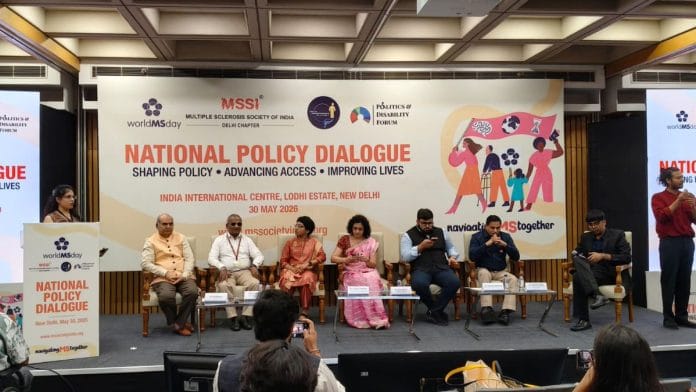


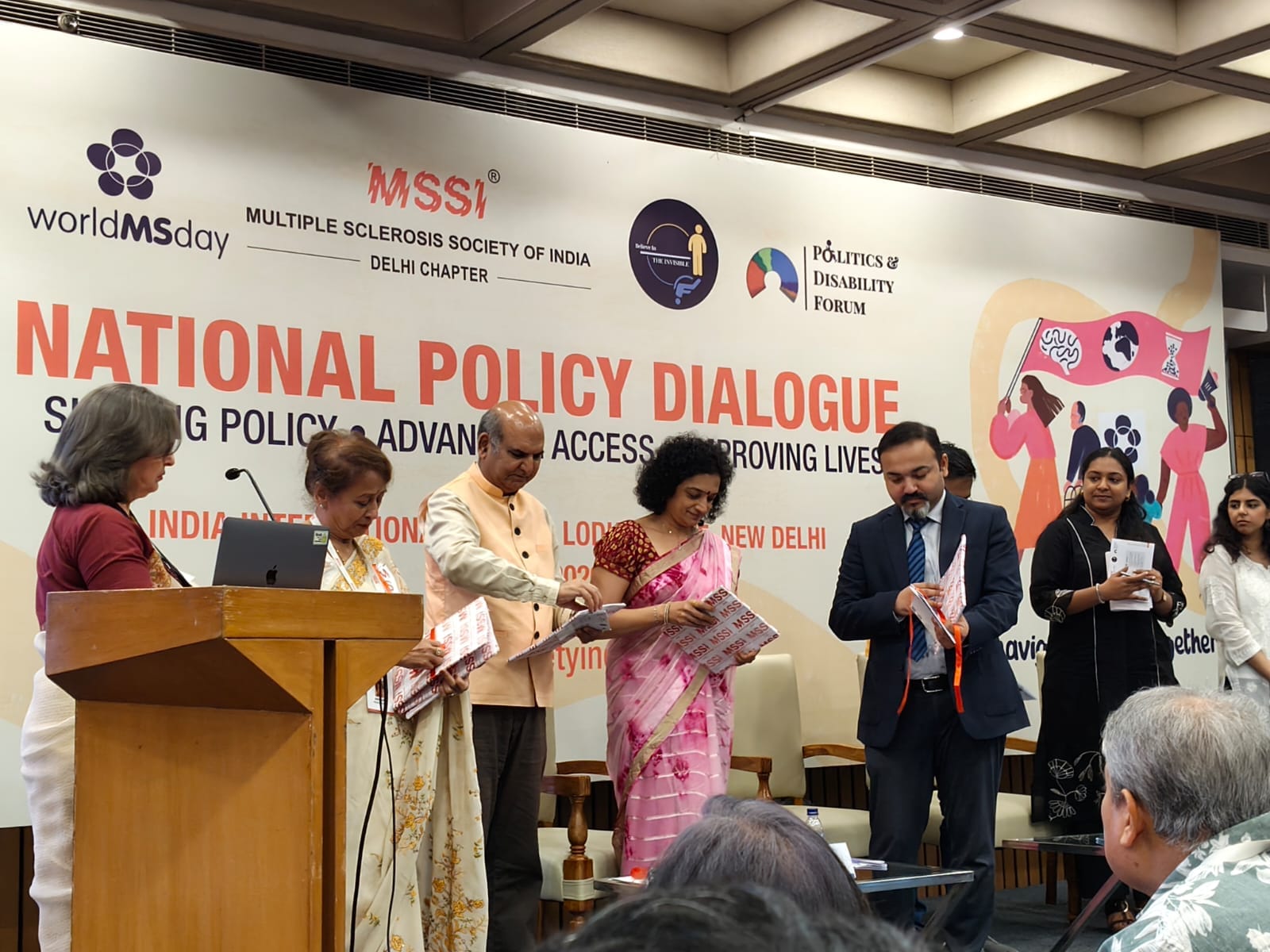
New Delhi: Launching the “Declaration on Invisible Disabilities and Gender” Saturday, the Multiple Sclerosis Society of India (MSSI), in collaboration with Politics and Disability Forum, and Believe in The Invisible, presented a roadmap to strengthen the implementation of the Rights of Person with Disabilities (RPwD) Act, 2016. The declaration is aimed at inclusion of invisible neurological conditions, such as multiple sclerosis, in India’s healthcare, disability and welfare systems.
Seeking to expand India’s disability rights framework—which has evolved from the Persons with Disabilities Act, 1995 to the broader RPwD Act—the declaration includes recommended guidelines for inclusion of invisible and episodic disabilities under the 2016 law, flexible disability certification for people with fluctuating conditions, inclusive workplace policies for invisible disabilities, and a National Mission for Invisible Disabilities, among other proposals.
The proposal was a key outcome of the day-long National Policy Dialogue organised Saturday by the MSSI on the occasion of World MS Day—observed on 30 May every year—at the India International Centre in New Delhi. The theme for this year’s event was “Shaping Policy, Advancing Access, and Improving Lives”.
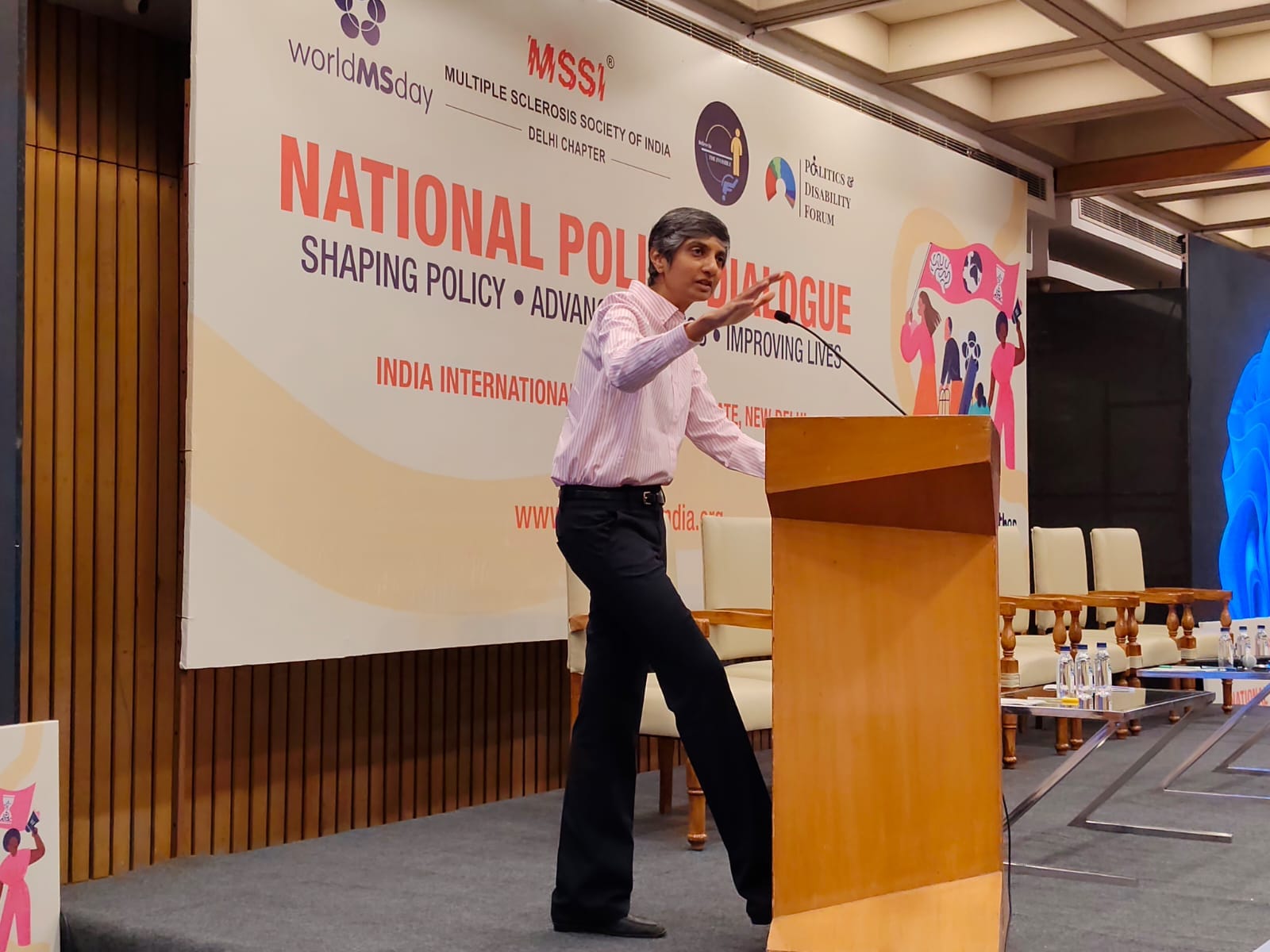
Delivering the keynote address, Rajya Sabha MP Dr Menaka Guruswamy noted that the Constitution of India imposes an obligation on people to recognise the inherent dignity of any individual, including people with disabilities. She stressed the importance of dialogues, such as the one organised by MSSI, to deepen public understanding of conditions like multiple sclerosis, and the realities of people living with disabilities.
Additionally, Dr R.K. Dhamija, Director of Institute of Human Behaviour and Allied Sciences (IHBAS), Delhi, and other noted doctors, advocates, and policy professionals shared their insights on the unique challenges that debilitating conditions like multiple sclerosis pose, and how the healthcare ecosystem in the country could evolve to better address them.
The sessions at the event were a deep dive into several subjects, such as doctor-patient narratives, invisible disabilities and digital healthcare in MS management. Persons living with multiple sclerosis, too, shared their experiences of navigating the challenging condition.
Doctors at the dialogue noted that India has over 2 lakh MS patients. However, the condition still remains highly undiagnosed, with lack of awareness and stigma playing a part. It mostly affects young adults aged 20-40, particularly women.
Also Read: Gaining weight, losing health: National survey finds India trapped between obesity & undernutrition
Exorbitant costs, no insurance
“Just to tell you, the range of the total cost of living of a person with MS in India could be anywhere between Rs 18 lakh to Rs 32 lakh per annum. Let this figure sink in,” noted Renuka Malaker, MSSI’s National Treasurer, in a session on “Cost of Living with MS and Insurance Access”.
“The cost of living with the condition in India could be anywhere between Rs 8 lakh to Rs 15 lakh per year. Disease modifying therapies (DMT) or treatments could cost an added Rs 6 lakh to Rs 10 lakh per year. Annual Magnetic Resonance Imaging (MRI) scans, rehabilitation and other expenses of management of MS symptoms could be Rs 2 lakh to Rs 3 lakh. Indirect costs like caregiver burnout, mental health condition of caregivers, and all other added problems could be anywhere between Rs 2 lakh to Rs 4 lakh,” she explained.
Making the problem worse is the lack of insurance access. In 2024, MSSI ran an online campaign called ‘Insure My MS’ to raise awareness about the gaps in insurance coverage for a person with the condition. “In a quick survey, we got respondents saying 68 percent of them did not have insurance. Of those insured, only 23 percent got DMT claims. And 60 percent of our respondents had to discontinue treatment of MS because of the cost,” Malaker noted. “When this happens, relapse rates double, disease progress is accelerated, and so is the degree of disability.”
Dr Nonita Gangwani, assistant professor at University College of Medical Science and Guru Teg Bahadur Hospital—who is herself a person living with MS—said, “If you are spending more than 20 percent of the total family income on your health, it is called catastrophic health expenditure. When we talk about MS, the amount spent by the total family is far more than that.”
An ‘invisible’ disease
Multiple Sclerosis, or MS, is a chronic autoimmune disease in which a person’s immune system attacks the central nervous system, resulting in damage to the myelin—the protective coating of nerve fibers. This causes an “interruption” in signaling between the brain and spinal cord, and the rest of the person’s body, resulting in symptoms like vision loss, fatigue, muscle weakness and a host of other issues.
“There is no ‘one look’ to MS,” explained Dr Manjari Tripathi, head of Neurosciences at All India Institute for Medical Sciences (AIIMS), Delhi. “The body map of where you experience your symptoms differs for each person living with MS.”
Thus, while for one patient poor balance and gait issues could be the biggest hurdle, cognitive symptoms, like brain fog or memory issues, make everyday tasks a hassle for another.
A massive challenge for MS patients is to communicate to the rest of the world that there is a problem. The “invisibility of MS symptoms” mean that on several days, the world around just cannot fathom why you are not functioning at your optimum, said Arnab Bose, an academic and a person living with MS. “That affects employment opportunities. Very often, you are told not to tell anyone about your condition.”
The dialogue, however, concluded on a note of optimism. “With this declaration, we hope to achieve a more inclusive framework for people with MS and similar conditions before the RPwD Act completes 10 years later this year,” Shashank Pandey from the Politics and Disability Forum told ThePrint. “We will follow this up with regular liaison with the government and the Parliament.”