







New Delhi: Patients in northern and northeastern states incur the highest personal expenses for government hospital admissions, while southern and border states spend most in private hospitals, according to a government survey released last week.
The Household Social Consumption: Health survey, part of the 80th round of the National Sample Survey (NSS), shows that Nagaland, Manipur, Himachal Pradesh, Punjab and Uttar Pradesh logged the highest out-of-pocket expenses in government hospitals, while Tamil Nadu, Telangana and Jammu and Kashmir spent the most on private hospitalisation.
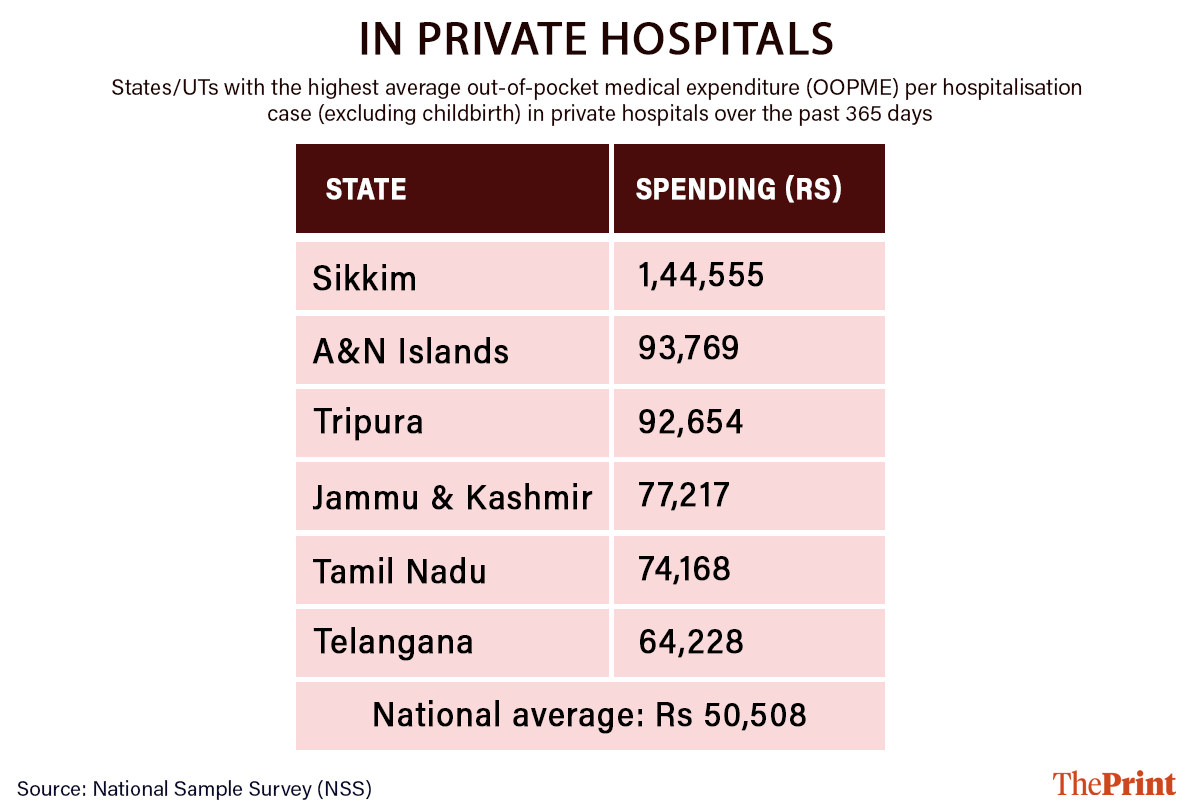
The survey also found that in the private sector, people in states and Union territories like Sikkim, Jammu & Kashmir, Andaman and Nicobar Islands, and Tripura rank among the highest spenders per hospitalisation case.
Released on 20 April 2026, the survey was conducted between January and December 2025, and is the eighth such full-scale health survey conducted since the country’s primary nationwide socio-economic data collection programme began tracking morbidity in the 1950s. It covers 139,732 households across rural and urban India.
In healthcare, out-of-pocket expenditure (OOPE) refers to what a patient or their family pays directly at the time of receiving care. This may include money spent on medicines, diagnostics, surgeon fees and consumables such as gloves or syringes—without reimbursement from the government or an insurance provider.
Dr Dileep Mavalankar, former director of the Indian Institute of Public Health in Gandhinagar, Gujarat, explained that even in a public hospital, patients often pay for items the facility does not stock or services it does not fully cover.
“The higher this number, the greater the financial burden on households seeking care,” he said.
Northern, northeastern states spend most in govt hospitals
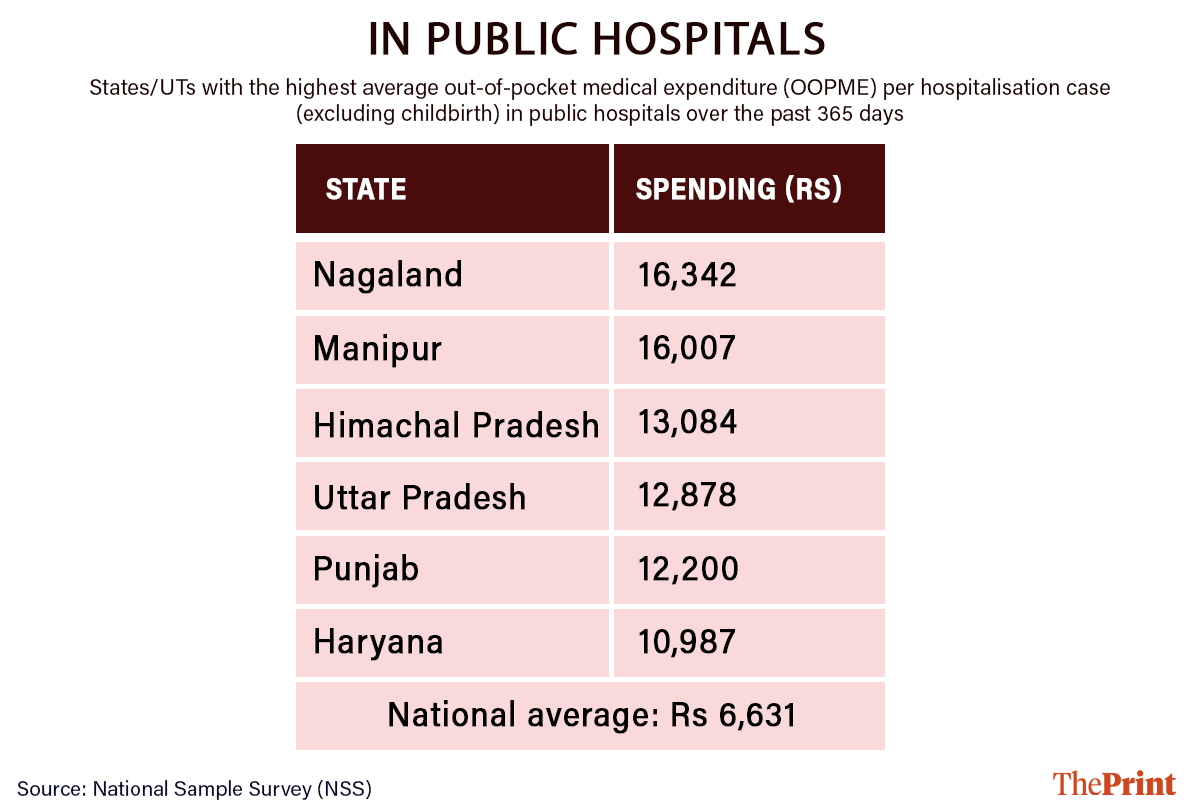
According to the survey, Nagaland and Manipur report the highest average out-of-pocket expenditure per hospitalisation in public hospitals, at Rs 16,342 and Rs 16,007, respectively. Himachal Pradesh at Rs 13,084, Uttar Pradesh at Rs 12,878, Punjab at Rs 12,200 and Haryana at Rs 10,987 follow—all well above the national average of Rs 6,631.
The figures cover combined rural and urban spending per hospitalisation case, excluding childbirth.
According to public health experts, the numbers reflect, in large part, how well or poorly state governments fund their hospital systems.
“If a public hospital is well funded, ideally, a patient should spend almost nothing except travel costs. The hospital should provide medicines, gloves, food, tests and all essential services,” Mavalankar said.
But in states where governments are not spending enough, he said, patients are forced to pay from their own pockets for things that should be covered—medicines, consumables, implants, and other treatment-related expenses.
He added that a state’s wealth does not automatically translate into better-funded hospitals. “The state may be richer, but they may not be giving money to the hospitals,” he added.
Southern, border states spend most in private hospitals
The survey found that in the private sector, Jammu and Kashmir tops the list at Rs 77,217 per hospitalisation, followed by Tamil Nadu at Rs 74,168. Telangana at Rs 64,228 also figures among the highest, all above the national average of Rs 50,508 for private hospitalisation.
K. Srinath Reddy, president of the Public Health Foundation of India, told ThePrint that high costs in Tamil Nadu and Telangana reflect the structure of urban care.
“High private costs in urban-heavy states likely reflect corporate hospital pricing, higher use of specialist and technology-intensive care, and weak regulation of private sector charges,” he said.
Mavalankar pointed to market dynamics, saying that when public hospitals are weak, private providers face no competitive check on pricing.
“If public hospitals are poor, then by force everybody has to go to private hospitals. So, there is no check,” he said.
Sikkim: An outlier at Rs 1.44 lakh per hospitalisation
Sikkim’s average private hospitalisation expenditure of Rs 1,44,555 is nearly three times the national average, the highest in the country by a wide margin.
Reddy said this reflects both statistical and structural factors. “As a small state, survey averages may be skewed by a few high-cost cases,” he said.
He added that limited tertiary care capacity means many complex patients may be referred outside the state, increasing reported expenditure.
“A thin provider market may also reduce competition and increase prices,” he added.
Cost of distance
Andaman and Nicobar Islands at Rs 93,769 and Tripura at Rs 92,654 also show high private hospitalisation costs.
Reddy explained this through what he called the “cost of remoteness”—higher logistics costs for medicines and equipment, specialist shortages, medical evacuation expenses, and small populations that prevent economies of scale.
Mavalankar added that the absence of competition in remote private markets allows providers to set prices unchecked.
“In remote areas, because of a lack of competition, the private sector may be charging more. Ideally, because it is a low-cost economy, the prices should be low,” he said.
Charitable hospitals: Not as affordable as assumed
The survey also reveals that out-of-pocket expenditure at charitable and trust-run hospitals—often assumed to be more affordable than private facilities—is in many states close to, or in some cases higher than, private hospital costs.
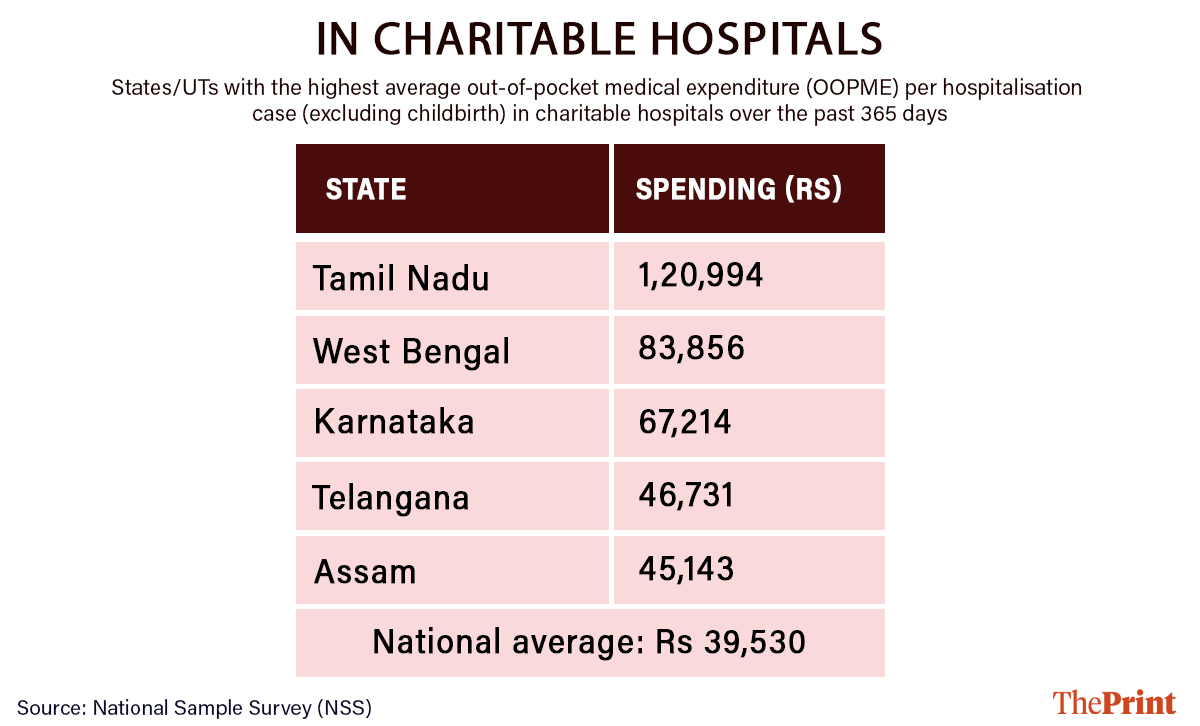
At the national level, the average out-of-pocket expenditure per hospitalisation at charitable hospitals stands at Rs 39,530, compared to Rs 50,508 at private hospitals.
But in several states, the gap narrows sharply. In Tamil Nadu, people spend Rs 1,20,994 per hospitalisation at charitable hospitals, higher than the state’s own private hospital figure of Rs 74,168.
In West Bengal, charitable hospital spending stands at Rs 83,856, and in Karnataka at Rs 67,214, both close to their respective figures for private hospitals.
Dr Anant Bhan, a Bhopal-based public health researcher, said the data challenges a common assumption. “It’s relatively simpler to say that a public hospital is cheaper in terms of out-of-pocket, understandably, than private. But then trust-based or NGO hospitals are not too cheap either,” he said.
The reason, he said, may lie in the fundamental cost structure of running a hospital.
“The NGOs have to generate funds to cover everything. And so maybe the cost that they offer is better than corporate or private for-profit care, but unfortunately, the hit on the pocket of the patient and their families is still significant,” he said. “Almost as much or very close to what is there in the private sector.”
Bhan added that this finding has implications for health policy. “These numbers go against the assumption that care in charitable hospitals is necessarily much more reasonable.”
OOPE is a crucial indicator of the level of financial protection available for healthcare payments.
Limits of data
Both experts, however, cautioned against reading the public and private figures as direct comparisons. Government facilities are subsidised; so lower spending there is structurally expected rather than exceptional.
Mavalankar also noted that the survey does not capture what share of patients in each state use public versus private facilities, which limits interpretation.
“The case mix may be very different in public versus private,” he said, noting that government hospitals tend to handle routine cases while complex procedures migrate to the private sector, pushing private averages higher.
The NSS health survey is the government’s primary source for estimating household medical expenditure and feeds into the National Health Accounts. The previous such survey was conducted in 2017-18.
(Edited by Sugita Katyal)