



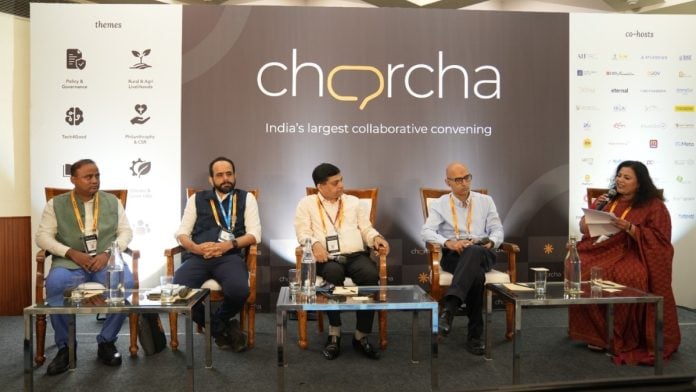
New Delhi: India’s health and livelihood surveys should assess whether poor vision affects people’s ability to read, work or carry out everyday activities, rather than relying solely on clinical measures of blindness and visual impairment, a panel of eye-care experts said Tuesday.
The discussion was part of a charcha 2026 session titled ‘The Next Frontier: Integrating Vision into India’s Community Health and Livelihood Systems’, at the India Habitat Centre in New Delhi. The experts said surveys should capture “functional vision” — whether a person can perform activities such as reading, sewing, maintaining records or doing their job — alongside clinical assessments.
The distinction is particularly relevant for presbyopia, the age-related loss of the eye’s ability to focus on nearby objects. Presbyopia affects about 1.8 billion people globally, while more than 800 million have near-vision impairment due to uncorrected presbyopia.
While presbyopia has defined clinical criteria, its impact on work and daily life may go unrecorded, pointed out the experts. Someone may not identify themselves as having a “vision problem” even when they struggle to read, sew or perform tasks required for their livelihood, they added.
Dr Praveen Vashist, professor of Community Ophthalmology at the Dr Rajendra Prasad Centre for Ophthalmic Sciences, All India Institute of Medical Sciences (AIIMS), New Delhi, said national surveys have traditionally focused on blindness and distance vision.
“When I was the principal investigator in the 2016 national survey, we did not assess the prevalence of near-vision impairment,” he said.
A subsequent nationally representative survey, conducted between 2015 and 2019 and published in 2022, found that 74.2 percent of those examined had uncorrected presbyopia.
Vashist said surveys could instead ask how vision affects people’s daily lives.
According to Dr Mohammed Asheel, National Professional Officer, Injury Prevention, Disability Inclusion, Rehabilitation and Assistive Technology at the World Health Organization, India, this approach would capture people who may not identify themselves as having a vision problem.
“If you ask someone, ‘Do you have a vision problem?’, they may say no. But if you ask them to read something, they may say it is difficult,” he said.
Dr Shalinder Sabherwal, director of public health and projects at Dr Shroff’s Charity Eye Hospital Network, said this illustrates the difference between clinical and “functional” vision.
“What we measure is physiological vision — what a patient is able to see in a clinic. But when you say functional vision, it is basically what people are or are not able to do because of their vision,” he said.
He said screening programmes run by his organisation found that, across age groups above 35, almost one in three people required only a simple intervention for near vision.
Also Read: How much do periods, childbirth, menopause cost? Australian MP pegs it at $100,000
Bringing screening closer to communities
The panel also discussed using existing community health and livelihood networks to identify people with vision difficulties.
Vashist cited a pilot project in which six ASHA workers received two days of training and screened about 8,000 people in seven working days. The programme screened for distance and near vision, identified 5,005 people with refractive errors and referred others for further care.
India has about one million ASHA workers, Vashist said, making the network a potential route for community-level vision screening.
However, Sabherwal cautioned that ASHA workers already have multiple responsibilities and eye screening could consume significant working time. Livelihood organisations with field workers who regularly interact with communities could also be trained, he said.
The need for such an approach is underscored by evidence linking near-vision correction to work. A randomised 2017 trial among rural tea workers in India found that providing reading glasses to workers with presbyopia increased productivity by 21.7 percent, equivalent to about 5.25 kg more tea per worker per day than the control group.
India’s National Programme for Control of Blindness and Visual Impairment, launched in 1976, already provides comprehensive eye-care services, including for refractive errors.
The experts said the next step could be to use existing health, livelihood and development networks to assess whether people can see well enough to work, participate and carry out everyday tasks, and use that information to connect them with appropriate eye care.
charcha 2026 is organised by the*spark forum at the India Habitat Centre. ThePrint is the digital media partner for charcha 2026.
(Edited by Chingkheinganbi Mayengbam)
Also Read: Sweet taste, sour sales—why India’s food industry needs more than voluntary health pledges