








New Delhi: India’s food regulator has told the Supreme Court that it is still working out how warning labels on packaged food should look—simple pictures or tables—even as pressure mounts to roll out this long-pending reform.
In an affidavit filed on 13 March 2026, the Food Safety and Standards Authority of India (FSSAI) said it is considering a tabular or pictorial format to highlight food high in fat, sugar and salt (HFSS) to help consumers make informed choices.
The authority said that it is examining existing recommendations and criteria for HFSS foods to ensure scientific consistency across regulations. The food regulator said it is also considering displaying HFSS-related nutritional information on front-of-pack labels to help consumers make informed choices.
Based on a review of global practices, FSSAI noted that front-of-pack labelling has been introduced in 44 countries, with 16 making it mandatory and others adopting it on a voluntary basis. However, it told the Supreme Court that no single country’s model can be directly replicated in India, given the country’s vast demographic diversity, multiple languages, and varying literacy levels.
The regulator indicated that more consultations are needed before finalising the format. It has also sought an additional six weeks to submit a detailed proposal.
The affidavit follows a 10 February order by the Supreme Court, which urged FSSAI to consider mandating front-of-pack labels on packaged food products. The court said that such labelling could comprise warning labels for high sugar, sodium, or saturated fat. It also suggested a positive front-of-pack logo for healthier products.
After reviewing the earlier compliance affidavit filed by FSSAI, the court had said that it was ‘not satisfied’ and observed, prima facie, that the exercise undertaken so far ‘has not yielded any positive or good result’.
In the latest affidavit, FSSAI has also informed the court of a ‘stakeholder consultation’ on March 19 about the proposed labels to be issued.
The food regulator also stated that based on the outcome of stakeholder consultations, they will prepare a draft amendment regulation. This draft will then be presented to a scientific panel, the Scientific Committee, and the Food Authority before going to the health ministry for consideration.
“After approval of the Ministry of Health and Family Welfare (MoHFW), in case it is again a draft regulation, the same is notified in the gazette for public comments, giving 60 days’ time and entire procedure is repeated before it is finally notified. However, in case it is a final regulation, the same is sent to the Legislative Department in the Ministry of Law for vetting, followed by the approval of the MoHFW. The approved final regulation(s) is then published in the Gazette of India for implementation,” says the affidavit explaining the complete process till final implementation.
Also Read: FSSAI puts brakes on ‘star-rating’ of packaged food, underlines need for more research before SC
HFSS block body’s satiety centre
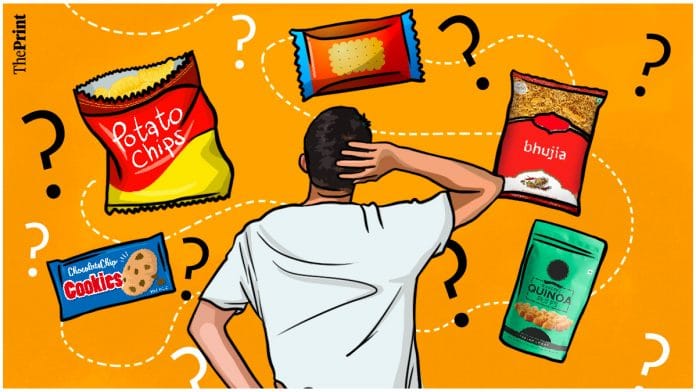
The push for front-of-pack labelling in India has been building for years, driven by concerns over rising consumption of ultra-processed foods such as chips, sugary drinks, instant noodles and packaged snacks that are often high in fat, sugar and salt. “These products are deliberately designed to be addictive and highly appealing to taste. When consumed, they interfere with the body’s satiety centre—the brain’s mechanism that signals when you are full. Unlike regular food, which triggers a sense of fullness, junk food bypasses this system, preventing the brain from registering satiety and leading to overeating,” said Dr Arun Gupta, convenor of Delhi-based think tank Nutrition Advocacy in Public Interest India (NAPi).
At present, food labels in India list nutritional information on the back of packs, but do not clearly warn consumers upfront if a product is high in sugar, salt or fat. Front-of-pack labels are meant to fix this by giving simple, easy-to-understand warnings on the front of the package. The idea has also gained momentum legally. The Supreme Court is hearing a petition seeking mandatory warning labels on all such packaged foods, calling it an important public health intervention.
Earlier attempts to introduce labelling—such as a “health star rating” system—were met with criticism from health groups, who argued that ratings could confuse consumers rather than warn them.
Also Read: FSSAI expert panel reviewing norms that allow 20% carbs in form of sugar in baby foods
Evidence on risk of HFSS
HFSS foods are defined as foods that exceed recommended thresholds for fat, sugar, or salt, according to the Apex Nutrition Research Institute Indian Council of Medical Research-National Institute of Nutrition (ICMR-NIN). They are typically energy-dense, low in micronutrients and fibre, and are linked to increased risk of diseases such as obesity, diabetes, hypertension, and cardiovascular disease.
However, the FSSAI does not have a clear definition of HFSS as of now. The ICMR-NIN Dietary Guidelines for Indians estimate that 56.4 per cent of India’s total disease burden is linked to unhealthy diets, underscoring the growing public health challenge posed by foods high in fat, sugar, and salt.
A 2023 WHO India study also found that retail sales of ultra-processed foods grew at a compound annual growth rate of 13.37 per cent between 2011 and 2021, reflecting rapidly changing dietary patterns. The Economic Survey this year has also recognised ultra-processed foods (UPFs) as a major public health hazard, linking them to rising obesity, diabetes, and heart disease. It recommended strict front-of-pack warning labels, higher taxation, and advertising bans to combat the surging consumption of these nutrient-poor, high-fat/sugar/salt products.
Concerns about delays
NAPi has written to FSSAI raising concerns about holding ‘yet another stakeholder consultation’ on food labelling rules. “The question of front-of-pack labelling has already been the subject of extensive consultations and technical deliberations over several years… Reopening broad stakeholder consultations raises concerns about further delay in implementing a long-pending public health measure,” reads the NAPi letter to FSSAI Chairperson and Union Health Secretary Punya Salila Srivastava.
NAPi said that front-of-pack warning labels—which clearly show if a food is high in fat, sugar or salt—have even been reviewed by the Supreme Court. “We are concerned about the involvement of food industry bodies in designing these labels. This is a potential conflict of interest. Warning about public health, especially those concerning high fat, sugar and salt, should remain out of commercial influence,” Dr Gupta told ThePrint.
In the earlier affidavit, FSSAI had told the Supreme Court that it plans to carry out more research before finalising front-of-pack nutrition labelling. This, it said, includes studying packaged foods, conducting consumer surveys, reviewing global trends, and consulting stakeholders, including industry players.
However, the court, in its February 10 order, noted that such labelling is “internationally prevalent” and directed the authorities to examine the proposal that all pre-packaged foods carry front-of-pack warnings, directing it to submit a report within four weeks.
(Edited by Nardeep Singh Dahiya)
Also Read: FSSAI launches new digital tool allowing consumers to flag misleading claims on food labels