



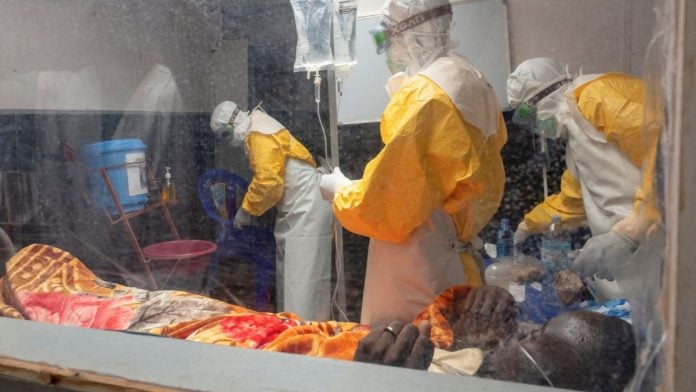
New Delhi: More than five months after an Ebola outbreak in the Democratic Republic of Congo, health authorities are still struggling to identify where the infections are occurring, while conflict, mistrust of medical teams and inadequate access to healthcare make it harder to contain the contagious viral disease.
About 80 percent cases in the country are being detected outside the network of contacts already under surveillance, news agency Associated Press (AP) reported Tuesday. Congo’s health authorities have reported 10,060 confirmed cases and 4,887 deaths till now. The outbreak, declared in May, is the fastest-growing Ebola outbreak on record and the deadliest in Congo’s history.
It has spread to 66 health zones across eight provinces—from just three when the outbreak was first declared—and reached five countries, including Kenya and Nigeria. Uganda and France, which also reported cases, have no active cases at present, AP reported.
Ebola spreads through direct contact with an infected person’s blood or bodily fluids, including those of someone who has died, or contaminated objects. Symptoms include fever, vomiting and diarrhoea, sometimes progressing to bleeding and organ failure. Early symptoms can resemble malaria or typhoid, making prompt diagnosis crucial.
The current outbreak is caused by the Bundibugyo virus. No vaccine is specifically approved against it, and the Ervebo vaccine, licensed for the Zaire strain, has not been shown to protect humans against Bundibugyo.
According to Dr Soumya Swaminathan, former chief scientist at the World Health Organization (WHO), the conflict in the region was making it difficult for responders to stay in touch with affected communities.
“There’s a sort of civil war going on there, and that is the main impediment to finding cases. People cannot stay where they are. Today they are there, and tomorrow they have fled because they are running for their lives. As a result, many contacts are being missed, and that is spreading the infection,” she told ThePrint.
Constant conflict between the Congolese army and other armed groups in eastern Congo has displaced communities and hampered healthcare access and Ebola containment.
Dr Swaminathan also flagged the risk that patients with milder symptoms were going undiagnosed, particularly where testing capacity was limited. “In the beginning the diagnostics was also an issue. The Bundibugyo strain was not available. Now it has been made available, but we are not sure if all facilities have it, or if it is available in a couple of places at the epicentre,” she said.
Dr Gautam Menon, Professor of Biology and Physics at Ashoka University, said that early diagnostic efforts had been geared towards the wrong species. “The initial spread was masked by testing which was later found to be inappropriate to this virus, since it tested for Zaire ebolavirus, not the Bundibugyo species. It is currently likely that many cases are being missed, so that people reach care only later,” he said.
On 16 September, WHO Director-General Tedros Adhanom Ghebreyesus said weekly Ebola cases in North Kivu province had doubled in two weeks. “The area is so vast that it’s hard to speak of a single epidemic,” he said, warning that “the epidemic continues to grow and continues to kill”.
Also Read: DGHS flags reuse of single-use medical devices, warns of infection risks and possible overcharging
Why Ebola keeps escaping detection
The outbreak is unfolding in areas where armed conflict, poor roads and limited healthcare access have complicated the response. Overwhelmed treatment centres, community distrust and strikes over unpaid wages have further disrupted the response.
Health workers are struggling to reach some communities, persuade people to report symptoms and ensure that suspected patients are taken to treatment centres.
The violence has continued despite the outbreak being under way for months. On Saturday, a nurse was killed and another health worker seriously injured while responding to an Ebola alert in Tshopo province, the Associated Press reported.
Dr Swaminathan said community hesitancy and the conditions health workers face were adding to the difficulty. “In the beginning there was no Personal Protective Equipment (PPE) even for these people. It is a very difficult place,” she said. “A lot of poverty and migration is also there. So it’s all the wrong things in one place.”
She added that no amount of outside support from WHO and others could easily make up for weak local capacity, and described the local situation as one that “requires peace”, which she called “the political solution”.
The high proportion of deaths outside treatment centres is another indication that patients are not being identified and brought into care early enough. In many cases, the first opportunity to detect an infection may come only after the patient has become severely ill or died, by which point family members and caregivers may already have been exposed.
Dr Menon listed late presentation, deaths at home, no specific treatment, and a weak, conflict-hit health system as contributing factors. He also pointed to the weakening of public-health surveillance capacity before the outbreak.
US aid to Congo fell from $1.4 billion in 2024 to $451 million in 2025.
He said, “Cutbacks in US funding has certainly been a major obstacle,” arguing that the reduction had weakened surveillance and contributed to the outbreak’s rapid escalation. “Given the many conflicts around the world, the Ebola outbreak is not attracting as much attention as it should.”
Consequences extend beyond Ebola
AP reported that maternal mortality has doubled in some provinces as pregnant women avoid hospitals for fear of infection or isolation. Routine childhood vaccination, schooling and the response to other diseases, including cholera, have also been disrupted.
There have nevertheless been signs of progress. At least 2,600 patients in Congo have recovered, AP reported.
No approved vaccine, but trial has begun
Ebola is caused by several related viruses, including the Zaire, Sudan and Bundibugyo viruses responsible for different outbreaks. Fruit bats are considered a possible natural host.
Symptoms can appear two to 21 days after exposure, beginning with fever, fatigue, muscle pain, headache and sore throat.
WHO estimates the average fatality rate across Ebola outbreaks at about 50 per cent.
Dr Swaminathan said Bundibugyo appeared less lethal than the Zaire strain, which has had fatality rates of 70-80 percent in some outbreaks. Intensive care could reduce deaths significantly, she said, but such facilities are scarce in affected parts of Congo.
There is no licensed vaccine specifically for Bundibugyo or approved virus-specific treatment. Patients receive supportive care, including fluids and treatment for complications.
The TUMAINI trial, launched in Bunia on 23 October, is evaluating vaccine candidates. The first is Ervebo, licensed against the Zaire strain, whose protection against Bundibugyo remains unproven in humans. Candidates developed specifically for Bundibugyo by Oxford, in collaboration with the Serum Institute of India, and Moderna are also expected to enter the trial.
“The vaccine trial has just started. Obviously it’s going to take several months for the results to come. But they have to accrue enough cases. So that’s going to take a while,” Dr Swaminathan said.
Dr Menon said Oxford’s candidate was still in Phase 1, which assesses safety and immune response rather than protection. “Even on the fastest timelines, these vaccines would not be ready for deployment within the next 6-9 months, which is worrying,” he said.
(Edited by Nardeep Singh Dahiya)
Also Read: A daily pill to fight breast cancer? Swiss firm’s new drug completes 3 phases of human trials