





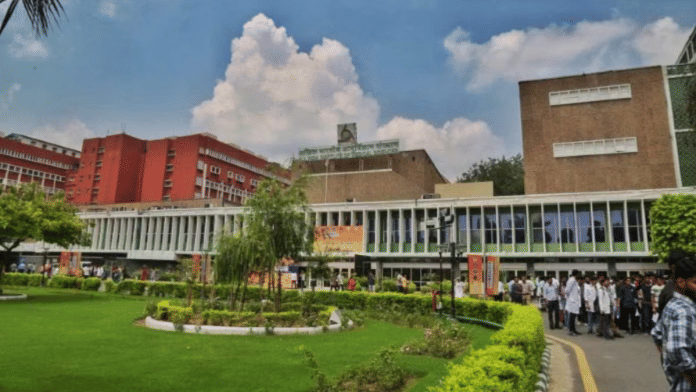


New Delhi: When Dr Shiv Kumar Choudhary opted for voluntary retirement from the All India Institute of Medical Sciences (AIIMS) New Delhi in 2024, he still had some years to go at India’s most prestigious public medical institution.
But in a move that surprised many, he chose to walk away from his post as Head of the Department of Cardiothoracic and Vascular Surgery (CTVS) after 27 years at the institute.
Dr Choudhary, now at Fortis Escorts Heart Institute in Okhla, New Delhi, said one reason why he and many others decided to leave AIIMS was what they believed was a rupture in institutional hierarchy.
“An institution runs on a particular order of seniority,” he said. “When a new director was appointed, who was much younger than many senior doctors, who had spent their lives at AIIMS, it never settled well.”
In September 2022, Dr M. Srinivas replaced Dr Randeep Guleria to become the youngest director in the institute’s history. Dr Srinivas later moved to NITI Aayog as a member and was replaced by an interim director Dr Nikhil Tandon.
At one time, getting a job at AIIMS New Delhi was every doctor’s dream. And people rarely wanted to leave. But in the past three years, Dr Chaudhary is not the only senior faculty to leave AIIMS Delhi. Between 2023 and 2025, as many as 15 senior faculty who were well into their careers, including HODs and professors, took voluntary retirement, with at least 13 of them joining private hospitals.
Among them were some of the most decorated department heads the institution had produced.
Dr Rajesh Malhotra, HOD of Orthopaedics, left in June 2023 after 31 years. Dr M.V. Padma, HOD of Neurology and chief of the Neurosciences Centre, left in October 2023 after 30 years.
Dr Balram Bhargava, HOD of Cardiology and chief of the Cardiothoracic Centre, left in April 2024 after over 31 years, while Dr S.V.S. Deo, HOD of Surgical Oncology, followed in February 2024 after nearly 29 years.
All cited “personal” as the reason in their official paperwork.
A senior doctor who retired from AIIMS told ThePrint, on condition of anonymity, that several doctors who left had between two and four years of service remaining. At least four had more than three years of service left.
ThePrint spoke to over a dozen doctors who resigned, took voluntary retirement, or are currently serving at AIIMS New Delhi, to understand the reason for the growing faculty exits.
Most of the doctors cited similar reasons for stepping away: bureaucratic hurdles, poor career progression, leadership constraints and, above all, an administrative overload that was cutting into their medical work.
Some pointed to bureaucratic dysfunction, like broken procurement chains and endless tender files that ate into time meant for patients and research.
Others spoke of a leadership structure that offered no room to grow. Still others pointed to the growing gap between what AIIMS pays and what a corporate hospital will offer a doctor with the institute’s name on their CV.
But running through nearly every account was the same underlying frustration: the institution keeps asking more of its doctors, while offering them steadily less.
Dr Milind Padmakar Hote, a professor in the cardiothoracic surgery department, said he opted for voluntary retirement in 2024, years before he was due to retire, because of growing frustration over the year due to procurement delays, cancelled surgeries and long hours of administrative work. He now works at Fortis Escorts Heart Institute in Okhla, New Delhi.
Cardiac surgeries were cancelled five to six days every month, and patients, including small children, were moved to waiting lists extending up to 15 months, said Dr Hote, who joined AIIMS as a student in 1999.
“About five percent of patients on the waiting list died before their surgery date… including small children. It was not just frustrating. It was causing me guilt,” Dr Hote told ThePrint.
“Moreover, around 60 percent of my working hours were spent on tender files and administrative disputes,” he told ThePrint. “I am supposed to attend to patients and operate. Why should I be doing this?”
To add to his frustration, the Make-in-India mandate barred international brands from bidding on tenders for certain critical items, which he said was creating problems. “We were having small problems in the OT because we were not using the best products.”
A senior doctor who worked at AIIMS for over 25 years before taking voluntary retirement around two-and-a-half years before she was due to retire said many senior doctors began feeling increasingly constrained by rising administrative interference.
“AIIMS is a place where everybody dreams of working. It was my first home,” she said. “I used to work 12-13 hours every day without a break, and enjoyed it. I started several initiatives there… and the work itself was deeply fulfilling.”
“Nobody wants to spend time doing useless work. When you have autonomy, your quality of work improves. But there came a time when it became depressing…. There was too much interference from the administration,” she added.
Many senior doctors, she said, were irked by an administration which increasingly required senior faculty to spend time preparing procurement documents, handling tender processes and resolving administrative disputes, often at the expense of clinical and research work.
She said her decision wasn’t driven by money and if money had been the deciding factor, many doctors would have left far earlier in their careers.
Also Read: An ultrasound a day from a doctor far far away: How AIIMS Delhi reached India’s Antarctic station
A rich legacy
AIIMS New Delhi was established in 1956 to provide Indian students with access to world-class postgraduate medical education without leaving the country.
In the years after Independence, India saw its best medical students leave for Britain and the United States. The Bhore Committee of 1943, also known as the Health Survey and Development Committee, had already flagged in its report the need for a premier institution that would train medical educators, not just practitioners, and retain the country’s brightest minds.
The idea was strongly pushed forward by Rajkumari Amrit Kaur, independent India’s first Health Minister, who introduced the AIIMS bill in Parliament on 18 February 1956. The bill was passed, the Act was notified, and AIIMS New Delhi came into existence.
Kaur herself became the institute’s first president in 1957. She aimed to give Indian students access to world-class postgraduate medical education without having to leave the country.
What emerged over the following decades was something that outgrew its original brief. AIIMS New Delhi became an ‘institute of national importance’, operating on four pillars — medical education, research, patient care, and governance.
It trained the doctors who trained the next generation. It built departments that did not exist elsewhere in India. It took patients that no one else could treat.
Dr A.B. Dey, widely regarded as the pioneer of geriatric medicine in India, joined in 1982 as a senior resident and spent 38 years at the institute before retiring in 2020. Today, he remembers the early days for the rigorous academic culture, proximity and the influence of its senior faculty.
“Every HOD would come and attend the clinical presentations on Tuesday afternoons and ask questions,” he recalled. “I had to present in front of the giants of Indian medicine.”
The heads of department were among the most distinguished and experienced doctors in the country, and their presence at these sessions carried considerable weight. For residents, being questioned by such eminent faculty members was often an intimidating experience.
The names Dr Dey recalled from those years read like a roll call of the legends of Indian medicine.
The institute had Dr P.N. Tandon, who founded the neurosurgery department at AIIMS from scratch in March 1965 with only two faculty members and a few beds, and trained generations of neurosurgeons who went on to head departments across the country. He eventually became President of the Indian National Science Academy, receiving both the Padma Shri and the Padma Bhushan.
Alongside him were Prof A.K. Banerji, who helped build the department’s postgraduate training programme; Prof Madan Lal Bhatia, who headed the Department of Cardiology and received the BC Roy Award, the highest honour in Indian medicine; Dr M.M.S. Ahuja, who joined AIIMS in 1958, became the first head of its Department of Endocrinology and Metabolism, founded the Research Society for the Study of Diabetes in India in 1972, and received the Padma Shri.
“Who can forget these legends,” Dr Dey said.
Losing doctors fast
Today, the exodus isn’t limited to HODs.
Between April 2018 and July last year, 58 doctors at the assistant, associate, and additional professor level resigned from AIIMS New Delhi.
Of the 58 who quit, 11 joined AIIMS in other cities, 10 joined other government medical institutes, like the Institute of Human Behaviour & Allied Sciences (IHBAS) New Delhi or PGI Chandigarh. The rest cited “personal reasons”.
Today, the institute has been losing doctors faster than it can replace them. The numbers from the Parliamentary Standing Committee’s March 2026 report on the working of AIIMS New Delhi make the scale of the problem hard to ignore. The committee recorded 452 vacant faculty posts out of 1,306 sanctioned—a shortage of 35 percent.
The parliamentary panel recommended a time-bound recruitment process, a fast-track drive to fill at least 85 percent of sanctioned faculty positions, a gradual reduction in dependence on contractual appointments, and retention incentives for specialists working in hard-to-fill disciplines.
Dr Sanjay Kumar Agarwal, who headed the AIIMS nephrology department from 2007 until September 2023 and spent 38 years at AIIMS, offered the starkest long-term assessment of what this steady brain drain means.
“The breed of doctors who stayed for 30 or 40 years—you will not see that again,” he said. “Now only about 30 percent of people who join as assistant professors will stay long enough to become head of department. That number was 100 percent when I joined. This is more so for doctors in clinical departments, who are in high demand by corporate hospitals.”
Rapid growth of private healthcare
Not every departure was driven by frustration. For some, it was arithmetic, and the private sector had made that arithmetic increasingly hard to ignore.
India’s private healthcare industry has grown at a pace that has fundamentally altered the landscape for medical talent. The Indian private healthcare market size reached $122.6 billion in 2025 and is expected to reach $197.8 billion by 2034, according to industry estimates.
Major listed hospitals in India—such as Apollo, Fortis, and Max—are expected to add around 10,000-12,000 beds over the next three to five years, representing 8-9 percent year-on-year growth, according to a March 2025 report by credit rating agency CareEdge Ratings.
As a result, the salaries on offer, particularly for heads of department and senior consultants, have grown to levels that government institutions, bound by pay commission structures, structurally cannot match.
A mid-level radiologist currently working at AIIMS told ThePrint that he could earn Rs 5-10 lakh monthly in the private sector. At AIIMS, he said, he wasn’t getting even one-tenth of that.
The Parliamentary Standing Committee’s March 2026 report also recorded high attrition at AIIMS driven in part by salaries that cannot compete with the private sector.
The report noted that a new cardiologist at AIIMS earns roughly Rs 1 lakh a month in government service against Rs 4 to 5 lakh in a private hospital.
The reason, the committee said, is a government-imposed salary cap that prevents super-specialists like cardiologists, nephrologists and endocrinologists from being paid more than a chief secretary, regardless of their seniority or scarcity.
“If the government wishes to run super-speciality centres in AIIMS or all over the country,” the committee recommended, “the government should remove the pay barrier cap and raise the pay scale of doctors for their assured retention.”
“If a member of Parliament can be paid more than a Chief Secretary, why cannot a doctor?” the committee remarked.
Dr Agarwal left AIIMS in 2023, just 15 days before his official retirement, not through VRS, but for a personal reason.
He was careful to note that his own exit does not fit the broader pattern. But he was clear that for many of his peers, leaving early is not driven by frustration alone. It was indeed also a calculated financial move.
“Once you retire completely at 65, you are at the receiving end,” he said. “The corporate sector offers you a lower package. But if you leave while you are still heading a department, you are in a much better position to bargain.”
Rotational leadership
The governance debate regarding a rotatory versus permanent headship model in the departments remains a critical talking point across India’s premier medical institutions.
While major central universities, Delhi government medical colleges, and leading autonomous bodies like Banaras Hindu University (BHU), NIMHANS, CMC Vellore, and JIPMER Puducherry have fully integrated rotational leadership, AIIMS New Delhi and PGIMER Chandigarh remain the sole exceptions where its implementation is still pending.
Currently, these two premier institutes are operating under an interim collegium system.
Ordered by the Union Health Ministry in May 2023, based on recommendations from a high-level committee chaired by Dr V.K. Paul, this temporary set-up distributes departmental administrative decisions among senior professors.
However, unsatisfied with this halfway measure, faculty associations continue to organise protest demonstrations to demand a definitive, permanent shift to a true rotatory headship system.
“No steps have been taken for implementation yet. There are departments where the head has not changed in 18 years,” said Dr Amrinder Singh, assistant professor in the Department of Cardiovascular Radiology & Endovascular Intervention at AIIMS.
He has written to the prime minister, the President, the health minister, and the health secretary on the issue. “The number two and number three have no path forward. They will never become head of department, never become director. So they leave,” he told ThePrint.
He added that without rotation, HODs acquire unchecked authority over equipment procurement, conference approvals, and the direction of entire departments.
A senior official, who left AIIMS in 2016, said that the issues went beyond administrative burden and procurement frustration. In his assessment, money drove only about 10 percent of departures.
The real reason was internal departmental politics—a world of lobbies and counter-lobbies.
The consequences of all this have a cascading effect, Dr Singh said. Junior faculty see a ceiling above them and leave early, often citing “personal reasons” in their official paperwork before turning up at private hospitals or other AIIMS campuses.
He explained that doctors work in academic medical institutions for a combination of reasons, which are research, education, and patient care.
However, when they feel that opportunities for leadership positions such as department headships or directorships are limited, or when there is excessive control over academic freedom, some begin to reconsider their path.
“Over time, many senior doctors who have achieved a certain level of academic excellence and training may find the private sector more lucrative and professionally fulfilling, and, therefore, choose to move out.”
ThePrint reached out to the AIIMS administration with a detailed list of questions about faculty attrition, procurement failures, pay disparities, and the long-pending rotational headship reform. Medical Superintendent Dr Nirupam Madaan declined to comment.
Interim Director Dr Nikhil Tandon and Additional Director (Administration) Anshul Mishra also didn’t respond to email queries. This report will be updated if a response is received.
ThePrint also reached out to the Union Health Ministry with a detailed list of questions about faculty attrition at AIIMS New Delhi, concerns about procurement systems, the long-pending rotational headship reform, the widening pay gap between government and private sector doctors, the faculty deficit flagged by a Parliamentary Standing Committee in March 2026, and what is being done to implement the committee recommendations.
The ministry has not responded. This report will be updated if a response is received.
Also Read: The new face of AIIMS: India’s first face transplant programme and how it can change lives
The price of prestige
Beyond departmental friction, there was a structural financial problem.
AIIMS sits in one of the most expensive parts of South Delhi, and assistant professors’ salaries are not enough to comfortably afford decent housing nearby, where they can live with their families. Government quarters exist on campus, but come with a waiting list of at least a year.
The Parliamentary Standing Committee’s March 2026 report put numbers to what doctors had long felt. Of more than 850 faculty members, only around 250 had been provided campus accommodation—less than 30 percent.
Less than four percent of nursing staff and under 10 percent of other employees had been housed on campus. The redevelopment of residential colonies in West Ansari Nagar and Ayur Vigyan Nagar, meant to address this issue, has been held up by land-use restrictions and procedural delays for years.
The committee called the situation unsustainable, warning that the housing shortage was not merely a matter of comfort but was actively undermining the institution’s model of immersive medical training and its capacity to handle night-time emergencies.
For one of the doctors quoted above, the arithmetic was simple and defeating.
“Most doctors get married till the time they become professors. If you’re living outside—say a 2BHK with family—that’s a minimum of Rs 40,000 in rent, and now it’s even higher,” he said. “If you take a loan to buy property here, it’ll take two lifetimes to pay it off.
The AIIMS tag
Still, what all doctors who leave carry with them is the prestigious AIIMS tag.
One doctor who decided to quit in 2021 after serving for four-and-a-half years at a job most doctors in India spend a career chasing now heads a department at a government medical college in Madhya Pradesh.
Like almost all ex-AIIMS doctors, he too lists AIIMS New Delhi on his CV. “Yes, this is not AIIMS,” he said. “But I am the boss here.”
He joined AIIMS as an assistant professor in 2016, but the coveted position turned into a source of deep professional frustration. He alleged favouritism and internal politics, which began bothering him after a while.
“People work for two to three years…. they feel they are not getting promoted academically. So they get frustrated and leave,” he said.
Citing departmental issues, he eventually put in his papers.
However, what the institute still had to offer him was its name and the prestige.
Others who quit also say the AIIMS name is valuable.
Another doctor joined AIIMS in January 2023 and left eight months later, citing personal reasons. But he said he left with something useful. “If you were at AIIMS, your name itself has a value. You can sell your name—ex-faculty of AIIMS, New Delhi. Then you can bargain with private institutions and corporate hospitals.”
This calculus—join AIIMS, collect the tag, leave—is increasingly defining a large number of mid-career faculty exits at AIIMS.
The power of the AIIMS tag isn’t surprising.
Despite the exodus of senior faculty, the institute continues to serve a massive number of patients who have nowhere else to go. AIIMS New Delhi sees an average Outpatient Department (OPD) footfall of around 15,000 patients a day.
“That idea is still alive,” said Dr Dey.
This is an updated version of the article
(Edited by Sugita Katyal)
Also Read: Doctor exodus & faculty vacancies cripple India’s AIIMS system. What’s causing the crisis
Maybe, India needs Indian medical service to take care of administration at major hospitals. This will ease burden on doctors.
It is pity that scientists and doctors are paid less. that what they deserve. The cap on their salaries should be removed, and the salaries should be increased many folds with assured campus accommodation. Otherwise, we will not have the best talents in our govt labs and hospitals.