



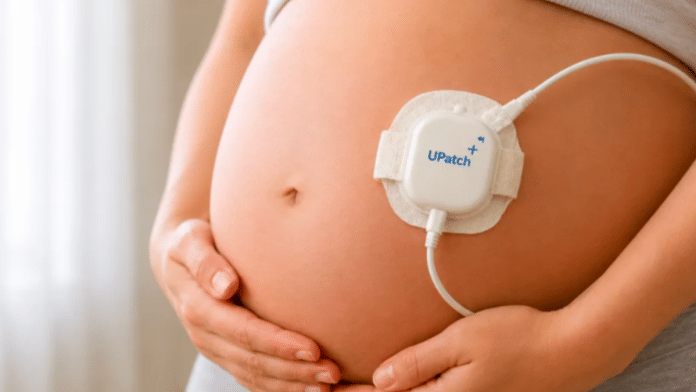

New Delhi: A soft, wearable ultrasound patch that can continuously monitor a fetus’ blood flow and heart rate could transform care for millions of women at risk of complications. Developed by researchers at the University of Oxford and tested in high-risk pregnancies, the device promises to fill a critical gap between hospital visits by giving doctors a real-time window into fetal health, potentially allowing dangerous conditions to be detected before they become emergencies.
In a report published in Nature Biotechnology titled ‘Fetal monitoring for high-risk pregnancies using a wearable ultrasound patch’, on 26 May, 2026, Professor Antoniya Georgieva, senior author and researcher at Oxford’s Nuffield Department of Women’s & Reproductive Health, who led the research into this technology said it “opens the possibility of monitoring the most important signals of fetal health over much longer periods” which “ultimately help clinicians identify problems earlier”.
The device is a soft wearable called UPatch, which sticks to the abdomen of the pregnant woman and uses ultrasound waves continuously to monitor the baby’s anatomy as well as the constant blood flow to the fetus and the mother. This patch automatically tracks blood vessels when the mother or the fetus move.
Unlike conventional ultrasounds, which require trained sonographers and provide only brief snapshots during appointments, UPatch is designed for continuous monitoring. The researchers say it can also help detect problems such as fetus not growing at a normal pace, or growing too big, preeclampsia (sudden, persistent high blood pressure and signs of damage to other organs) or gestational hypertension.
The study was done on two groups of women. One of the groups had 62 women where the study tested if the UPatch device produced results similar to handheld ultrasound machines. The second group of 52 women were monitored continuously to see how the baby’s heart rate and umbilical cord blood flow behaved over time in different pregnancy conditions like healthy pregnancies, preeclampsia or when the baby is small for its age.
During the research, the UPatch noted that one of the participants had high blood pressure due to which her placenta was damaged which restricted the baby’s growth. To prevent any harm to the baby, doctors opted for an emergency Cesarean section to avoid the risk of stillbirth.
Dr Shelly Singh, Director of Obstetrics & Gynaecology at Fortis LaFemme GK II, told ThePrint that UPatch could allow women with high-risk pregnancies to be monitored remotely at home, offering continuous monitoring that may detect warning signs of fetal distress earlier than routine hospital visits.
She further elaborated and said that UPatch offers a “dynamic, continuous monitoring over hours and days” which otherwise is not possible in the current system of monitoring pregnancies.
Current limitations
Around 6 percent to 8 percent births worldwide are classified high-risk, and require close monitoring because complications can develop rapidly and sometimes without obvious warning signs.
In some cases, fetal loss may unfortunately be the first indication that something was medically wrong, with abnormalities only identified afterward through examinations and testing following a miscarriage or stillbirth. Researchers say this shows a major gap in pregnancy care where complications can emerge between routine hospital visits.
Within the current framework for monitoring high-risk pregnancies, there are multiple clinical assessments—such as ultrasound scans, fetal surveillance techniques—which depend on a reading of different conditions which are affecting either the baby or the mother.
Doctors also usually use Doppler ultrasound, which is a non-invasive imaging test that uses high-frequency sound waves to measure the speed and direction of blood flowing through the mother’s blood vessel to check the fetal growth and blood flow through the placenta and umbilical cord. There are also other clinical assessments used for this, which include blood pressure tracking, glucose monitoring in diabetic pregnancies, and fetal movement counting.
Dr Uma Vaidyanathan, Director of Obstetrics and Gynaecology at Fortis Hospital, Shalimar Bagh in Delhi, told ThePrint that they rely heavily on clinical evaluation for high-risk pregnancies, which includes blood pressure trends, urine protein, laboratory tests, fetal movement assessment and maternal symptoms. However, most of these methods provide only periodic assessments, meaning complications can still develop between appointments.
Researchers developed UPatch to address this limitation through continuous monitoring. The soft wearable device attaches to the abdomen of a pregnant woman and uses continuous ultrasound to track the baby’s anatomy, heart rate, and blood flow between the fetus and the mother.
According to researchers, the device will also help detect fetal and maternal distress, which includes conditions like gestational diabetes, fetal growth restriction, gestational hypertension or preeclampsia.
Professor Sheng Xu, senior author of the study and now based at Stanford University, mentioned on the University of Oxford website: “This work shows how advances in soft electronics, ultrasound engineering and clinical science can come together to address one of the most important unmet needs in pregnancy care.”
How UPatch could change pregnancy monitoring
Dr Vidyanathan said: “The ultrasound patch is very interesting as there are (currently) no remote fetal monitoring systems, which can track both the placental and the umbilical blood flow,” she said.
However, she cautioned that the technology is at an early stage. “The real question is whether earlier detection through such devices actually improves maternal and fetal outcomes without increasing unnecessary interventions, false alarms or anxiety. That evidence based on multicentre studies over several patients and years will be critical before this becomes mainstream practice,” Dr Vidyanathan added.
(Edited by Viny Mishra)
Cool use of tech, Innovations like this could make a real difference to maternal and infant mortality in India.”