



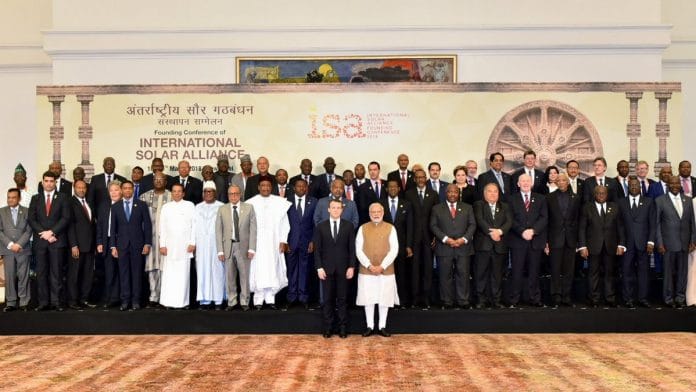
New Delhi: Last month, leaders from 20 European countries gathered in Brussels for a three-day high-level regional meeting of the International Solar Alliance. The grand outcome was a single document on battery recycling guidelines, according to the press release. For India’s first ambitious multilateral climate organisation, such modest outputs seem to have become the norm.
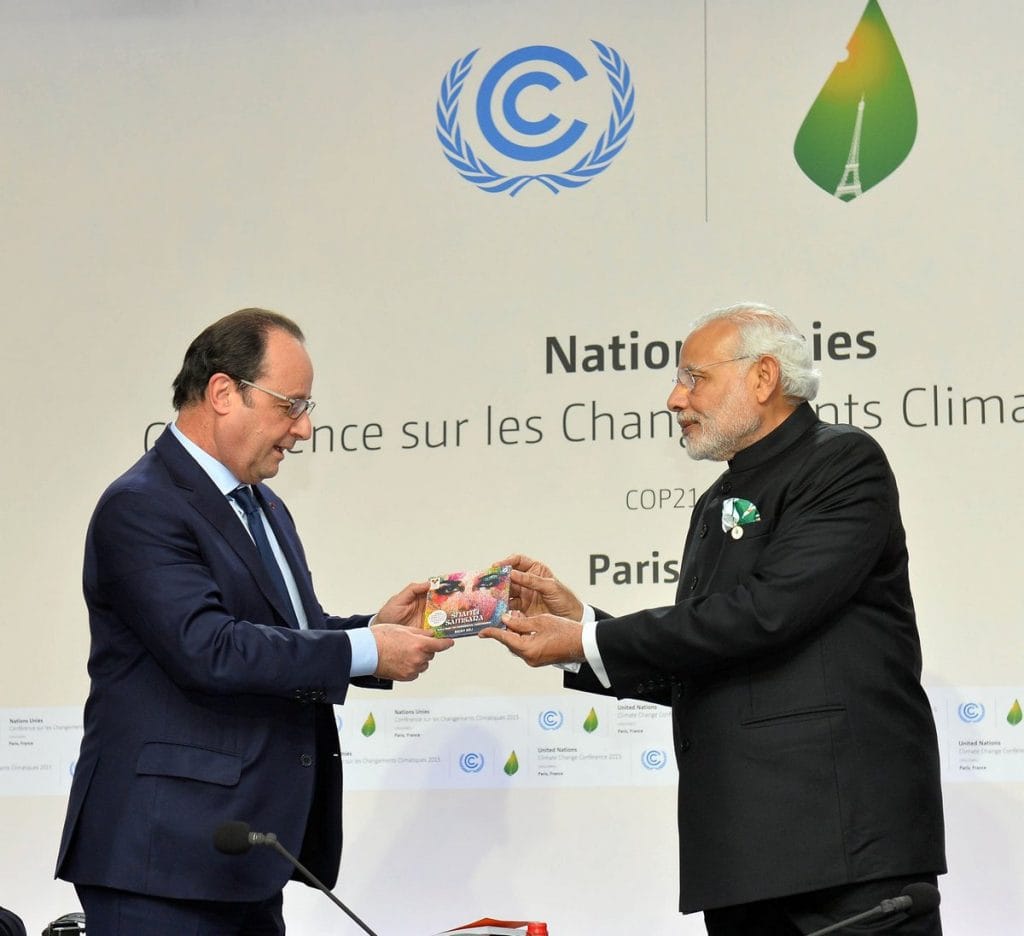
A decade after Prime Minister Narendra Modi and then French President François Hollande launched the International Solar Alliance (ISA) on the sidelines of the United Nations COP in Paris, its role remains largely unclear. Announced with massive fanfare as the first treaty-based global body headquartered in India, the country’s marquee climate vehicle is still mostly powered by New Delhi.
The promise was enormous. ISA vowed to herald the world’s ‘sunshine’ tropical nations into a solar-powered future: $1 trillion of solar investment unlocked by 2030, energy access for 1 billion people, 1,000 GW of new capacity.
Broadly, ISA’s function is to ‘catalyse’ private money for solar projects by putting down small sums of its own to lower the risk.
“There are $1.6 trillion in annual investments in the solar sector worldwide. Our job is to ensure that the countries in Africa and island countries that are not yet seeking the benefits of these solar investments can do so,” said Ashish Khanna, Director General, ISA, in an interview with ThePrint.
But even as the world’s solar energy adoption soars, ISA is struggling to raise the money it had hoped for. It is falling woefully short of its own ambitious imagination and scope. Since 2015, the latest documents show it has mobilised around $20 million for its programmes, from member countries and international organisations.
Solar has two components—usage and manufacturing. The ISA never addresses the second component. How can you have an ISA that ignores China, the father of solar technology?
– Ajay Srivastava, founder of the Global Trade Research Initiative
Beyond securing a seat as a United Nations Observer, its footprint seems limited to a flurry of report launches, global conferences, solar ‘festivals’, and small tech-demonstration projects that leave little sustained impact.
Some of its flagship programmes, such as Solar Technology & Application Resource Centres (STAR-C), have managed to pull in financial support from other member states. But many other ISA ventures are struggling to find their footing.
Despite boasting over 120 member countries and signatories across four continents, its activities are still funded mainly by India’s Ministry of New and Renewable Energy (MNRE). The latest publicly available financial documents show that as of September 2025, member countries other than India had committed $5.6 million for its programmes and activities, of which only $3.9 million had been mobilised.

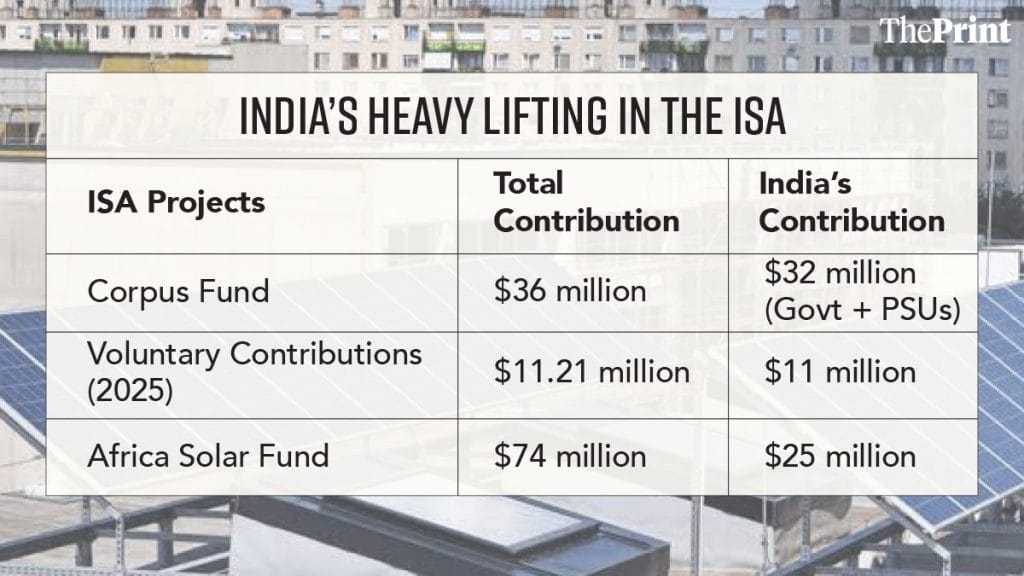
Its flagship ‘catalytic financing’ plan for solar projects in Africa has mobilised only $74 million toward a $200 million target since it was launched in 2024.
But the most conspicuous missing piece is China, which manufactures more than 80 per cent of the world’s solar panels. It is not part of the alliance and is barely mentioned in its key documents. On top of that, the US withdrew from the ISA in January 2026. The alliance is now operating without the world’s two biggest solar powers on board.
“An international ‘solar’ alliance needs to address solar manufacturing too, not just usage,” said Ajay Srivastava, founder of the Global Trade Research Initiative, a think tank focused on climate change, technology, and trade. “How can India lead the ISA if we don’t have any manufacturing capacity?”
Also Read: Does PM-WANI need a reset? India’s public Wi-Fi is everywhere and nowhere
What does ISA do?
The ISA is not a multilateral bank like the Asian Development Bank, nor is it a pure research and advocacy body like the International Renewable Energy Agency (IRENA). It is also not a think tank or a diplomatic grouping.
Headquartered in Gurugram, it started out defining itself as a platform for “solar energy cooperation” for countries falling between the Tropic of Cancer and the Tropic of Capricorn; since 2020, membership has been open to all UN member states. Under this broad umbrella, it wears many hats: publishing analytical reports, training technicians, advising on policy, and providing risk-mitigation finance for solar projects.
In 2024, the ISA codified these services under four strategic pillars— Catalytic Finance Hub, Global Capability Centre & Digitisation, Regional and Country-Level Engagement, and Technology Roadmap & Policy.
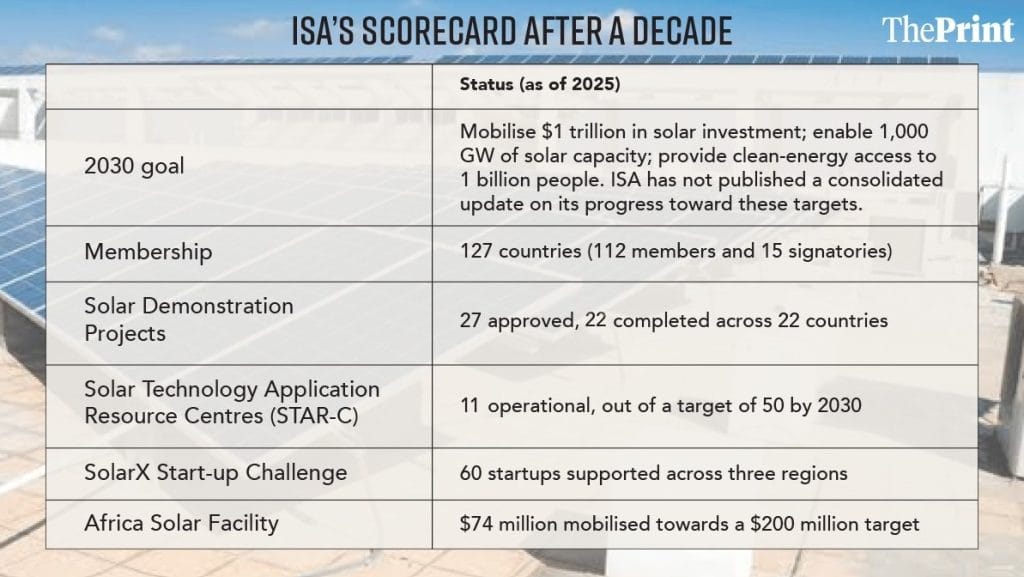
On paper, the scope is impressive. The ISA has more than 125 member and signatory countries, holds observer status at the United Nations, and maintains partnerships with global institutions such as the World Bank. Its mandate stretches from Africa and the Pacific to Latin America and Asia, and it runs ten different programmes, from solar power for agriculture to rooftop solar to solar waste management.
Building on solar-technology demonstration projects across 22 countries, including solarising health centres in Uganda and Burkina Faso and installing water pumps in Togo and Ethiopia, ISA is now convening platforms for aggregation and policy programme implementation. These projects are meant to demonstrate what solar can do across different settings and encourage wider adoption. As of September 2025, it had completed 22 of 27 approved projects.
Some programmes will take off, some will be a bit slow, but unless we increase our ambition on ‘getting things done’, how will we stay relevant?”
– Ashish Khanna, DG of the International Solar Alliance
“I often tell African leaders that India was like you a few decades ago, but now has provided energy access to an additional 300 million Indians and added 150 GW of solar, representing what a successful African Mission 300 would look like,” said Khanna. “Building capability in countries, including helping them with digitisation and AI to help absorb solar, are essential needs that are being filled in by ISA.”
But a closer look at the ISA’s reports over the years shows that most of its projects are still in the early mobilisation phase, and some have yet to be operationalised.
The STAR-C—regional hubs for training government officials, engineers, and technicians on solar products and applications—have been slow to set up. The goal was to set up 50 centres by 2030, but only about 22 per cent of that target has been met, with 11 centres operational in countries such as Bangladesh, Cuba, Kiribati, Bhutan, and Cameroon, and six more in development.
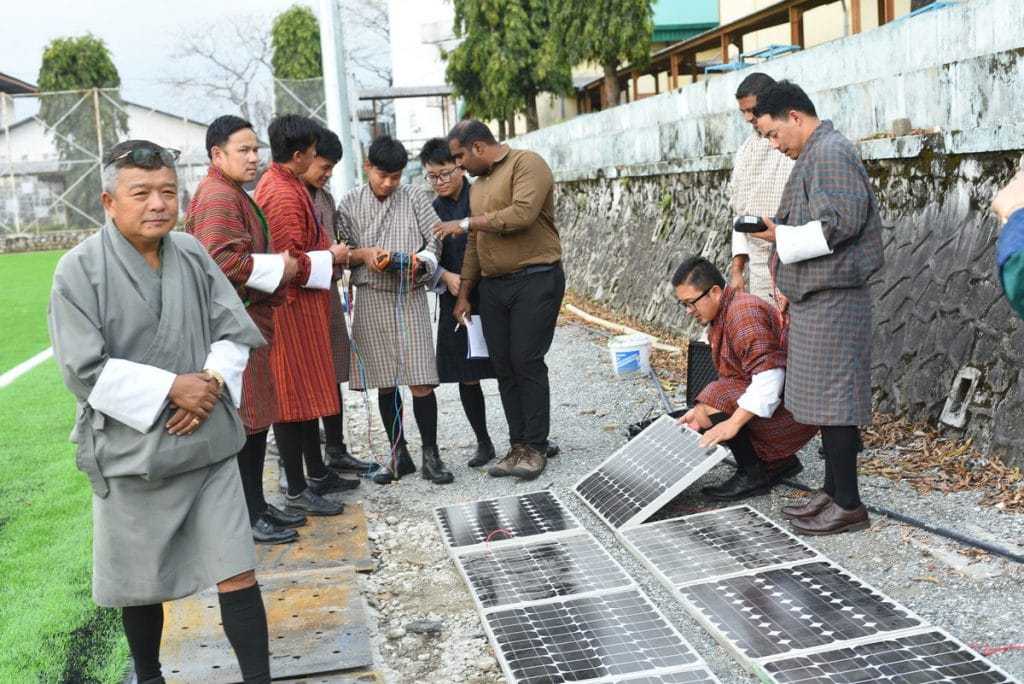
The ISA’s 2024 General Assembly documents show that France and Denmark are the only countries other than India to have provided funding for the programme, contributing $1.06 million and $400,000 respectively.
Another initiative, the Viability Gap Funding scheme introduced in 2021 to support solar projects in Least Developed Countries, was discontinued in 2025, with no funds and no progress made.
Other programmes, such as One Sun, One World, One Grid (OSOWOG)— which aims to connect electricity grids across national borders—are still in their nascent stages and, by Khanna’s own admission, will take decades to take off. As with any transformational endeavour, Khanna says, progress will be gradual, but ISA is working with partners across regions to build the technical, institutional, and financing mechanisms needed to turn ambition into action.
He added that keeping a crowded plate is the best way to make progress.
“Some programmes will take off, some will be a bit slow, but unless we increase our ambition on ‘getting things done’, how will we stay relevant?” he asked.
But lofty goals have never been the ISA’s problem.
Where’s the money?
The ISA’s most measurable impact is meant to come through finance. But India is doing most of the heavy lifting while other member countries pay lip service.
ISA’s 2025 financial documents paint a picture of modest pledges and even more modest disbursals. In total, the Alliance has mobilised $3.94 million from member countries and $17.64 million from international organisations for its programmes.
The US had signed grant agreements worth nearly $1.6 million across two phases, of which about $981,000 had been received by June 2025. Denmark had committed about $1.37 million to the ISA, including for STAR-C centres in Ghana and Tanzania, but only about $922,000 had been received by September 2025. Out of $6 million committed by Bloomberg Philanthropies for various programmes, $2 million was still under discussion.
For the ISA, the ultimate test is whether it can turn this limited public money into massive private investments. Unlike the Asian Development Bank (ADB), the ISA does not fund projects outright. As a ‘catalytic finance hub’, its job is different.
“We’re not a financing institution; we are a catalysing institution. We don’t provide the entire funding for a solar project,” Khanna said. “Instead, we provide the initial seed capital that catalyses the funding from the private sector.”
The ISA’s Global Solar Facility (GSF) is built on that premise. It aims to “catalyse solar investments across the world, starting with Africa’s underserved segments and geographies.” Its plan is to use a $50 million fund to “unlock” $700 million in investment — $200 million for the Africa Solar Facility (ASF) and $500 million for a distributed renewable energy fund in Nigeria.
There’s often a perceived risk of investing in solar projects in developing countries by developed countries and private investors. I say perceived because it isn’t a real risk.
– Ajay Mathur, former DG of ISA
The real problem the GSF is designed to solve is a lack of investor confidence. Private capital avoids developing economies out of fear that projects won’t pay them back.
“There’s often a perceived risk of investing in solar projects in developing countries by developed countries and private investors,” said Ajay Mathur, former DG of ISA. “I say perceived because it isn’t a real risk. The loan repayment rate in Africa is 98 per cent actually.”
The GSF, approved in 2021, attempts to circumvent the risk perception by offering payment guarantees and insurance, so that if a project fails to pay, the private investor is covered. Beyond Africa, the same model is planned for Latin America, the Caribbean, and the Asia-Pacific regions.
“Private is the way to go to increase solar adoption. It is the way India did it. The reason why the private sector isn’t willing to invest is because of the risk, so we decided to mitigate the risk,” added Khanna.
However, the Africa Solar Facility has yet to even start operations.
India has committed $25 million, so has the World Bank, and France has committed $170,000, but contributions from major member countries like Australia, the UK, Germany, and the UAE are, as yet, absent. The other contributors are private organisations such as Bloomberg Philanthropies.
While Brazil, Germany, and Australia all expressed glowing praise for the ASF during the last ISA Assembly in October 2025, they haven’t actually pitched in money.
An India-led show
The onus of running the ISA rests squarely on India, from organising meetings and general assemblies to the annual Solar Festival.
To fund these activities, the organisation takes voluntary contributions from its member states. As of 2025, the ISA has received $46.97 million in voluntary contributions from member countries, out of which India paid $46.64 million.
In 2025, India contributed $11 million, which made up 98 per cent of the total funds, while ten other countries together pitched in merely $200,000. Once again, the I in ISA appears to be India instead of ‘international’ in spirit and action.
The latest public financial statements also reveal that in the ISA corpus fund as of September 2025, the permanent fund needed for basic expenditures, $32 million out of the total $36 million comes from the Indian government and public sector undertakings (PSUs).

India’s overwhelming and outsized effort in the ISA is not just in the form of its financial contributions but in other forms of control too. While officially an international organisation, the ISA’s nodal agency is the Union Ministry of New and Renewable Energy. MNRE minister Pralhad Joshi is the president. France, the ISA’s co-founder, holds the co-presidency but has taken a backseat relative to India.
Most experts say that as the founding member, it was inevitable for India to helm the organisation for the first few years at least. However, Mathur suggested that agencies such as IRENA and the Global Green Growth Institute—which are no longer dependent only on the countries that founded them— could serve as models for the ISA in the future.
“At some point, India has to let go, but it needs to figure out its own way to do it. Maybe, instead of the MNRE, the ISA’s budget could come from the Ministry of External Affairs,” he said. “That would solidify the principle that it is an international organisation.”
Khanna also admitted that India, as a founding nation and President of the Assembly, has shouldered the ISA’s budget robustly, pointing to a harsh, cash-strapped global landscape as the primary roadblock to diversifying their funding.
“Today, one of our biggest challenges is financing. With global conflicts and less development assistance available, it has become much harder to mobilise grants and concessional finance for solar projects,” he said.
The structure of the ISA itself could eventually provide a solution.
“If we manage to create a revenue stream from our catalytic finance model, we might not need concessional finance after all,” he added.
China is missing
The biggest hole in the ISA’s solar map is China. The alliance focuses heavily on getting countries to use solar power, while largely ignoring the country that makes most of the world’s panels and has helped bring prices down.
The ISA’s 2025 General Assembly report, Standing Committee report, and Ease of Doing Solar report fail to acknowledge China’s role in the world’s solar acceleration. Its position as a raw material hub, manufacturing giant, and deployment pioneer seems to barely register with the ISA.
There’s a disconnect between the alliance’s rhetoric and actual market realities.
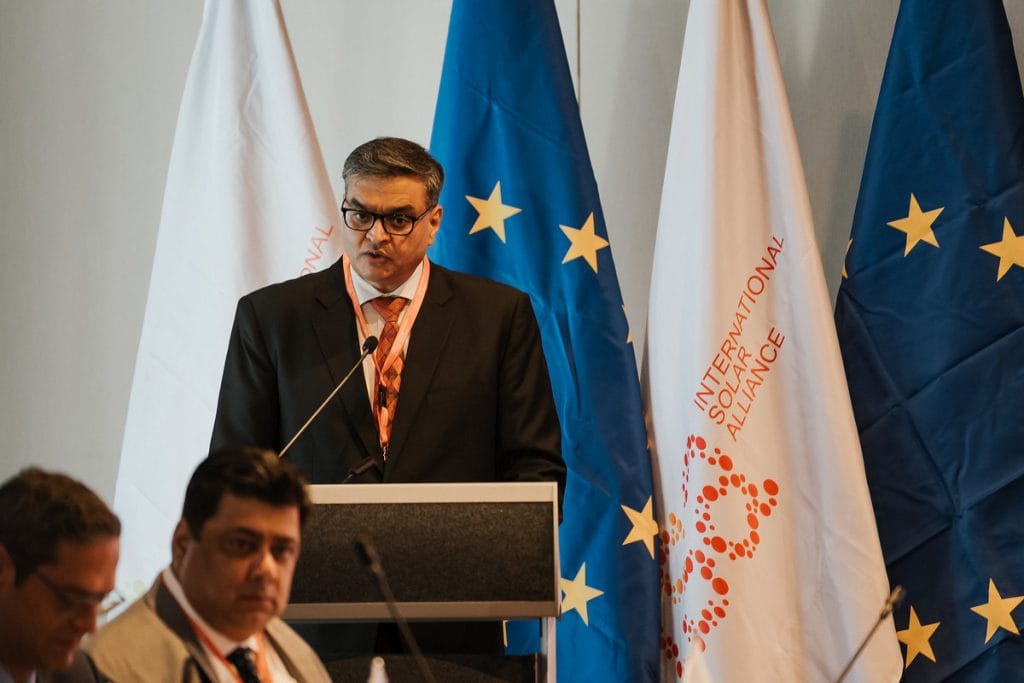
At the last General Assembly meeting in Delhi’s Bharat Mandapam, the French representative cited IRENA figures to show that “in just ten years, the cost of solar photovoltaic energy had fallen by more than 80 per cent.” He described this as a collective success of the ISA.
But global analysts explicitly attribute the decline in solar installation costs to China. A June 2026 McKinsey report noted that solar prices are down by about 98 per cent since the 1990s and that “a highly industrialised supply chain led by Chinese manufacturers underpins this cost decline”.
Also at the Delhi General Assembly, Khanna spoke about the world’s soaring solar adoption.
“It took 75 years to reach 1,000 GW of solar capacity, just two years more to reach 2,000 GW, and it is expected to reach 4,600 GW in the next four years,” he said to the gathering. “This placed an enormous responsibility on a Global South institution like the ISA.”
The world did indeed reach 2,800 GW of solar photovoltaic capacity in 2025. But the responsibility for that boom belongs in large part to the country outside the room. China accounted for around 60 per cent of new solar capacity added worldwide last year, commissioning about 370 GW of the 610 GW added globally.
By ignoring Beijing’s dominance, some experts argue the ISA is undermining its own ‘international’ status.
“Solar has two components—usage and manufacturing. The ISA never addresses the second component,” said Srivastava. “Even to promote solar adoption, you must reckon with the producers. Where would countries buy their solar panels from? How can you have an ISA that ignores China, the father of solar technology?”
Also Read: Built in India, served in India—How unicorn Sarvam AI plans to inject its millions
Will ISA get a chance to shine?
The ISA was a diplomatic breakthrough and a potential template for India’s future role in global leadership, as the US and China slowly cede ground.
It signalled to the world India’s capability on climate. Since its formation, India has launched organisations such as the Global Biofuels Alliance and the International Big Cat Alliance, both focused on environmental and energy diplomacy.
But ten years on, ISA is still like a fledgling organisation that is finding its feet.
“We’re evolving; our mandate is evolving because we’re still getting new members. But one thing is that we want to create the platforms, the opportunities for solar implementation,” said Khanna.
In a 2019 paper, scholars Sarang Shidore and Joshua W Busby described the ISA as part of India’s “search” for geopolitical influence, but questioned its prospects of success.
“India has limited capacity to provide financial support for this effort and is not a solar technology innovator [in contrast to China],” noted the paper. “Whether ISA enhances India’s geopolitical status depends on whether it can actually generate ‘joint gains’ for participating countries rather than simply existing as an institution.”
As the ISA enters its next phase with the operationalisation of the ASF in 2026, its main challenge is to convert its diplomatic wealth into financial outcomes and megawatts on the ground.
A working paper last year, ‘The International Solar Alliance and South Asia’, from the National University of Singapore’s Institute of South Asian Studies locates the problem in how the ISA is structured.
“India’s ambition for geopolitical influence is a major reason for India’s leadership in the ISA and for making it a treaty-based organisation. However, it does not have the characteristics of a treaty, particularly because there are no binding obligations and constraints on its members,” says the paper. “As its name suggests, it is an alliance, a soft mechanism for collaboration. How successful it can be in the absence of binding provisions is an important question.”
An independent expert who wished to remain anonymous said ISA needs to answer one question—what has it really changed in the world and in the solar sector since it was established?
Editor’s note: An earlier version of this article mentioned Burundi and Cuba as examples of countries where water pumps have been installed. The correct locations are Togo and Ethiopia.
(Edited by Asavari Singh)