


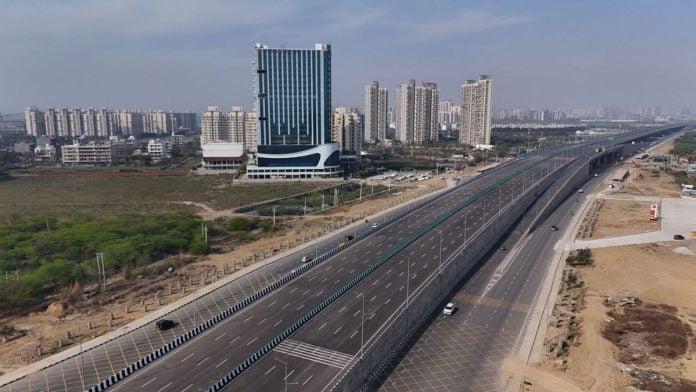
Gurugram: Prakhar Sahay fought for almost a decade to get the Dwarka Expressway built. He protested at Jantar Mantar in 2016 and lobbied endlessly so that his distant corner of Gurugram would finally be connected to Delhi. The expressway is here now, but Sahay is still fighting. This time it’s for the basic amenities residents were promised but never got.
In premium towers and affordable projects alike, thousands of families who have invested crores in homes along the Dwarka Expressway are grappling with broken approach roads, open drains, incomplete sewage networks and unreliable electricity. They live in apartments with clubhouses and tennis courts beside a Rs 9,000-crore expressway, but some still have to cross open fields to get home.
“I would always say that I wanted to see the Dwarka Expressway completed while I was still a father and not a grandfather. Now that it’s finally there, the surrounding infrastructure is nowhere to be seen,” said Sahay, convener of the Dwarka Expressway Gurugram Development Association.
Announced in 2006, the 29-kilometre Dwarka Expressway was billed as Delhi-NCR’s answer to Dubai’s Sheikh Zayed Road. Not just India’s first eight-lane elevated expressway, but the centre of a new oasis of urban planning that could give central Gurugram and Noida a run for their money.
Prime Minister Narendra Modi inaugurated the Gurugram stretch in March 2024 and the final Delhi section in August last year, though the building and buying boom had started well before that. Of the 42,816 units that were reportedly launched along the expressway between 2010 and 2024, 41,899 were sold in the same period. Today, about 115 housing projects are under construction. Sales of homes priced above Rs 10 crore have increased 22-fold in value to Rs 8,347 crore between 2024 and 2025. Real estate developers are marketing it as the new “power address”.
“Dwarka Expressway has been inspired by Dubai. Very soon, you will see towering skyscrapers lining the expressway just like Sheikh Zayed Road. The price rise after the launch of the expressway itself shows that it has become a power address,” said the sales manager of Roots Courtyard, which is selling plots starting at Rs 5 crore in a gated complex with amenities such as guards and EV chargers.
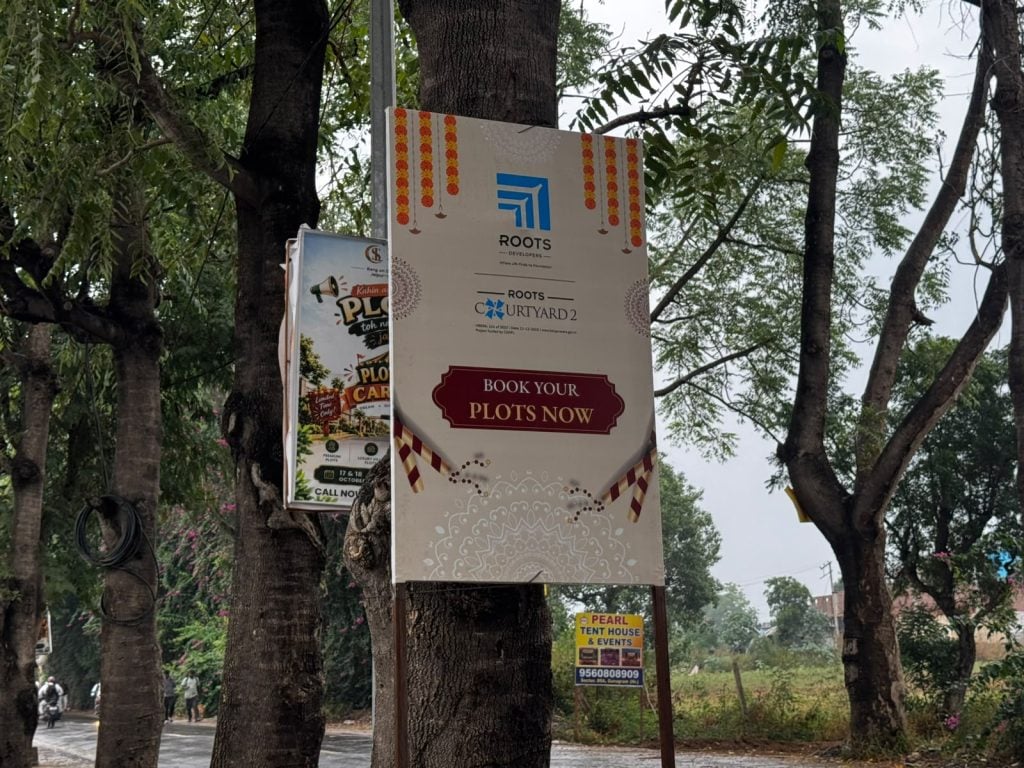
Connecting Mahipalpur in Delhi to Kherki Daula on the Manesar side of Gurugram, the road is an impressive sight, including its 3.6-km ‘musical’ underpass—a popular selfie spot with walls decorated with artwork representing different states. But the spectacle of the expressway ends where the neighbourhoods around it begin—whether it is luxury projects such as Tata La Vida or more modest developments such as ROF Alante.
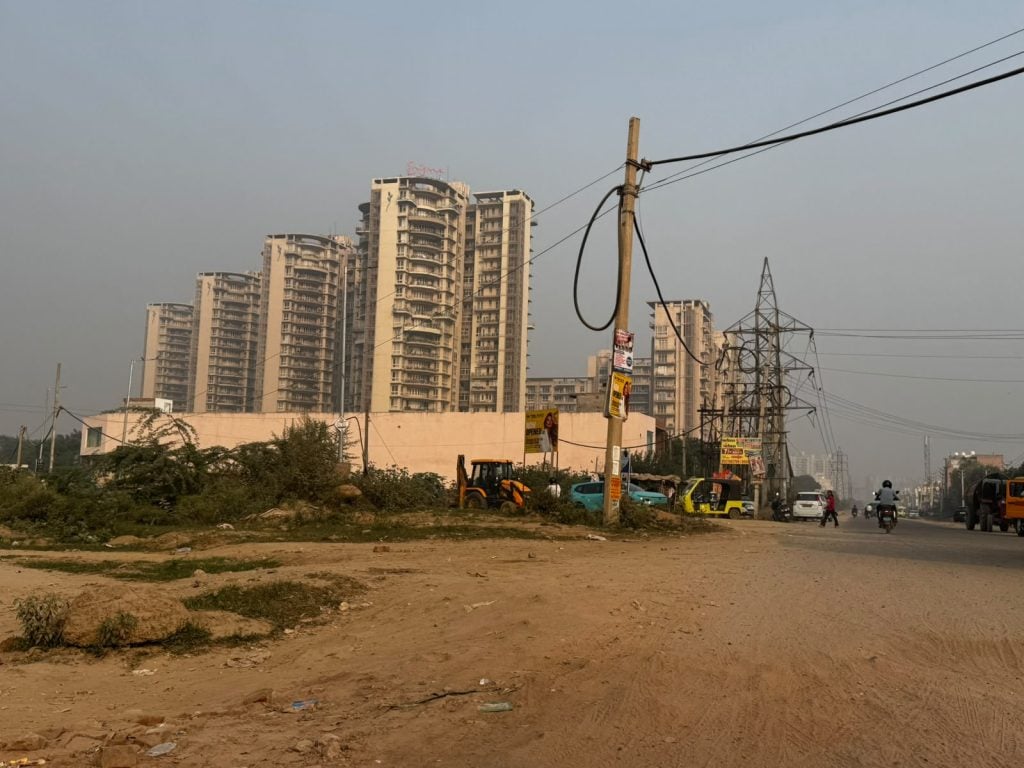
The moment one turns off the Dwarka Expressway, the smooth, sweeping road gives way to broken access roads, clouds of dust and open drains. In newer sectors such as 99, 102, 104, 110 and 113, residents also contend with clogged stormwater lines and unreliable power. Many of the planned 24-metre and 30-metre internal roads remain unbuilt.
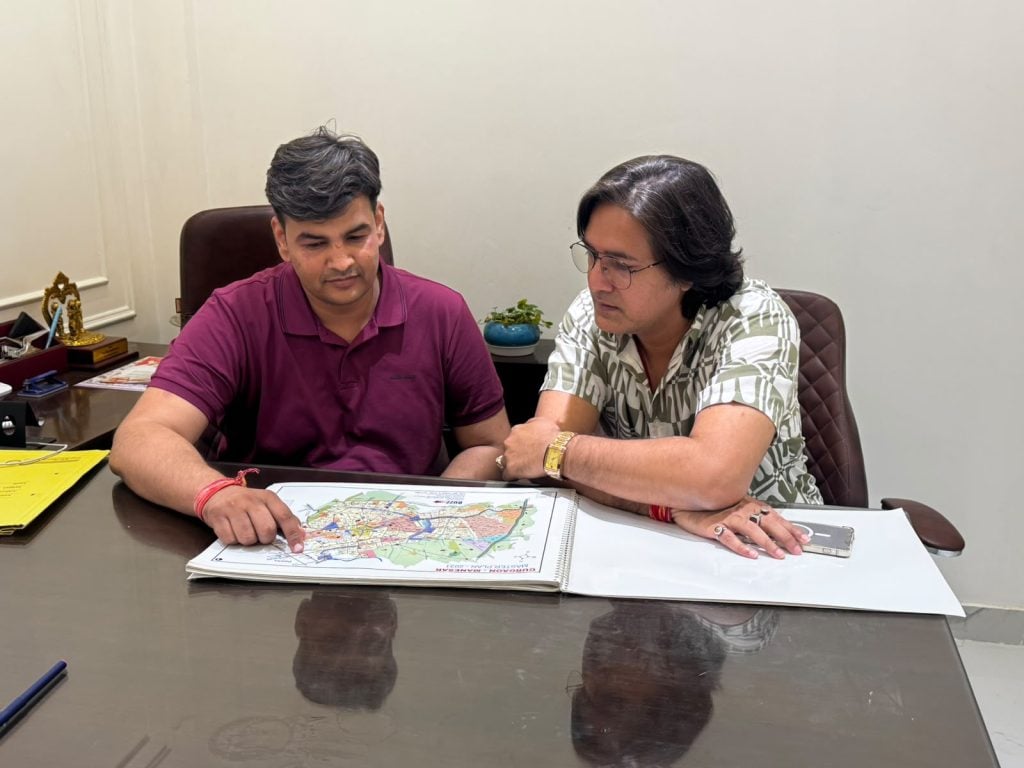
After repeated appeals to civic authorities went nowhere, the Dwarka Expressway Gurugram Development Association approached the Punjab and Haryana High Court last year over the missing roads. Haryana Chief Minister Nayab Singh Saini promised a “permanent solution” in his March budget speech, but when the court asked for a timetable in September, the state still couldn’t say when it would finish acquiring the 1,157 acres needed for the 24-metre roads in Gurugram and Manesar.
Animals and drunkards enter the society at night. There was no STP until recently. My question is, how did the authorities issue the builder an occupancy certificate?
– Shivani Thusoo, ROF Alante resident
These sectors were meant to learn from the planning mistakes that have long plagued central Gurugram. Instead, they have inherited them in a more acute form.
“There are no internal roads, sewerage network or even drainage. Can you imagine, there are a few areas where residents have to cross open fields to reach their homes,” said Sahay. In his 40s now, he bought a 3BHK in Ansal Estella, Sector 103, in 2010, banking on the proposed expressway. A dispute with the builder has kept him in a rented flat nearby, at Rs 44,000 a month.
“It feels as though you must remain in complaint mode simply to secure the most basic amenities and necessities from the government,” he added.
Also Read: Inside Hyderabad’s housing glut. Unsold homes, skyscrapers without residents
A Rs 3-crore bubble
Tata La Vida in Sector 113 has all the trappings of a typical upscale Gurugram condominium: guarded gates, manicured gardens, a swimming pool, a well-equipped clubhouse, walking tracks and dedicated courts for tennis, badminton and basketball. Residents barely need to step out for daily necessities. Which is just as well, since they often don’t dare to.
Resident Kshitij Sharma paid Rs 3 crore for his apartment in 2024. The Dwarka Expressway was one of the clinchers. It promised easy access to Delhi and Gurugram, with IGI Airport just 15 minutes away. But the mess outside the gates has cast a pall, from piles of construction debris to the stagnant water lining both sides of the street all the way to the expressway.
“As soon as you step out of the society, the frustration really mounts. There is an open drain just 150 metres from our society. The approach road to the expressway is not built. And the sewage water lies stagnant on the roadside,” said 45-year-old Sharma, who works in the telecom sector. “I have everything inside my condominium, so unless it’s necessary, we don’t step out.”
As general secretary of the residents’ welfare association, Sharma spends much of his week shuttling between the offices of the Gurugram Metropolitan Development Authority (GMDA) and the Municipal Corporation of Gurugram (MCG), repeating the same demands for roads, drainage, sanitation and basic services.
“Each time, I am told that they are working on it. And somebody will come soon to fix the problems. But nobody comes. And then I will visit their office again with the same request,” he said.
At least three couples have sold their apartments in the past year. They were unable to put up with the day-to-day infrastructural and civic shortcomings. Several other owners are also actively discussing leaving Dwarka Expressway
– Kshitij Sharma, Tata La Vida resident
In a letter to the GMDA chief executive officer on 22 May, the La Vida Residents Welfare Association (LVRWA) wrote: “The storm water drain project in the area being managed by GMDA has seen no progress for months. The lack of a proper drainage route causes rainwater to seep into the ground, leading to dangerous levels of water ingress and seepage into society apartments.”
The letter also blamed non-functional streetlights on a pending electricity connection from GMDA. “Street light infrastructure has been in place for over two years, yet the road remains dark at night,” it said. Six months on, it still hasn’t been fixed.
Expressway, then potholes & open fields
When Shivani Thusoo moved into her new apartment in Sector 108 in 2025, the first thing she looked for was a road. There wasn’t one. Residents of neighbouring Nanakheri wouldn’t let the apartment owners use the village road. They told them to use the “government road”.
“But there was no government road,” said Thusoo, who moved here primarily because it offered both connectivity and affordability. With six towers and over 700 apartments, her society ROF Alante never had premium pretensions. But living here has turned out to be much more harrowing than Thusoo had expected.
The daily commute is like an obstacle course. Getting home from the expressway means driving nearly two kilometres on a bumpy, unpaved road through the neighbouring village of Nanakheri. Then comes a dusty path between fields. Only the last 100 metres are paved—a stretch built by the developer. Even this is an improvement. It took months of visits to government offices and an intervention by the local MLA before residents could use the village road.
“Outside our society, we have roads up to 100 metres. After that, it is all soil and potholes. I am tired of visiting government offices now, they never listen,” Thusoo said.
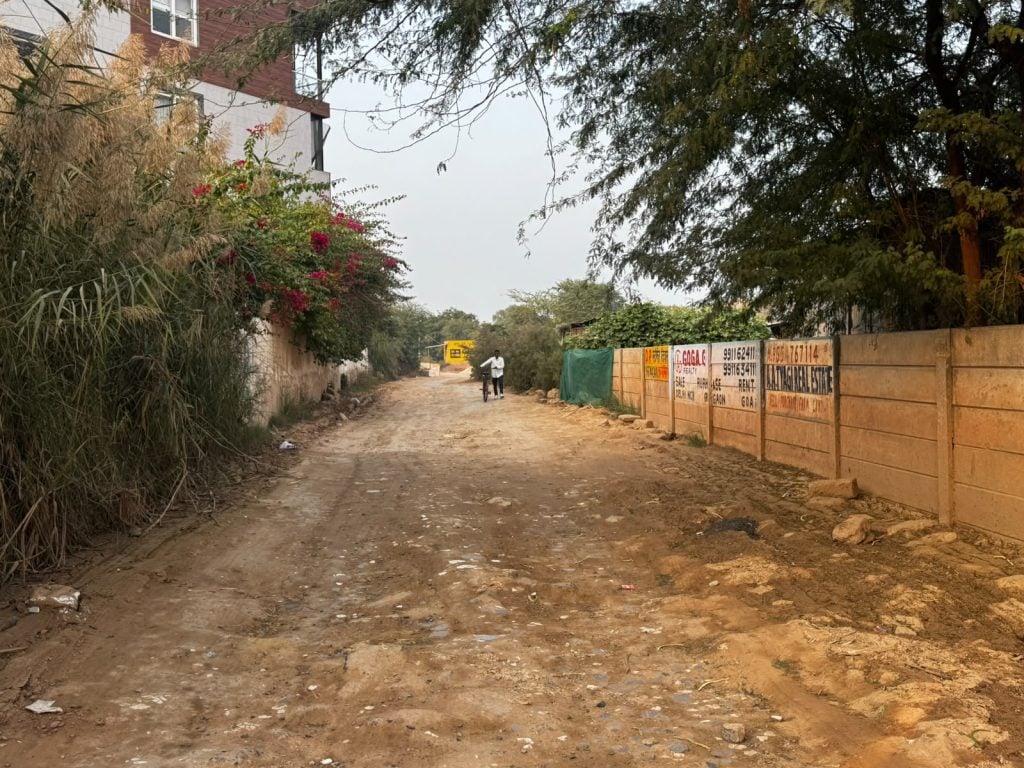
Last year, ROF Alante residents staged a heated protest outside the builder’s office in Sector 44, asking how the project had got a licence and an occupancy certificate without a proper approach road. The builder, in turn, blamed local landowners for digging up the road and blocking access to the society.
The road problem is not limited to Sector 108. Across the Dwarka Expressway, residents have protested time and again for 24-metre approach roads. Fixing accountability on this front has been a challenge.
Under the Gurgaon-Manesar Master Plan 2031, developers are responsible for the 24-metre internal roads and government agencies for the 60-metre roads between sectors. One reason for the mess is that each builder is responsible only for the stretch within its licensed area. So a road can be built up to the edge of one project and stop at the next plot, where the land hasn’t been acquired or ownership is in dispute.
The government has repeatedly acknowledged the problem but a solution has been slow to come. In August last year, Haryana Industries and Commerce Minister Rao Narbir Singh directed town planning officials to withhold occupancy certificates in Gurugram until builders constructed the approach roads they had promised. “Public convenience is paramount,” he said.
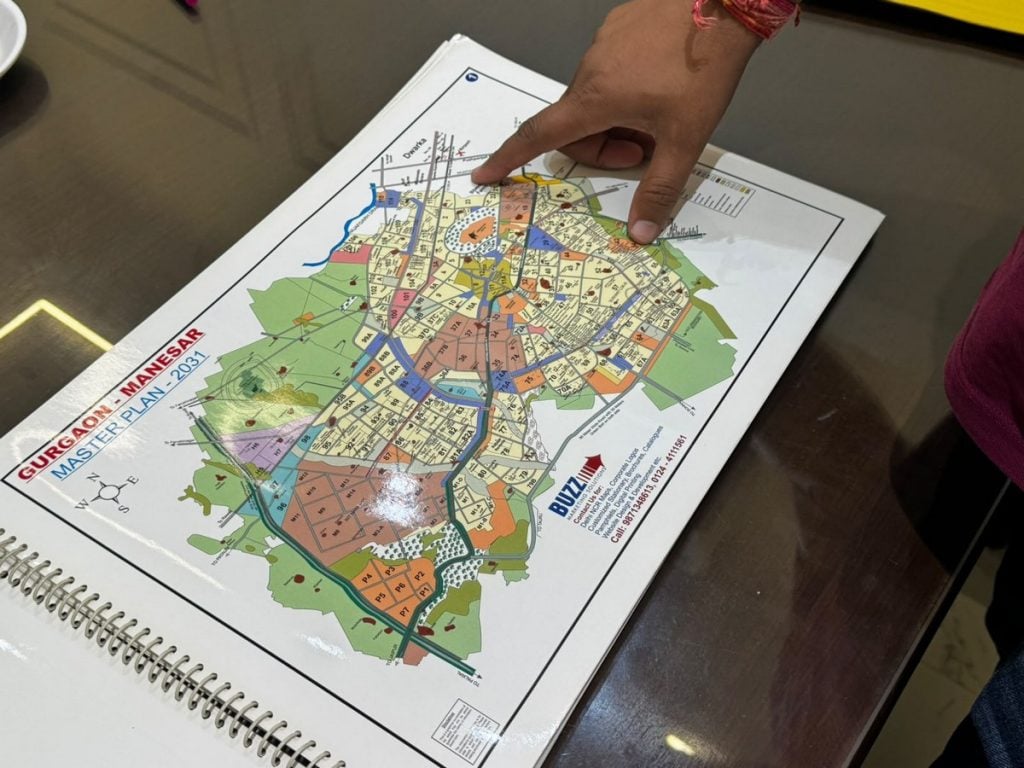
Then in his Budget speech, CM Saini referred to the road issue in Gurugram’s Sectors 58 to 115. Blaming previous governments for leaving land acquisition out of the development charges paid by builders, he said the state would now acquire the land and that “the expenditure incurred will be recovered from builders.”
Some movement at least has started. In September, Haryana set up a joint site inspection committee led by the zonal administrator of the Haryana Shehri Vikas Pradhikaran (HSVP), with officials from town planning, the city administration, land acquisition and urban estates. Of the roughly 1,157 acres needed for the missing roads, the state has zeroed in on about 38 acres in Sectors 58 to 67A and Sector 81 to acquire first. The committee will check land titles and submit a feasibility report to the HSVP’s chief administrator.
In Sector 109, Gaurav Prakash was among the early buyers along the corridor. He booked an apartment in 2010, when the expressway project was still getting repeatedly delayed by land acquisition, litigation and other issues. It was a leap of faith. According to him, the underlying issue is one of passing the buck. When residents asked officials for a proper approach road, he said, they were told it was the developer’s job.
I can’t lie to people and tell them that everything on the Dwarka Expressway is hunky-dory. I can only tell them the ground reality and let them make an informed decision
– Prakhar Sahay, real estate consultant
“But the developer had already built the stretch immediately outside their housing complex. The road beyond that is the government’s responsibility,” said Prakash.
The roads aren’t the only thing missing. Sewage tankers have become a familiar sight around societies along the Dwarka Expressway. With sewer lines incomplete or non-functional, they are the fallback for removing surplus treated effluent from in-house sewage treatment plants (STPs). But the solution is also a problem. Residents across societies say the tankers don’t take the waste to designated treatment plants, but instead dump it into open drains or vacant plots.
“Societies have their own STPs, but they cannot treat or reuse all the sewage. The surplus is meant to be taken to designated STPs, but it never reaches there,” said Prakash.
On 18 November, Municipal Corporation Manesar (MCM) Joint Commissioner Puneet Kumar caught two tankers dumping sewage in the open near the Holiday Inn by the expressway in Manesar and issued challans of Rs 50,000 each.
खुले में सीवरेज का गंदा पानी डालने वाले दो टैंकरों के 50-50 हजार रुपये के चालान
– संयुक्त आयुक्त @PuneetJ83054825 ने निरीक्षण के दौरान मौके पर किए चालान
– दोनों टैंकरों को जब्त करने के भी दिए आदेश@cmohry @ulbharyana @SwachhBharatGov @diprogurugram1 @DiprHaryana @DC_Gurugram pic.twitter.com/yPOxc3fH7N
— Municipal Corporation Manesar (@MCManesar) November 18, 2026
But many residents say they are yet to see their grievances addressed. Rajat Kumar, who lives in Sector 84, says he regularly files complaints on government portals with photographs of the tankers and the dumping.
“There is no answer or action,” he said.
Also Read: Gurugram, Noida are building for NRIs. Salaried class is trapped between dreams and means
Boom outside, bust inside
Soon after the Haryana stretch of the Dwarka Expressway opened in March 2024, prices along the corridor surged. A typical three-bedroom apartment went from around Rs 1.8 crore in 2022 to Rs 2.6 crore to Rs 4 crore by 2025.
The boom has attracted major developers, with new projects announced along the corridor, including Sobha City, M3M Capital, Adani The Marq and Roots Courtyard. But there are problems both outside and inside many of these complexes.
At ROF Alante, there is no proper boundary wall. A wire fence marks the edge, leaving the complex exposed to the fields beyond. Two massive diesel generators sit in the open beside the fence, their large exhaust pipes roaring. It would look like an industrial site were it not for the playground and small parking lot nearby.
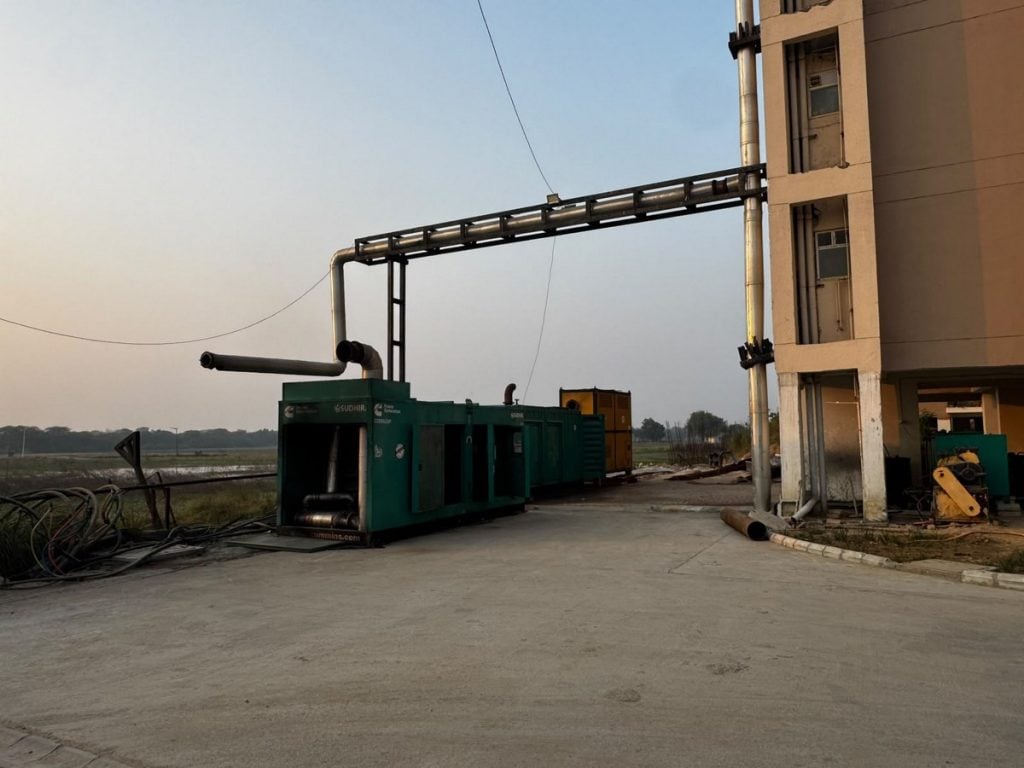
Thusoo said the lack of a gate and boundary wall makes her worry for her family’s safety.
“Animals and drunkards enter the society at night. There was no STP until recently. My question is, how did the authorities issue the builder an occupancy certificate?” she said.
At Tata La Vida, about 600 apartments are occupied and only 70 are empty. But Kshitij Sharma says people are slowly trickling out and moving to Delhi and Noida.
“At least three couples have sold their apartments in the past year. They were unable to put up with the day-to-day infrastructural and civic shortcomings. Several other owners are also actively discussing leaving Dwarka Expressway,” said Sharma, with a sigh.
For Prakhar Sahay, the journey from fighting for the Dwarka Expressway to demanding basic amenities has reshaped his career. He moved from the corporate sector to real estate consultancy about five years ago.
“After a point, it feels like we should quit our jobs and spend all our time coordinating with the government to get the work done, simply because we bought a house here. That is why I decided to become a consultant,” said Sahay.
His conscience prevents him from endorsing his neighbourhood to would-be buyers.
“I can’t lie to people and tell them that everything on the Dwarka Expressway is hunky-dory. I can only tell them the ground reality and let them make an informed decision,” he said.
(Edited by Asavar Singh)