



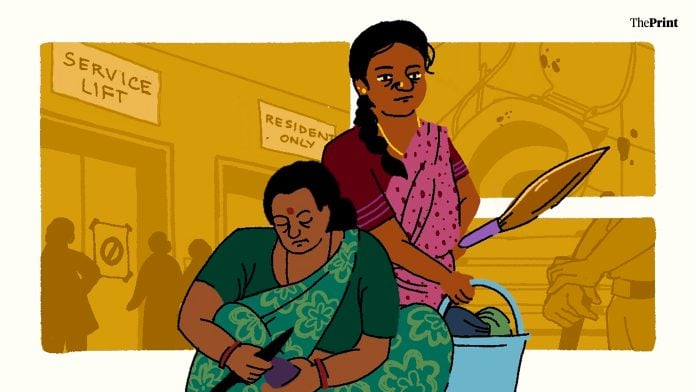
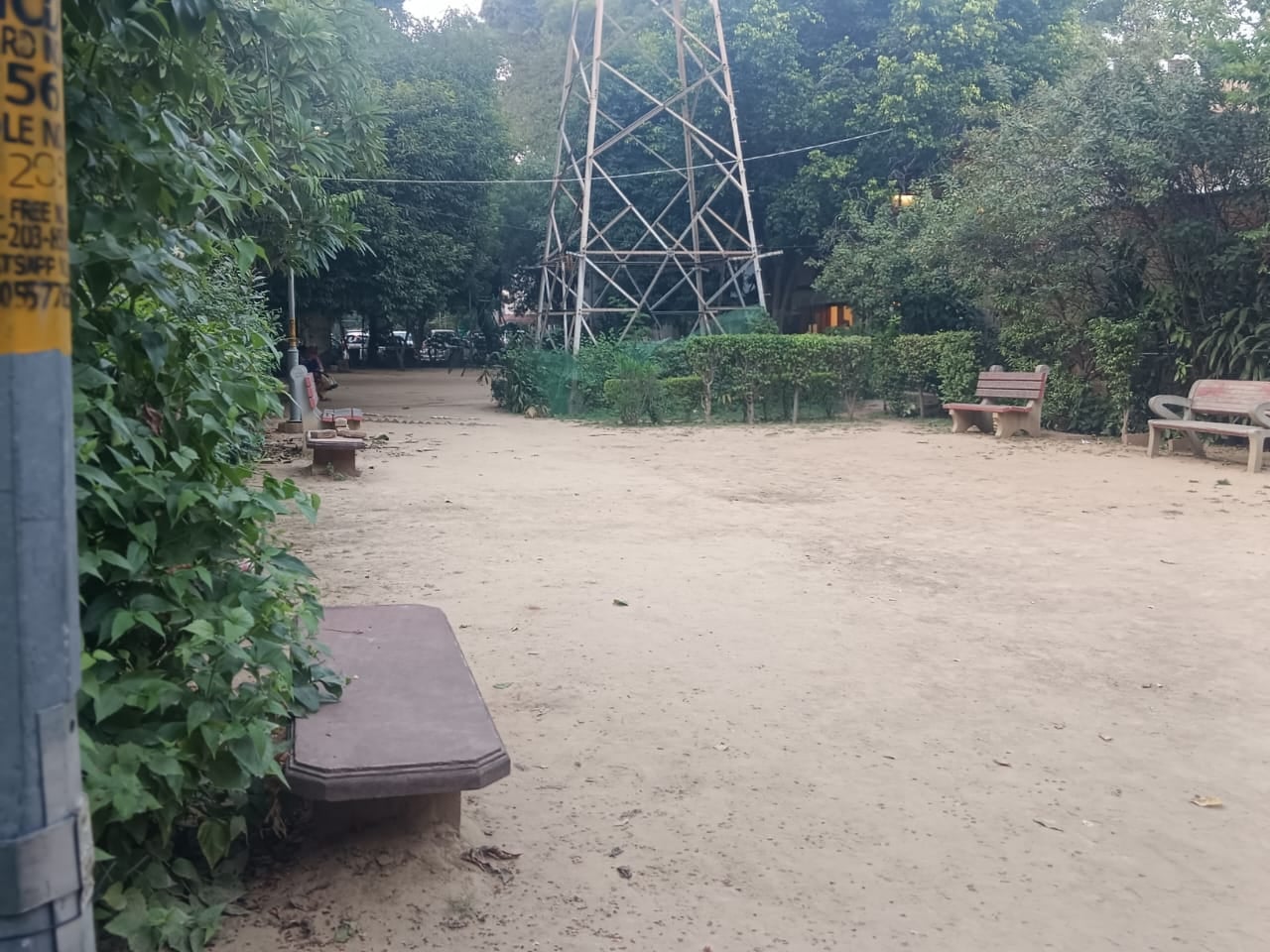
New Delhi: Maryam is a familiar face in Vasant Kunj’s pockets B1 and B2. For the past 15 years, she has scrubbed kitchens, wiped bathroom floors and cleaned the dirtiest corners in different houses of these DDA colonies. Yet, years of her labour have not translated into acceptance. She is still viewed with suspicion. She is not allowed to sit on park benches. If she uses the common lift, it is seen as an act of contamination.
Last month, she was sitting under the shade of a tree, chatting with a friend over a video call, when a resident out on a walk approached her. She asked her to leave the society’s walking area and wait outside its gates.
“I told her that my next household work starts in 15 minutes. So, I was just sitting here. But she said, ‘Don’t dirty our society by sitting in the park. You sit here and gossip about residents.’ I felt so humiliated,” 45-year-old Maryam recalled. Helpless, she lowered her head and walked out the park.
Her experience is not an isolated incident. Rather it reflects the wider pattern of discrimination against the very people who cook, clean and care for families. Domestic workers are excluded from areas they need to get through their workday and take breaks between jobs. From restrictions on using elevators to being denied access to washrooms, parks and common areas, domestic workers routinely confront a class divide that relegates them to the lowest rung of the gated society’s social hierarchy.
The debate gained renewed attention after a viral video purportedly showed a domestic worker being brutally assaulted by her employer inside DLF Camellias, one of Gurugram’s most luxurious residential complexes. The video, which appears to be recorded by a neighbour from a window overlooking a kitchen, showed the woman slapping and pushing the worker multiple times and pulling her hair. The incident drew obvious criticism against the employer’s conduct and a police complaint was lodged but a section of residents backed the employer.
“There are two sides to every story. She must have done something for this reaction; we should always listen to both sides,” a DLF Camellias resident earlier told ThePrint.
These are the residents who also justify the restrictions that single out domestic workers, arguing that they leave paan and gutkha stains, litter shared spaces and fail to maintain cleanliness.
“Segregation is necessary. If domestic workers are given unrestricted access, they stop respecting shared spaces. We have complaints about paan and gutkha stains, and littering in common areas. There are also concerns that workers collectively refuse to work in certain households or behave rudely with residents. Residents feel there have to be rules, and that those rules must be followed by everyone,” said a Vasant Kunj RWA member, requesting anonymity.
However, domestic workers, who face humiliation, verbal abuse or discrimination, neither have a say in the framing of these rules nor any recourse for their grievances. The fear of losing their jobs and the power imbalance make it extremely difficult for domestic workers to speak out against the people they depend on for their livelihoods.
“We work in their homes, they know our names, our faces. But when it comes to our problems, they instantly look the other way. We cannot always complain or protest because our livelihoods depend on these jobs,” said Basanti, who works in a residential society in Malviya Nagar. “For many of us, humiliation has become so routine that we are expected to accept it in silence.”
Not a place to pee
Vineeta, who works in three households in Gurugram’s upscale Sector 53, says she has witnessed entry passes give way to digital registrations and common spaces come under constant CCTV surveillance. But there is still no provision for a toilet that domestic workers can use freely.
“Imagine someone telling you that you cannot use their washroom because you will make it dirty,” she said. “The same washroom that I clean.”
Vineeta recounted looking for a hidden corner behind a house whenever they needed to use the toilet, as domestic workers had nowhere else to go. Now, with CCTV cameras surveilling every corner, that is no longer possible. Some societies have common washrooms, but getting access to them is not always easy.
“What are we supposed to do when we need to pee? We know going behind a house is wrong, but we have no other option. We cannot go all the way home just to use the toilet and spend an hour travelling back,” said Vineeta.
Vineeta earns more than Rs 20,000 a month, working in three households. But, even after years of domestic work, she still finds herself under scrutiny. Despite common areas being open to domestic workers waiting between jobs, the residents’ stares make them feel unwelcome.
“If I sit in the lobby for even ten minutes, passing residents start staring at me, as if to ask what I was doing there. So I just leave,” said Vineeta.
“Ensuring that societies and residents provide domestic workers with basic infrastructure is a challenge, and change needs to happen at an individual level,” said an RWA member from Sector 54, Gurugram. He further noted that many societies have common washrooms that can be used by visitors and domestic helpers. However, access often depends on the rules of the society and the willingness of residents to allow them to use these facilities.
An RWA member from Vasant Kunj also pointed out that some societies face difficulties setting up designated washrooms because of space constraints and the need for approval from the relevant authorities. The process also gets delayed and stuck when residents cannot reach a consensus on allocating a suitable space for the facility.
Routine silent discrimination
The humiliation and segregation is not limited to domestic workers. Security guards, gardeners and garbage collectors too have faced discrimination in Delhi NCR’s luxury residential complexes.
“They see us as their personal servants, and that is where everything begins and ends for them,” said 27-year-old Hamid Hauqe, a garbage collector in Vasant Kunj’s Sector B. “The respect ends the moment they think of us as their servants and not workers.”
An earlier report by ThePrint also highlighted how security guards often become the targets of residents’ anger, often blamed for incidents they had nothing to do with. “We have become immune to the humiliation. We are routinely scolded and asked not to touch the walls or flower pots outside their houses. Forget entering their common spaces and lifts,” Haque added.
Anita Kapoor, co-founder of the Shahri Mahila Kaamgar Union (SMKU – Urban Women Workers’ Union), said that domestic workers are often denied their most basic rights, such as access to drinking water or washrooms, by the households that employ them.
She pointed out that a majority of the women engaged in domestic work are Muslim and face discrimination on the basis of their religion. In many cases, they are even forced to change their names to Hindu names to secure employment.
“Many people refuse to give work to Muslim women. Others don’t want women from the Valmiki community cooking for them. These forms of silent discrimination have been going on for ages, yet nobody addresses them openly,” said Kapoor.
Kapoor also highlighted the mental harassment domestic workers face. She shared a case study of a domestic worker from Delhi’s posh Green Park neighbourhood, where the employer would routinely mock the woman’s religion and blame her for every incident reported from her community.
“The employer used to show her the news and say – see what your community is doing. You all are like this only,’” Kapoor recalled, adding that the employer had been showing the domestic worker news reports about the Red Fort blast last year.
The emergence of on-demand home services apps, that allow people to hire cleaners, cooks, and domestic workers by the hour, were expected to formalise the sector. It has, instead, contributed to greater irregularities, conflicts, and instances of discrimination over the past five to six years.
“Earlier, there was a relationship between domestic workers and the households that employed them. But, with the emergence of these apps, that relationship is disappearing. People come for an hour, do their work, and leave. There is no trust or communication between the two parties, which further reinforces the class hierarchy,” she added.
Kapoor further highlighted the lack of avenues for domestic workers to file complaints against their employers, who hold significantly more power and privilege.
“When a domestic worker is at fault, the employer will complain to the police, post about it in Whatsapp groups or social media, and take it up with the RWA. But domestic workers rarely get the same opportunity unless their cases make it to the news,” said Kapoor.
Stay-at-home domestic workers have it worse
Afsana Bibi, 32, lives in Masoodpur with her husband and 13-year-old son. She was just 16 when she started working as a full-time babysitter. Since then, she has spent years looking after other people’s children, cooking their meals and cleaning their homes. But in a household that employed her for six years, she could never even ask for something as basic as a bed to sleep in.
Afsana recalls baby-sitting a four-year-old in Vasant Kunj Sector A. She remembered the child’s grandmother asking her to keep her utensils separate and wait until the family had finished eating before having her own meal.
“I worked for them for years. I lived in their house and worked for them 24/7, but they never gave me a bed to sleep in. At night, I would make a makeshift bed in the hall and sleep there, whether it was summer or winter. The moment we enter someone’s house as a kamwali (domestic worker), they start treating us differently. We can be trusted with their children, their belongings and their entire home, but we are not considered good enough to sit and eat with them,” said Afsana.
Drawing out the comparison between part-time and stay-at-home domestic workers, Kapoor said that one would expect employers to show the latter more empathy and dignity considering they live in the same household and are expected to be available for work 24 hours a day. But that is not always the case.
“We rescued a minor girl who used to work in a house in GK. Forget about a bed and food, the girl was not even provided with sanitary pads,” Kapoor recounted.
Many young domestic workers, who live with their employers and work round the clock, are often not allowed to use the same bathrooms as the family. They are either put up in a barsaati (a small room on the terrace) or they sleep on a mattress in the hall.
“Empathy does not come with the number of hours you put in for work, be it two or 24. That is why these women deserve strict laws that protect their rights,” she said.
Having left her stay-at-home domestic worker days behind her, Afsana now cleans and cooks for three different households. The change has given her something she did not have earlier: time for herself and her family, particularly her teenaged son. She earns around Rs 13,000 a month but likes the little freedom that the new routine has given her. Even though she has not been working for her current employers for very long, she says they treat her with more respect than some of the families she worked for earlier.
“Not every finger is the same size. People are different,” Afsana said. “I am working for families who ask me to sit and eat with them. Humanity does not depend on how many years you have worked for someone. It depends on the kind of person your employer is.”
She recalled an incident where her aunt, also a domestic worker, was accused of theft by her Gurugram-based employers of 15 years. “One day, the woman couldn’t find her diamond earrings. But instead of looking harder, she suspected my aunt, who had taken care of her house for more than a decade. She threatened to call the police, even when my aunt insisted she had not taken them. It was only after the family checked the CCTV footage that the earrings turned up in the woman’s own bedroom.”
The incident angers Afsana not just because of the accusation, but also because how quickly 15 years of her aunt’s hard work was dismissed. “Baat kamwali pe aati hai toh log insaniyat hi bhool jaate hain. Hum log aapke ghar ka dhyan rakhte hain. Thoda bharosa toh karna chahiye na (When it comes to domestic workers, people seem to forget basic humanity. We take care of their homes, they should at least have some trust in us),” she said.
Residents, however, say the relationship between employers and domestic workers is not always straightforward. A resident of Sector A, Vasant Kunj, requesting anonymity, said incidents of theft, disagreements over wages and workers leaving without notice had left them wary of those they employed.
The resident stressed that following society rules, including those governing the use of lifts and common areas, were necessary to ensure the smooth functioning of the residential complex.
“Residents also have to follow several rules and regulations in a society, so why can’t the same be applicable for domestic workers? If we are expected to respect their demands, they should also understand our concerns. Just because some incidents have happened does not mean every resident is at fault,” the resident said.
Who cares about our complaints?
45-year-old Rita Devi works as a domestic worker in Saket. She said that in her 17 years of work experience, she has never faced discrimination. But something continues to worry her.
“There is no security when it comes to our jobs or salaries. That needs to change. But who will start a fight with our rich employers? And who will pay heed to our grievances? They will simply replace us with another worker,” Devi said.
After finishing work, she often sits in the park with other domestic workers. They talk about their families, their employers and the widening gap between what they think they are entitled to, say a Diwali bonus, and what they get — leftover food, which they usually end up disposing of.
“We discuss our problems among ourselves and suggest what the other person can do — either leave the job or adjust. We don’t have many options,” said Devi.
From the balcony of his home in C Block, Saket, 68-year-old Rakesh Dabas often sees domestic workers, including the one he employs, gather in the same park. He is a former member of the society’s RWA.
“It is upsetting to hear that workers are asked to leave parks or are denied entry through certain lifts simply because they work in these homes. They spend hours looking after our households, yet some people cannot accept sharing common spaces with them,” he said.
Dabas claims he has also seen residents object when domestic workers sit on the staircase for a few minutes, raising their voices at them. He claims to have frequently stepped in to speak to residents and support the workers.
“Respect has to work both ways. Even if you have a problem with someone, there is no need to shout at them or humiliate them,” he said. After speaking to residents, Dabas claims, he has helped ensure that domestic workers can sit in the park, eat their lunch or wait there between shifts. RWAs said, however, that they seldom receive complaints from residents or domestic workers regarding personal disputes, disagreements, or the treatment meted out to them.
Making headlines
Manu lives in a three-bedroom apartment in Noida’s Amrapali Sapphire. The gated society has separate “service” elevators for domestic workers and other blue-collared workers including guards, delivery persons, garbage collectors, and sanitation workers.
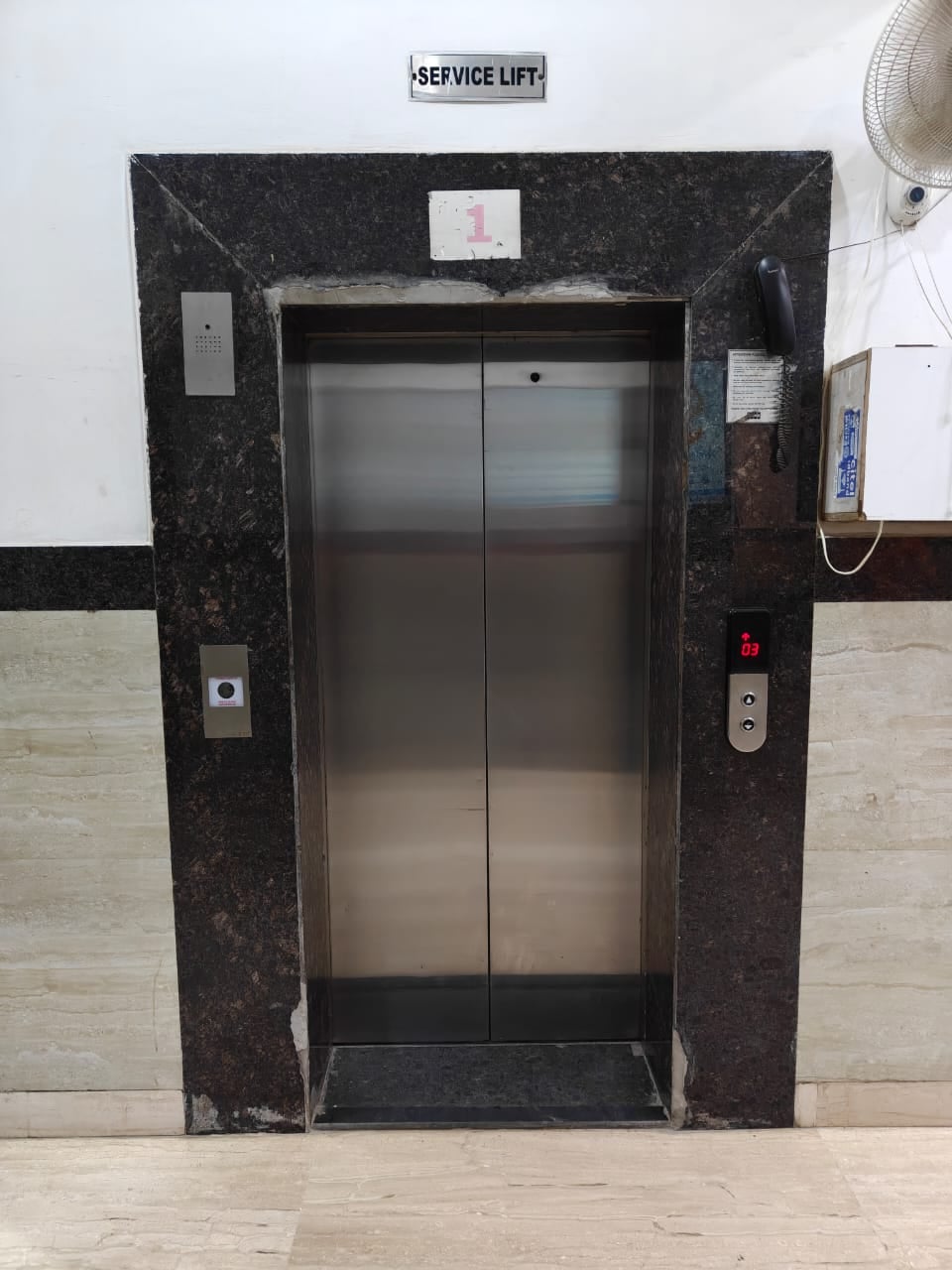
She recalled the day she saw her domestic worker waiting by the lift and invited her to take the lift reserved for residents.
“A woman entered the lift on another floor and stared my didi down until we exited,” Manu said. “People can be very rude; it is disappointing to witness,” she said.
Not all residents, however, view these restrictions as discriminatory. Vishwendu said residents have their own reasons for wanting rules around shared spaces. “Residents pay maintenance to keep the society clean and well maintained. Some domestic workers spit in common areas, litter the lifts or leave behind food waste. These things also need to be taken seriously,” said Vishwendu, a resident and former member of the society’s RWA.
Although these disagreements do not necessarily end with formal complaints lodged with the RWAs or the police, they are discussed thoroughly in society WhatsApp groups. At the same time, digital gate-management apps allow them to record feedback and ratings that affect a worker’s chances of finding employment.
“Residents can rate us, complain about us in their groups and affect our work. But can we do the same to them? That is where the difference lies. They have the power to decide whether we find work; but we can’t even question how they treat us”, said a domestic worker, requesting anonymity.
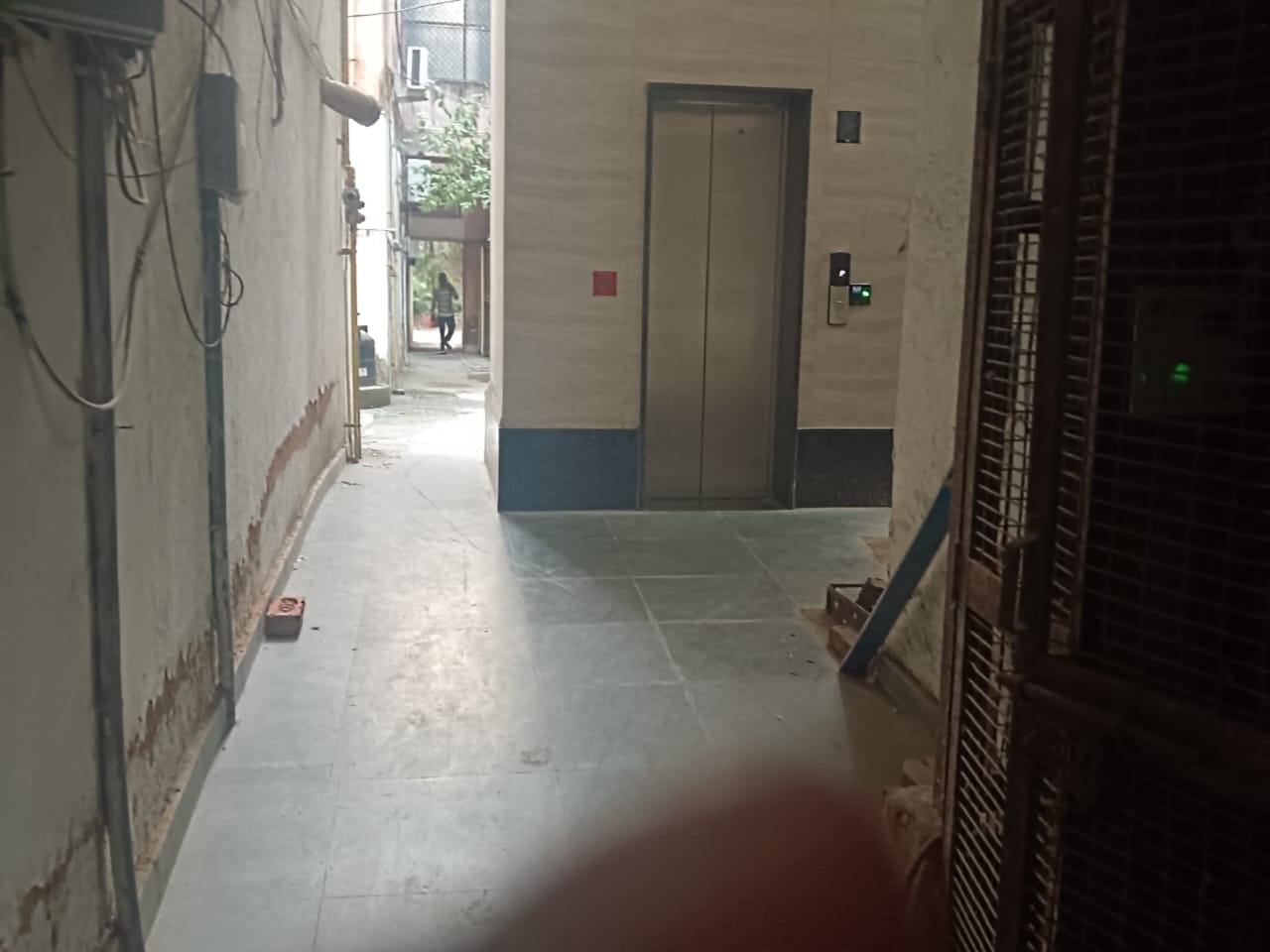
Back in Vasant Kunj, Maryam makes her way towards the far end of the society, where the water tanks stand. She has 15 minutes before she needs to leave for her next house. She waits there, away from the park and the woman, who berated her.
“How often do you see a kamwali making headlines for theft or fighting with a resident? But so many stories are about residents denying access to lifts, slapping or assaulting workers,” she said.
“Humein pata hai taali ek haath se nahi bajti, lekin humein yeh bhi pata hai ki humein barabari aur izzat nahi milegi. Hum bas itne mein hi khush ho jaate hain ki kuch log toh humein izzat dete hain aur insaan samajhkar pesh aate hain (We understand that there are two sides to every story, but we also know that we may never be treated as equals or given the respect we deserve. We have learned to be grateful for the few who treat us with dignity and see us as equals).”
(Edited by Aakriti Handa)