



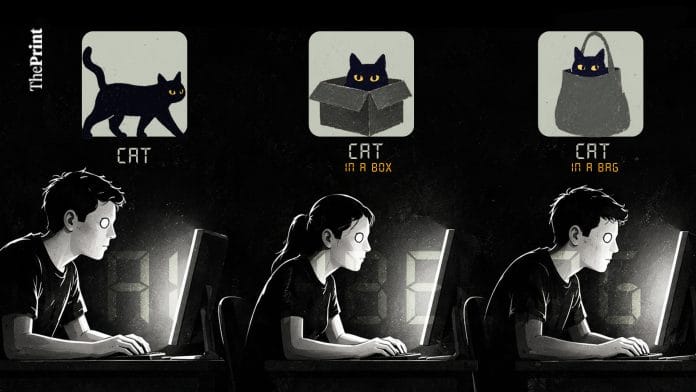
Noida: Play the video. Spot the drone. Draw a box around it. Label it. Move to the next video. Repeat.
This is what a 23-year-old data annotator in Noida does, glued to his computer screen for eight hours straight. He trains an AI model to identify objects from different angles. On his screen, a drone picks up a parcel, flies to another location and drops it. He watches the video frame by frame, tags the drone, and moves on to the next one. He does this repeatedly with hundreds of videos every day.
But he says, he does it with an ache in his heart. “Each time I tag and label the drone, I realise that soon delivery boys’ jobs will also be taken over by AI,” he says, quickly gobbling up a paratha before his strictly-timed lunch break is over.
This 23-year-old is among thousands of workers in Noida and Gurugram, who form the invisible workforce getting the world ready for AI dominance. Their job is to teach AI how to see and identify – a cat’s face, a pedestrian crossing a road, a drone carrying a parcel, or anything under the sun. The current project he is working on is a model being developed for Qatar.
Although the work can be mind-numbingly repetitive, it is this drudgery that makes AI systems intelligent and more accurate. Behind this bold new world of AI, is a workforce of low-income Indian Gen Zs caught in a loop.
Across NCR’s Noida and Gurugram, dozens of new outfits have mushroomed with hundreds of workers coding and cataloguing images and videos for future AI use. It is the new BPO boom, a short window of economic opportunity for India and Indian youth to capitalise on the need to help the world transition to a new era.
“Data annotation is fundamental to AI — it transforms the real world’s random, unstructured information into structured data that machine-learning models can learn from,” said Prasanto Roy, tech policy advisor and former Vice President at NASSCOM.
NASSCOM has estimated the AI data annotation market “serviced by India” to exceed $7 billion by 2030, with a potential of up to 1 million-strong workforce “engaged via full-time and part-time employment models.”
According to Clutch, a B2B rating and review platform, there are over 80 registered AI data annotation companies in India including Shaip, InFolks, TaskMonk, NextWealth, Desicrew, Macgene, and Cogito.
Roy sees this as a positive outcome. Initially, a lot of AI was trained on western knowledge systems and western people. Now, India is not only a low-cost annotation hub but training AI models on Indian data is also helping it understand the Indian context, language and people.
“Anywhere you ask an AI model to generate an image, and you will instantly get an image of a white person. But now, that has begun to change,” said Roy. “The representation of 1.4 billion Indians in the 7-8 billion global population is a significant thing.”
The annotation work is increasingly moving to Tier-II and Tier-III cities, Roy says, where people are more willing to take up these relatively low-skilled jobs.
ThePrint visited several AI labelling companies in Noida and Gurugram and spoke to data annotators about their work. They spoke about long hours, repetitive tasks, strict targets and low wages.
The new BPO
Over the last five years, AI data-labelling startups have boomed — first springing up in South India and soon spreading across North India, including NCR. Initially, these startups had offices but many have now shifted to remote operations to cut office space and infrastructure costs. While this may have helped smaller firms to scale up the workforce, it has marginalised the workers further.
According to 6Wresearch, a Delhi-based market research and commercial advisory firm, India’s data annotation and labeling market was estimated at $419 million in 2025 and is projected to reach $603 million by 2032. The market is further expected to grow at CAGR of around 6.4 percent between 2026 and 2032.
The disconnect is stark. The AI technology being built is worth billions of dollars. But the people training it don’t earn even a miniscule fraction of it, barely enough to support their families for a month. India reportedly accounts for about 36 per cent of image and video labelling services provided to some of the world’s biggest tech firms.
The AI economy, being driven by lakhs of young Indians, echoes the Business Process Outsourcing (BPO) boom of the 1990s and 2000s. When the BPO wave arrived in India in the mid-1990s, it too rode on India’s large pool of inexpensive labour, recruited for repetitive back office tasks and customer-care operations for multi-national companies. Call centres emerged as the new form of urban employment.
Three decades later, global companies are still looking towards India to get large volumes of repetitive work done cheaply. “AI models can either be language models or they could be modelling the world and how we interact with it. For instance, a few models are being trained to mimic human movements to create humanoid robots. The current wave of AI makes data annotation a high value job,” said Arvind Jha, founder of Mithila Stack, an IT company that also works on AI projects.
“The largest category of jobs AI has created so far is data labelling – annotators. While we are losing entry-level and routine jobs because of AI, this sector of jobs is just growing and growing,” Jha added.
Roy pointed out, however, that these jobs are not high-paying ones and that the employment is not long-term. “This is not perpetual employment. As AI acquires more and more human knowledge, there will be a reduction in the numbers of such jobs,” he said. Roy added, “The low-pay, low-end work resembles sweatshop conditions. And it gets worse when you move beyond annotation to training embodied AI, where the AI model learns from mimicking a human’s movements (aka imitation learning). In the latter, you are training your own replacement.”
The life of a data annotator
A large flock of young men and women rush out of an office in Noida Sector 60, walking with an unusual urgency. They have 30 minutes to eat lunch. Not a minute more.
“If we are a minute late, the Google sheet will turn red and we will be reprimanded,” said one of them, stopping briefly to speak to ThePrint before hurrying back. These young data annotators have few or no paid leaves, often work on weekends and operate in tightly-monitored environments.
At the gates of the Anolytics office in Noida, these employees hand over their phones to security guards in exchange for a token, before they walk inside and begin their day. They get access to their phones briefly during lunch breaks and then at the end of the day.
Anolytics, a data-labelling company, has two offices in Noida — in Sector 2 and Sector 60 — and employs hundreds of data annotators. The employees described it as “walking into a prison.” Even lunch comes with a clock.
“We have to first inform the team leader before stepping out…It feels humiliating,” claimed a 24-year-old employee. The team leader records the time and the 30-minute lunch break begins. Sunday is their only day off. All this for Rs 10,000 to Rs 15,000 a month.
In a research paper titled, Challenging the Myth of AI Autonomy and published by the International Labour Organisation, authors Usha Rani and Morgan Williams write, “A common misconception is that artificial intelligence (AI) functions magically, without human intervention.” According to the paper, the AI economy is largely driven by two forms of human labour: an ‘algorithmic worker,’ who is responsible for coding and fine-tuning models; and a ‘data worker,’ who is responsible for labelling, cleaning, and expanding datasets to train AI models. The authors argue that the data worker often remains “invisible to the end-user, leaving them vulnerable to decent work deficits.”
A 19-year-old joined the data-annotation company in Noida soon after finishing school. During his training, he was told that taking a leave was not allowed, even during an emergency.
“If anyone takes three leaves in a row, the employees will be instantly terminated. I was shocked to learn this,” he claimed.
Over the last six months, the 19-year-old claims to have seen employees being terminated over taking offs and not punching on time. “We are told that our clients in the US love discipline. The more disciplined we are, the more they will appreciate our work,” he said.
In a response to ThePrint’s email, Abhijai Srivastava, VP – Marketing at Cogito Tech, a sister concern of Anolytics, wrote, “Our employees are required to deposit their mobile phones during working hours. This is a standard protocol followed to meet client confidentiality requirements, as the data we handle can be sensitive. Employees are free to access their phones during designated breaks.”
Srivastava, however, denied claims that three leaves in a row would lead to direct termination. He said, “The assertion that employees are not allowed to take leave, or that three consecutive days of leave can lead to termination, is incorrect. Employees can take planned leave with the required managerial approval. Emergency and family-related situations are also considered in accordance with company policies. There is no such blanket policy of termination for taking three consecutive days off.”
AI is a child
“The cat is under the bed.”
“The cat’s face is blurred.”
“The cat is inside the fridge.”
“The cat is running.”
These are among the labels attached to thousands of 10-second cat dashcam video footage sent by a Western client, who is building an AI-powered platform for lost-and-found cats.
On the seventh floor of Platina Heights in Noida’s Sector 62, a data annotating company called Macgence operates out of a small office. Here, workers are training AI to recognise cats in different situations – when they are eating, running, hiding under a bed or jumping onto one.
“The idea is to make AI understand what a cat’s face is like. Once it does, the next step is to help it identify a unique cat among five cats,” said Arun, the team leader, who oversees AI data annotation work at Macgence. “It’s a mechanical job. The only skill sets you need are basic English and computer literacy,” he added.
The company has an office each in Noida and Bengaluru, and caters to clients from the US and West Asia. It has only 20-23 data annotators in the Noida office and thousands others, who work remotely.
Macgence calls itself a “reliable collaborator in the development of AI by providing human-in-the-loop solutions that promote efficiency and automation.”
Siddhartha Chandurkar, CEO at ShepHertz Technologies, has made several indigenous AI models. He too has hundreds of annotators working for him remotely. He refers to AI as a child, which needs to be labelled repeatedly until it learns.
“AI is taught through annotation, where you draw a square around an object and tell the machine what it is. For example, there is a phone. But the phone may be partially hidden by our hand, so the annotator has to tell the AI that even if it looks like this, it is still a phone. The AI has no brain of its own; it learns what a phone looks like in different scenarios from the data we give it,” Chandurkar told ThePrint.
Aranaya Sahay’s 2024 film Humans in the Loop is about data annotators in rural Jharkhand. In the movie, an Adivasi woman named Nehma labels objects for Western clients and finds herself caught in a conflict between her traditional wisdom and Western education. The film too refers to AI as a child, and shows the need to make it culturally diverse.
Human-in-the-loop (HITL) is a term widely used in the AI world. It refers to the process where a human actively oversees the training, decision making and output of an AI model.
Jha is training AI models to understand the Trihut script used in the Darbhanga region of Bihar. He said that at present, there are very few people who can read the Trihut script but for hundreds of years, everything was written in the script — from court work to official documents.
“Computers, however, can’t read this script. So, we are trying to build an AI-powered model that will give us an Optical Character Recognition (OCR) for the Trihut script. This will, in turn, allow us to read any document or manuscript written in Trihut. Once you can read it, you can translate it into any other language,” said Jha, who is also a trustee at the Centre for Studies of Tradition and Systems (CSTS), which has a network of more than 350 language experts.
Jha is also working on another project to refine Hindi and Bhojpuri models. “We have a team working on Maithili for a big, private client. For this, we are recording audio of people conversing in Maithili. Then they transcribe and convert it into text, and there is data labelling on that. When the AI model is developed, our phones will be able to understand spoken Maithili. That’s a data labelling project,” he said.
Surveillance and screen fatigue
For another 23-year-old data annotator, who has been labelling highways, cars and pedestrians paths for different AI models in the last six months, the constant screen time is an irritant.
By the time he gets home, he does not even feel like looking at his phone. He says the work has made him morose. “It gets to you. You are staring at the screen and working like a robot. You feel lifeless,” he says.
Saurav, who completed his graduation in Economics from Delhi University, supported the CJP-led protests at Jantar Mantar last month. It was the only time he used his phone to watch reels from the protest.
“It felt like at least people of my generation are doing something. It gave me hope,” he smiles. When the 24-year-old joined Anolytics four years ago, he had been fascinated by the world of AI. He watched short videos about AI, curious about what went on behind the technology. When he started work, he thought he was becoming part of a futuristic world.
But a few months into the job, his fascination wore off. He now describes himself as a “modern-day labourer,” who mechanically marks highways, cars, cats, and dogs.
After four years in the industry, Saurav earns Rs 17,000 per month. “I am not only low paid, but my work is tightly monitored and the working conditions are also uncertain. They can replace us with a fresher for a lower salary at their whim,” he claimed.
A 20-year-old woman data annotator in Gurugram claimed that their speed, accuracy and productivity is monitored using software. “It feels like we are constantly under surveillance,” she said. She claimed that she did not get any social security benefits, including health insurance.
Nine months into the job, she is already sick of AI. But she has taken up annotation work as a side gig to earn extra income. She is saving money to buy a DSLR camera. “I have started hating AI. It is replacing cameras too. Soon enough, it will make us humans completely redundant.”
Please note: The story has been updated to include a response from Cogito, a sister concern of Anolytics — the data annotating firm referred to in the story.
(Edited by Aakriti Handa)
It is so sad that Indian youth are wasting their youth and potential on these low paying mind numbing jobs.