







Mumbai: When Manisha Mane, the 40-year-old domestic worker of the Wadhwa family, needed money for a medical emergency in her family, she turned to her employer for help.
“My mother was ill. I didn’t have any savings or any kind of insurance. With no fallback of any kind, I did the only thing I could. I asked Pinky madam for a loan,” Manisha said.
For Ayaan Wadhwa, the request raised a more fundamental question: what would workers like Manisha do if their employers could not help? “I just kept thinking — if we didn’t help her out, what would she have done?” Ayaan recalled.
Ayaan, a Class 12 student at Oberoi International School in Mumbai, began doing research on welfare schemes for unorganised workers. He came across the e-Shram portal and sat down with Manisha, a middle-school dropout who had studied only in Marathi, to register her so that she could avail social security benefits promised by the Union government.
What appeared to be a simple online registration soon turned into a lesson in inaccessible design, one-time passwords, unfamiliar questions, confusing address fields and a portal that could stop working midway at any given time. His frustration grew with every click.
That’s precisely when the germ of his ambitious new venture ‘Workers of India’ was born.
“My first step wasn’t coming up with an organisation. Instead, it was understanding how the system worked and if it actually benefited the ones that made our day-to-day lives better,” Ayaan said. “Once I figured that out, the next step was spreading the message.”
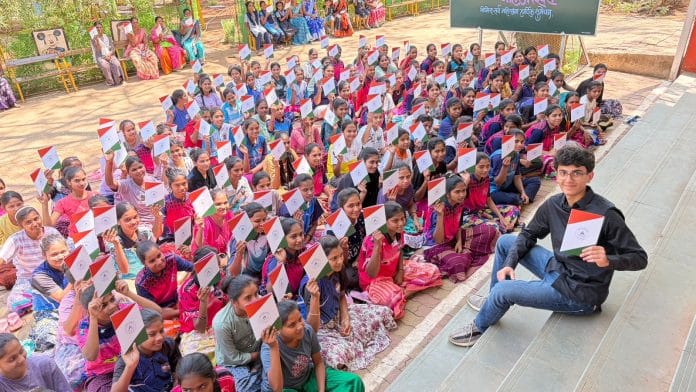
Ayaan now runs ‘Workers of India’, an initiative through which he conducts workshops across different residential societies in the western suburbs of Mumbai, registers informal workers on the e-Shram portal and distributes booklets explaining welfare schemes in English, Hindi and Marathi. Its website has since grown to include explainers on welfare schemes, a multilingual chatbot and ‘Naukri Nama’, a tool that generates basic employment agreements and salary slips.
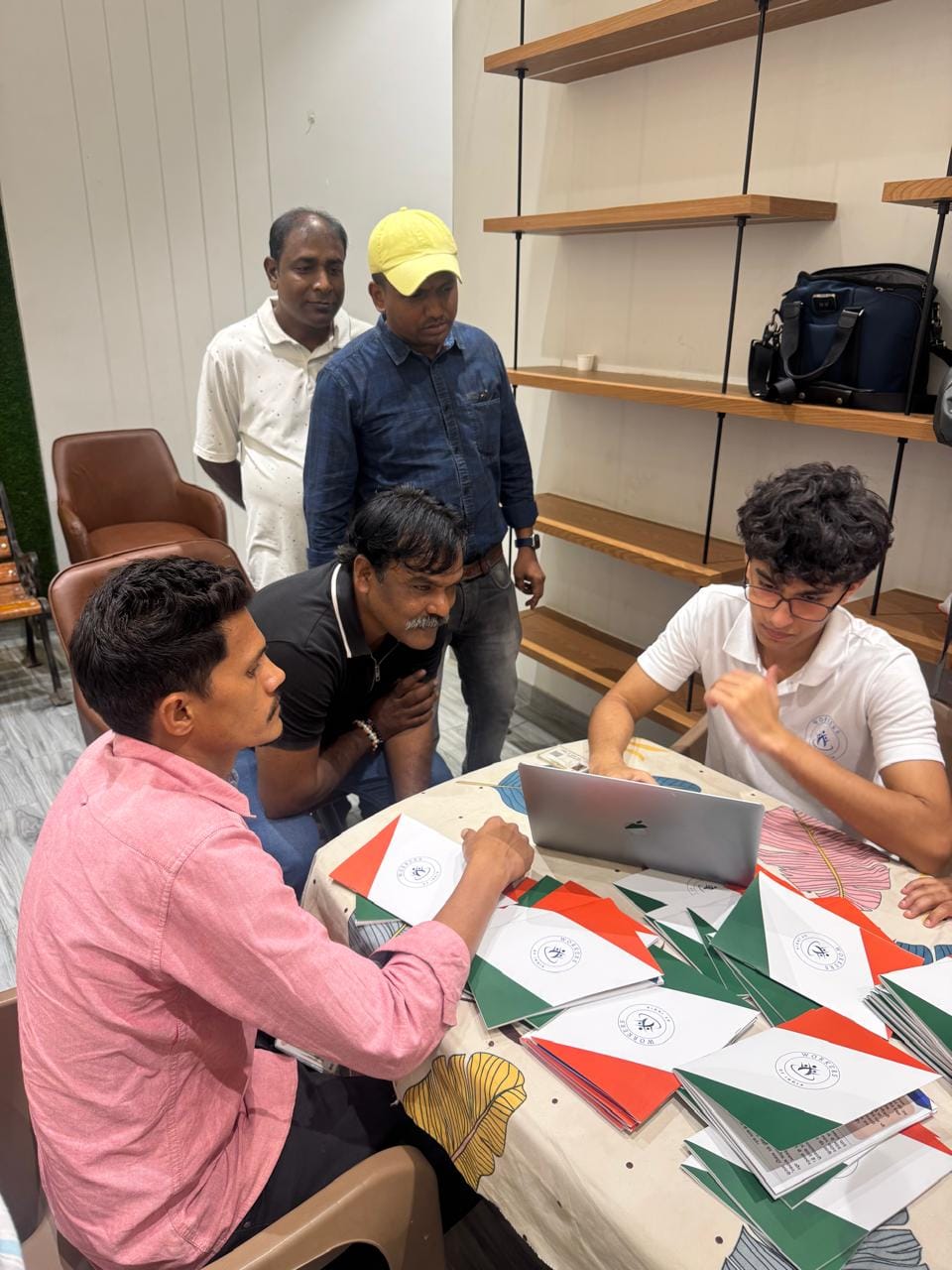
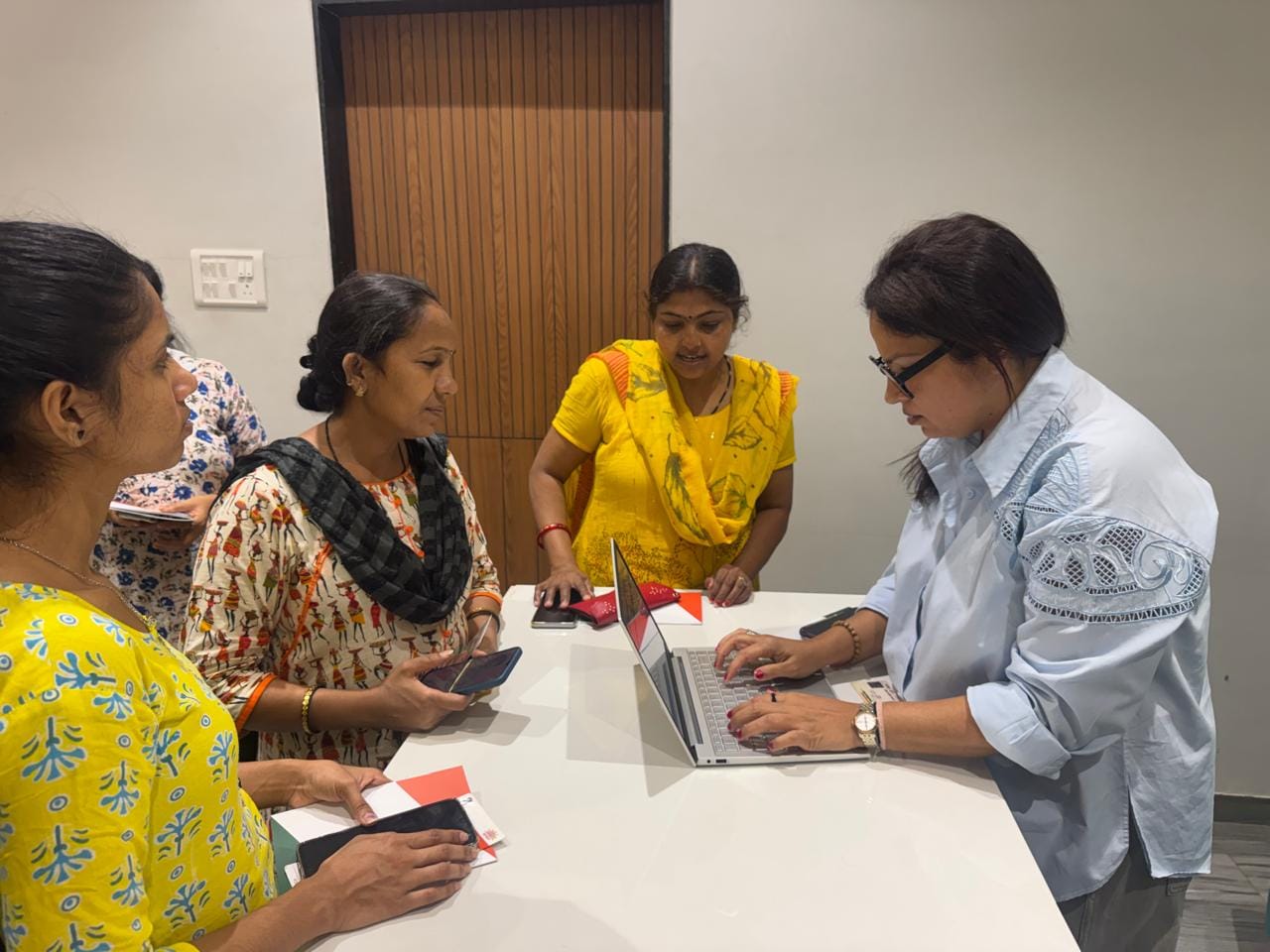
‘Workers of India’ says it has reached more than 1,000 workers and registered over 500 on the e-Shram portal. The need on the ground is huge. It comes out of the chasm between grand policy announcements and the inability of potential beneficiaries to even take the first step.
Launched by the Union Ministry of Labour and Employment on 26 August 2021, the e-Shram portal was conceived as a national database of unorganised workers — which includes domestic, migrant, construction, agricultural, gig and app-based platform workers. Once they are registered, each worker receives a Universal Account Number (UAN), which enables workers to access social security and welfare schemes.
“Once you actually have the e-Shram card, it’s sort of like a key that unlocks these schemes,” Ayaan explained.
But workers must still check their eligibility and apply separately for benefits such as pensions, insurance, housing assistance and skill-training programmes.
The gap between registration and receiving the benefit, however, can diminish the card’s usefulness. “Helping the workers actually receive benefits is an entire process altogether. Without adequate guidance, its effectiveness is seriously limited,” Ayaan said.
Why workers trust Ayaan
Ayaan spent roughly six months studying the e-Shram portal, the registration process and labour laws. He also participated in a Model United Nations committee modelled on the International Labour Organisation (ILO), before turning his research into a manual for workers.
Organising his first workshop in the summer of 2025 proved to be a tough task. But he was driven by a missionary zeal to help scores of informal domestic workers like Manisha.
He spent nearly three months writing emails to the RWA’s secretary, attending meetings and seeking permission from his housing society in Goregaon East. Even after securing a venue, he was uncertain whether anyone would attend.
“I was apprehensive that people wouldn’t even want to come here. Why would they listen to a teenager about things that could potentially help them? Why would they have any trust in me?” said Ayaan.
Manisha helped spread the word among other domestic workers. The session was attended by nearly 70 workers, far more than the 10 or 20 Ayaan had expected. He began his workshop with questions rather than an explanation of the policy.
“I began by asking: how many of them had heard of e-Shram. How many of them have had to ask their employers for money for medical needs,” he said. “Then, I asked them if they knew that they could seek a medical loan or get pension after retirement. This is when I had their attention.”
Then he went on to explain what e-Shram offers while circulating ‘Workers of India’ booklets among those attending.
For now, the booklets are available in English, Hindi and Marathi. But Ayaan plans to have them in more languages as ‘Workers of India’ expands to other major cities.
Since then, he has conducted eight workshops and several registration drives in residential societies across Mumbai and held smaller sessions for groups of factory workers in Palghar, Maharashtra. Currently, his peers work as student volunteers and help with registrations but Ayaan is also exploring a model to expand the initiative to more districts and cities.
At school, University Counsellor Padmaja Menon has watched the project develop from inception. Menon, Ayaan’s guidance counsellor since Grade 9, said she began working with him on ‘Workers of India’ right from the “ideation stage to where it stands today.”
“For a high school student to come up with this thought was truly inspiring. At first, I was sceptical about the degree to which he could scale this up,” Menon said. She connected Ayaan with Saanvi Foundation, an NGO on the outskirts of Mumbai, to spread awareness about his project.
Menon said the rigorous International Baccalaureate Diploma Programme (IBDP) did not affect his academics or ‘Workers of India’.
“Ayaan knows how to prioritise things and that’s the reason he never dropped in his academics. He was diligent and focused,” she said.
Menon added that his ability to collaborate and take suggestions meant the project developed relatively smoothly. But she has noticed a change in Ayaan.
“Ayaan is much more confident about himself compared to when he started the project; he is happier and cheerful,” Menon said. “I think that’s what being considerate to others does to you.”
A family that listens
Ayaan was born in the United States and moved to Mumbai with his family when he was five. An American citizen by birth, he plans to return to the US for graduation. Both his parents work in the information technology (IT) sector.
His mother, Pinky Panjwani, a product manager at a US-based tech firm, said conversations at home often encouraged him to question the status quo.
“In our family, we have a lot of conversations that are out of the box, and we talk about uncomfortable topics,” she said. “Ayaan has an opinion about everything that is going on in the world.”
She added that as a parent, she tries to listen to her son rather than dismiss an idea simply because it came from a child.
“I believe that schooling is beyond just textbooks. It’s beyond grades,” she said. “We need people to grow up as open-minded individuals, and we’ve got to support that.”
Ayaan’s parents paid to print hundreds of booklets and used personal connections to help Ayaan secure meetings with workers in housing societies. “Once inside the room, however, he took over since he is good at communicating,” Panjwani said.
Ayaan’s project was selected for the 2026 IB Global Youth Action Fund, making ‘Workers of India’ one of 110 youth-led projects chosen from over 40 countries. The award won him a $1,700 grant, along with a year of mentorship, programming and peer collaboration.
“It will directly fund the technology behind the chatbot and help bring my vision for a community mentor network to life,” Ayaan said. The plan is to build an AI-powered WhatsApp chatbot that can help informal workers generate employment contracts and receive real-time guidance while registering for welfare schemes.
“Building a multilingual tool with voice-to-text features requires more than just time and technical effort,” he said. “It requires a financial foundation to run the software, handle the AI processing, and eventually deploy it for the masses.”
A system not built for its users
When he began registering workers on the e-Shram portal, Ayaan noticed how a government website designed for unorganised workers could be difficult for many to use independently.
At a registration drive, Ayaan recalled, a woman arrived with her mobile number written on her palm because she could not remember it. “If a worker can’t even remember their phone number, how can they be expected to comprehend the website and go about the registration process?” said Ayaan.
Many workers, particularly women, had their Aadhaar cards linked to the mobile phones of their husbands or children. That added another layer to an already-complicated process.
“The registration process requires two OTPs,” Ayaan said, adding, “They would call their husband, get the first OTP, and then stay on the call for another five minutes until they get the second OTP. It’s really tedious.”
Filling the form can take ten minutes on a good day, and more than half an hour when the server fails. The CAPTCHA can be difficult to decipher, address fields are confusing, and some information must be typed twice without a copy-and-paste option.
“The questions are not the problem but the overall interface is difficult to maneuver,” he said.
Ayaan suggested a simpler user interface, reliable servers and a portal that works smoothly on mobile phones. But even a better website, he acknowledged, cannot solve limited literacy and digital familiarity. The government must hold more physical registration drives, publicise the programme and provide guidance to workers.
“Maybe in villages and smaller towns, the government has representatives helping workers, who want to register. But in big cities, reaching out to everyone would need more and more dedicated representatives,” he said.
So far, Ayaan has not taken his observations about the portal directly to the government. “I have not really spoken to anyone in the ministry or any officials as such. But I would like to convey my inputs and suggestions to them once I get more workers registered with the portal.”
The Union labour ministry has set up Common Service Centres to offer registration assistance, but Ayaan and his mother said locating a functioning centre can itself be a task. Numbers listed online may not work, centres may charge money, and workers must lose work hours to visit them.
“Sometimes these things are created but eventually abandoned,” Panjwani said. “The intention may be good, but the implementation dims as years pass.”
‘I felt good’
For Manisha, Wadhwa family’s domestic worker and the first worker Ayaan ever assisted, the e-Shram card offered the possibility of seeking support without always turning to an employer or relative.
Speaking in Marathi, Manisha told ThePrint that she had not known about the card or the benefits that come with it until Ayaan explained it to her.
“I felt good,” she said. “If we ask someone for money, it can be difficult for them to give it. With this card, we can seek a loan or save towards a pension using our own income.”
The experience also made her aware of benefits she had never associated with domestic work. “I did not even know that the retirement age is 60, or that domestic workers could also be eligible for pensions,” she said.
The gap between registration and measurable impact, however, is harder for Ayaan to track. He said that during one workshop, a worker told him a housing benefit accessed after obtaining an e-Shram card had helped her family move out of a crowded Mumbai home shared by seven people. Outside his own building, however, he often meets workers only once, making sustained follow-up difficult.
The next step: Naukri Nama
Having helped workers gain recognition from the government, Ayaan now wants ‘Workers of India’ to address the workers’ relationship with employers. ‘Naukri Nama’ creates an easy-to-understand employment agreement, which covers clauses on salary, working hours, weekly holidays and responsibilities. It can generate contracts in Hindi and English.
For Ayaan, the idea was to have a basic written record where employment arrangements, particularly for domestic workers, are often settled verbally. Having salary, working hours, holidays and responsibilities written down gives both sides a common reference point and makes expectations clearer. ‘Workers of India’ describes the idea as providing greater “dignity, fairness, and security” to both workers and employers.
Apart from the agreement, ‘Naukri Nama’ also provides a salary-slip generator. It gives workers a record of the salary they receive — adding another layer of documentation to jobs, where payments leave little paper trail.
Yet, Ayaan expects resistance. Employers have little incentive to formalise arrangements that currently depend on verbal negotiations. He believes the larger change must come through policy.
“If a house is not defined as a legal working place, how can you ever expect domestic workers to have a formalised working arrangement?”
His chatbot is another attempt to guide informal workers. It accepts text and voice notes in Hindi, Marathi and English and offers guidance on the working of the e-Shram portal, eligibility for welfare schemes and employment contracts through WhatsApp.
Ayaan is now looking to enlist younger students to take his initiative forward once he leaves for graduation.
“My ambition is to make it a legacy project. One person does something, another person sees it and takes action in the same way. Sort of like a chain reaction,” he said.
(Edited by Aakriti Handa)