


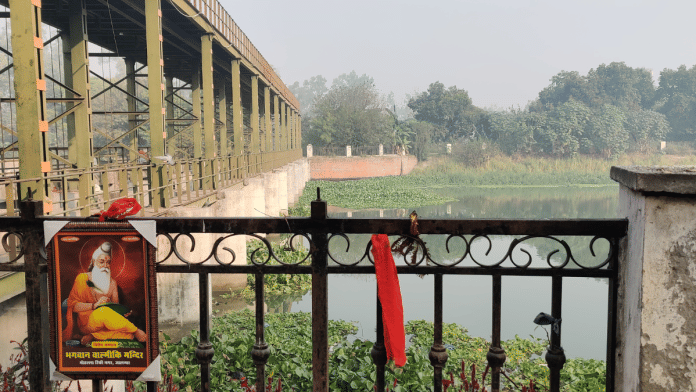
Kapurthala: Twenty-four years after Kanjli was recognised as a wetland of international importance, floating garbage, choking water hyacinth and abandoned tourist buildings have become part of its landscape. Now, the Punjab government wants to spend another Rs 20 crore developing the Ramsar site for tourists, even as questions remain over who is responsible for restoring its deteriorating ecology.
Successive governments have tried to turn Kanjli into a tourist attraction, leaving behind cycle tracks with missing streetlights, abandoned libraries and interpretation centres, and geese and ducks that seem out of place in the wetland. Also revered as a Sikh religious site, Kanjli has been pulled in different directions, with little clarity over whether conservation or tourism should come first.
This year, the district administration announced a new Rs 20-crore ‘eco-tourism development’ project for Kanjli, under the Union Tourism Ministry’s Swadesh Darshan 2.0 programme.
But the project has already raised concerns. In September, the tourism department awarded the tender to an event management company with no established record of wetland restoration. The project proposes boardwalks, glass bridges and huts along the wetland. Critics say the plan appears to prioritise tourism over ecology.
“I am all for making this a tourist hub, but in line with the local ecology,” said Bageshwar Singh, an ecologist and environmentalist from Jalandhar. “What Kanjli needs is ecological restoration, not just mindless tourism.”
Another makeover for Kanjli
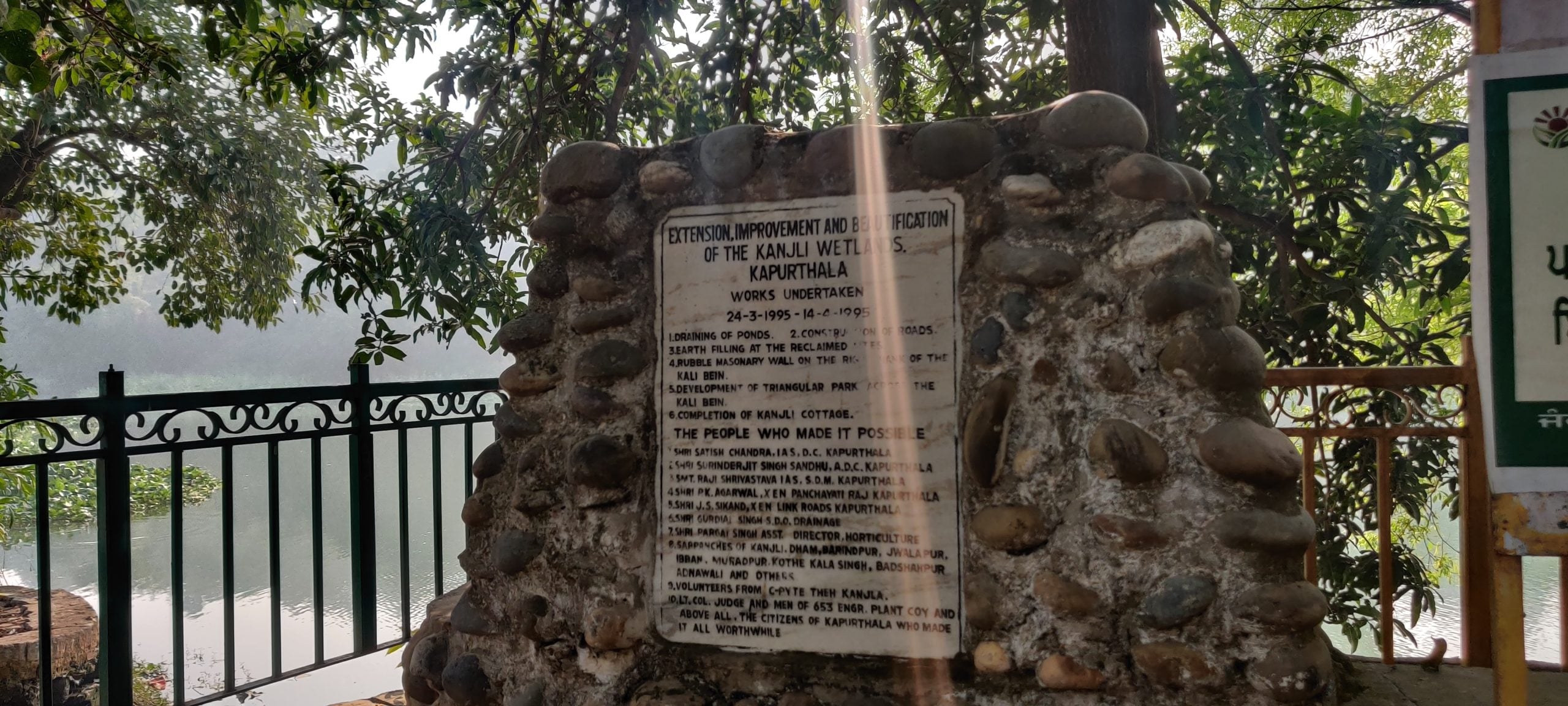
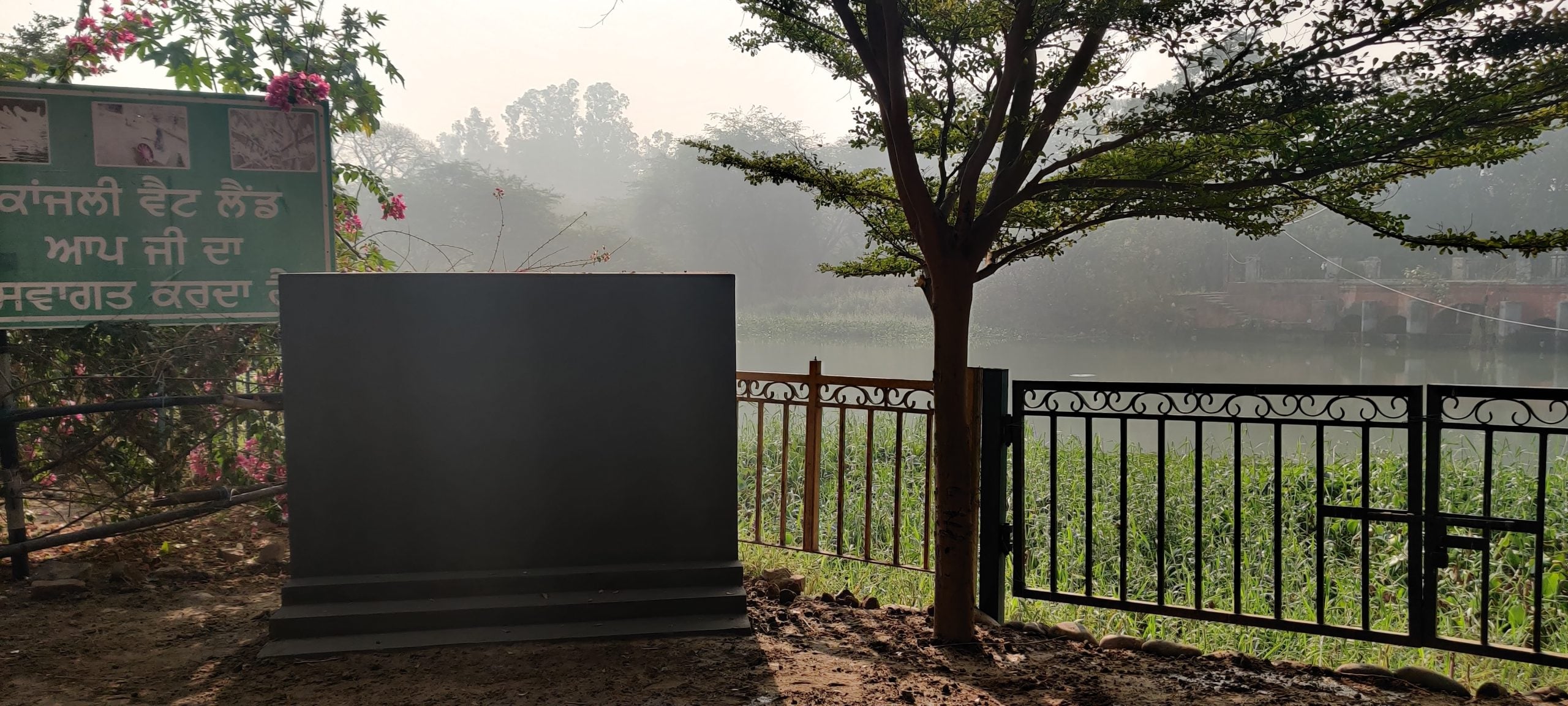
Two foundation stones stand just a few feet apart at Kanjli, reminders of earlier attempts to develop the wetland and attract tourists. Now, a third round of development is on the way, this time under the tourism ministry’s Rs 20-crore project.
The rivulet that forms Kanjli wetland is called Kali Bein, which literally translates to ‘black stream’. Its name originally came from the dark soil of the riverbed. Today, sewage flowing into the rivulet has given it another reason to be called black.
In Kapurthala, the wetland is flanked by a forest on one side and Public Works Department (PWD) land on the other.
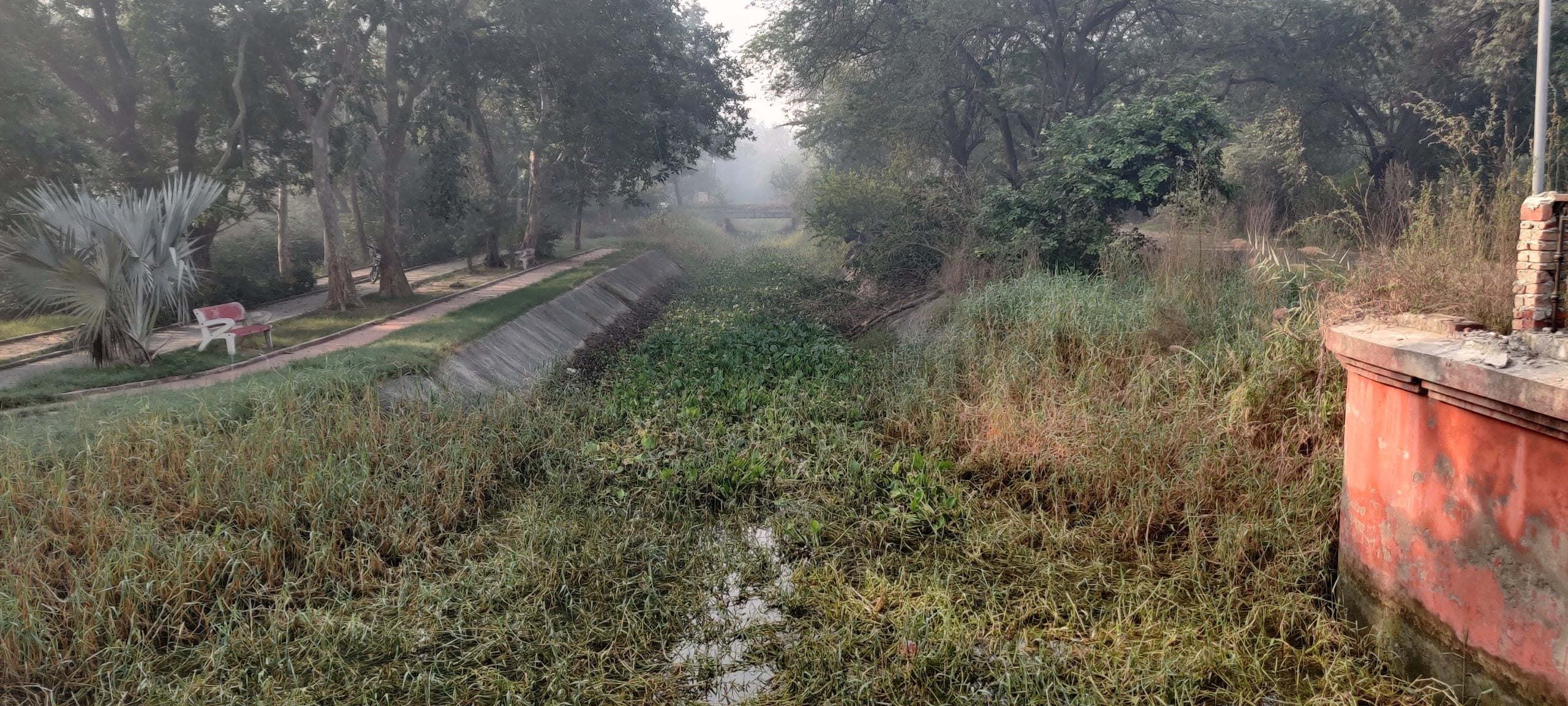
It was on this PWD land that the Kapurthala district administration began developing tourist facilities in 1995, building a park, cottage, library and interpretation centre. By 2000, a boating facility with four-seater pedal boats was drawing visitors from across Punjab. In 2006, more facilities, including a cafe and a jungle gym, came up. A small cycle track was also built on the forest side, gradually turning the wetland’s surroundings into something resembling a public park.
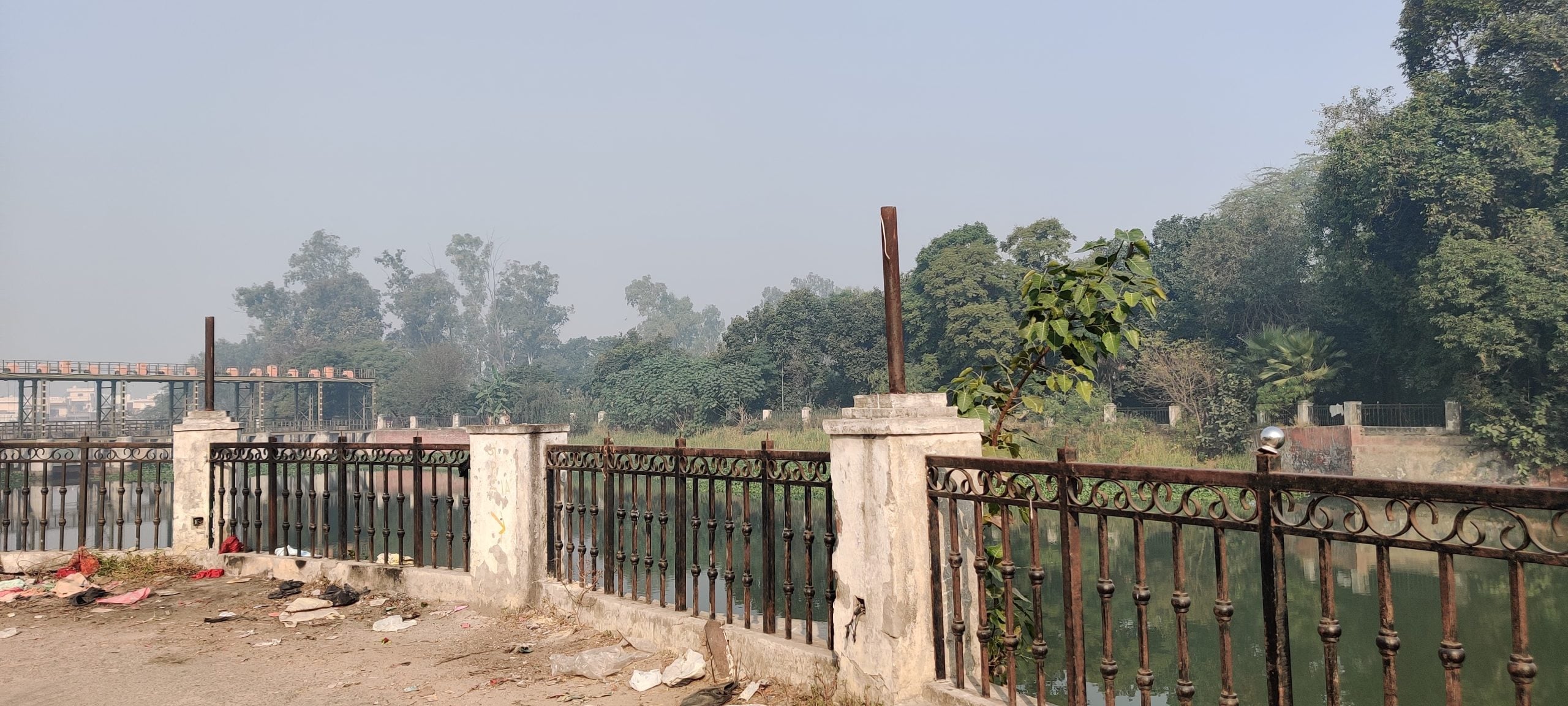
Now, the Swadesh Darshan 2.0 programme plans to revamp the area, building new interpretation centres and restaurants on PWD-owned land. The tender document issued by the Punjab Tourism Department, a copy of which is with ThePrint, also proposes a glass bridge connecting the tourist zone to the forest zone, along with watchtowers, yoga and meditation centres on the forest side.
According to the Punjab tourism department, the project will help revive Kanjli, whose surroundings have deteriorated over the past decade.
But the debate goes beyond whether the wetland needs another makeover. It raises a more fundamental question about how a Ramsar site should be managed and restored.
About an hour away lies Harike, North India’s largest wetland and a possible example of how biodiversity conservation can coexist with public interest. Yet Kanjli has struggled to follow a similar path, caught between the irrigation, forest and public works departments, with tourism now entering the picture.
“We want to beautify it and bring people back to Kanjli. Now, with the abandoned buildings and overrun forests, it’s just drawing unsocial elements,” said a senior official in the Punjab tourism department, on condition of anonymity. “And of course, we’ve taken all precautions to ensure the environment is protected.”
The tender, however, has done little to reassure ecologists and environmentalists in Kapurthala.
Despite being located at a Ramsar wetland site, the 267-page bid issued by the Punjab Heritage & Tourism Promotion Board does not mention the Wetlands (Conservation and Management) Rules, 2017, or the Environment (Protection) Act, 1986. It also makes no provision for an ecologist, environmentalist or environmental engineer on the project team, instead referring broadly to ‘sustainable’ construction using materials such as bamboo.
“One of the biggest blasphemies is the plants they want to grow. Out of the 18 trees and shrubs they’ve listed, only one is actually native to the region,” said Bageshwar. “Moreover, the list contains lantana camara–an invasive species. Most protected areas in India are struggling to remove it, but government wants to plant it in Kanjli?”
Bageshwar, who has a Master’s degree in Forestry from Forest Research Institute, Dehradun, completed his final research thesis on Kanjli wetland and its flora and fauna. He has been visiting the site since childhood with his father, who runs Pahal, a social development NGO in Punjab.
For Bageshwar and many others from Kapurthala and nearby Jalandhar, Kanjli was once a familiar destination for Sunday picnics, nature walks and boat rides.
“Kanjli is just a short drive from Jalandhar, and when we were young we would go there every month with friends, from school or with parents,” said Sahil Sareen, a businessman and birdwatcher from Jalandhar. “We’ve all done boating there; everyone who grew up in Jalandhar in the 90s and 2000s will definitely have memories of the place.”
But signs of neglect had begun appearing years ago. Bageshwar remembers organising cleaning drives with his father through Pahal as early as 2017, particularly in the forest adjoining the wetland.
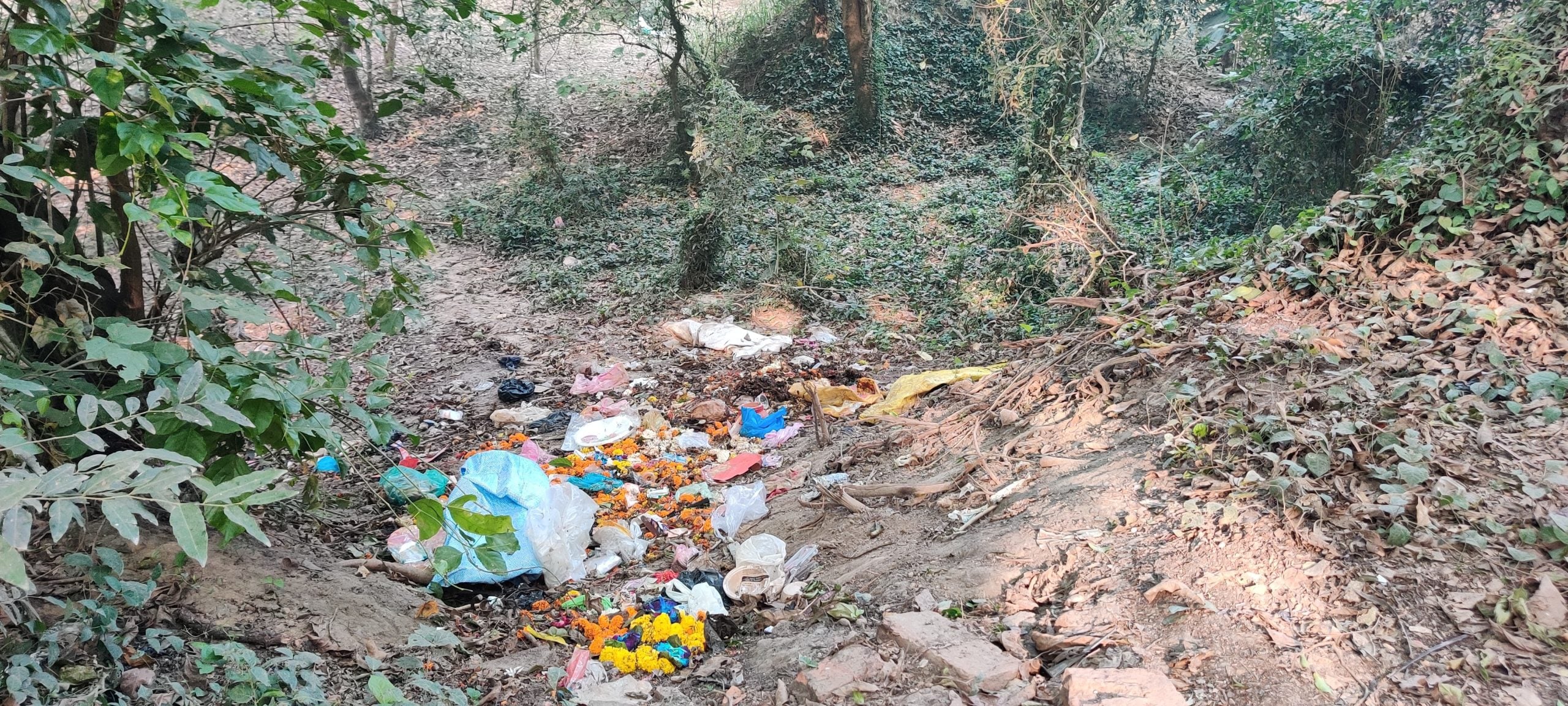
By 2009–10, the forest patch had become a dumping ground for household waste and dead animal carcasses. More recently, used syringes and hospital waste have also been found there.
“We used to organise cleaning drives with Pahal volunteers, and even asked the forest department for help many times,” recalled Bageshwar. “They allowed us to do our work always, but never actually offered help or showed any initiative themselves.”
Kanjli’s decline is particularly striking given the efforts that once went into securing its international recognition.
Kanjli Wetland was among the first ten wetlands in India to be designated as wetlands of international importance under the Ramsar Convention in 2002. India now has more than 103 Ramsar sites, including six in Punjab.
Kanjli, Harike and Ropar were Punjab’s first three Ramsar sites. Harike remains a major attraction, with more than 350 bird species recorded there, while Ropar has faced problems similar to Kanjli’s. Recent reports in The Tribune have highlighted wastewater and sewage contamination from multiple drains. Like Kanjli, Ropar has also reportedly witnessed a decline in migratory bird numbers amid worsening pollution.
How Kanjli became a Ramsar site
Long before Kanjli became a Ramsar site or a tourist destination, it was part of Punjab’s irrigation network. In 1870, Kapurthala’s ruler, Raja Randhir Singh, built a canal system around the Kali Bein rivulet, laying the foundation for the wetland that exists today.
He built headworks and a barrage across the Kali Bein rivulet, which flows from Hoshiarpur to Tarn Taran, before joining the Beas-Sutlej confluence at Harike, another Ramsar site.
More than a century later, it was Punjab’s forest officials who pushed for Kanjli’s international recognition. Basanta Raj Kumar, the former Chief Wildlife Warden of Punjab, recalls how the department surveyed Kanjli, Harike and Ropar between 1990 and 1995 to prepare their submissions under the Ramsar Convention.
“Being a Ramsar site offers international significance, but not necessarily legal protection. Still, we wanted to protect the wetlands from vested interests, and so we did our best to secure their recognition,” said Kumar, who retired from the forest service in August 2026.
The Convention on Wetlands of International Importance is an international treaty adopted in 1971 in the Iranian city of Ramsar, with 172 countries now party to it. It aims to protect wetlands and ensure their ‘wise use’, acknowledging their importance in sustaining ecosystems and biodiversity.
India signed the Ramsar Convention in 1982, designating its first two sites–Odisha’s Chilika Lake and Rajasthan’s Keoladeo National Park–in the same year. However, for almost three decades, the country did not have dedicated rules to protect wetlands as unique ecosystems. It was only in 2010 that the Union Ministry of Environment, Forests and Climate Change introduced the Wetlands (Conservation and Management) Rules, under the broader Environment (Protection) Act, 1986.
These Rules, which were subsequently revised in 2017, provided legal protection to wetlands against conversion of land-use, dumping of waste, and encroachment. The 2017 Rules also shifted greater responsibility for wetland management to state-level authorities, and Punjab was one of the first to comply and establish a Punjab Wetland Authority.
In a state like Punjab that relies heavily on groundwater, the importance of wetlands was recognised much earlier by the forest department itself.
“In most of Punjab, the groundwater levels are extremely low due to overextraction for agriculture,” explained SS Ladhar, former Additional Director of the Punjab State Council for Science & Technology. “But the natural functioning of wetlands was to control the water table, so they’re essential for us.”
In 1995, Ladhar travelled across the state, working with the Punjab Forest Department to identify over 14 wetlands and catalogue their ecological characteristics. His writings include the Inventory and Ecological Status of Wetlands and Lake Ecosystems of Punjab in 1995, along with early conservation plans and frameworks for protecting these systems.
Even back in 1995, Ladhar had identified the biggest challenges for Kanjli — sewage and garbage runoff from nearby villages, water hyacinths and other invasive species, and the threat of construction encroaching on the rivulet’s waterbody.
Three decades later, these challenges remain largely unchanged, but the state government’s efforts to address them appear to have weakened.
Why has there been so little government action?
A major part of the problem lies in how responsibility for Kanjli is divided. The wetland falls under three separate government departments–Forest, Irrigation and Public Works (PWD)–with no clear sense of collective ownership or accountability.
This fragmentation has also shaped its restoration efforts, according to retired bureaucrats in Punjab. Successive attempts to spruce up the site, in 1995, 2006 and 2020, were undertaken independently, with little attention to long-term upkeep. As a result, the cycle track built in 2020 fell into disuse, its streetlights were stripped of bulbs, the public buildings of 2006 now lie in disrepair, and the forest becomes a dumping ground weeks after any cleaning drive.
According to Shashpal Singh, the Forest Range Officer of Kapurthala, his jurisdiction is strictly limited to the 12 hectares of forest land adjoining the wetland.
“The forests adjoining the wetland, and the migratory wildlife like birds that come every season–only these are our responsibility. We work on the sides and embankments, not the actual water body,” he asserted. “And our job is to manage the existing trees and plant new ones. That’s it.”
Meanwhile, the irrigation department takes responsibility only for the water body, not the adjoining forest or the waste dumped in it.
“But everything is part of one ecosystem, and if each department just works in silos, how will they ever conserve the entire area?” questioned Bageshwar.
Efforts to bring these departments together under a common conservation plan have also fallen short. Kumar, who was part of the Punjab Environment department for over 40 years, said that in 2001 and 2002, they were tasked with preparing an Integrated Management Plan (IMP) for each important wetland in Punjab, including Kanjli.
An IMP, he explained, was intended to address the lack of coordination between different authorities, bringing all departments involved in the wetland under a single conservation plan. Despite working on it for four years and submitting it for approval, the Kanjli Integrated Management Plan never saw the light of day.
The new tourism project, however, plans to break this cycle of renovation and deterioration by handing responsibility for construction and upkeep to one company – EFactors. The company won the Rs 20-crore tender and will build and manage the site for the next five years.
Despite the project’s limited focus on ecological restoration, Kumar still sees potential in it to revive Kanjli.
“We need to understand that the area has both natural and religious significance, and the tourism department’s project is not going against environmental norms,” said Kumar. “It even has in-principle approval from the forest department, and once the detailed plan comes, that too will be presented for environmental approval.”
He added that not all aspects of the project need to be viewed in isolation; the plan to use lantana camara in landscaping, for example, is not abnormal or new.
“It is an invasive species when left unchecked, but if it is used in small pockets for landscaping, it can be quite beautiful actually,” he explained. “Similarly, small amounts of water hyacinth on the wetland surface are useful to absorb heavy metals in the water. Everything should be in moderation.”
While Kumar’s years of experience in the Punjab forest department have shaped his positive view of the project, ecologists like Bageshwar remain concerned. In his conversations with the state’s forest and tourism departments, he stressed the need to first protect the wetland and adjoining forest before moving on to tourism projects.
“I have recorded more than 150 species of plants and close to 200 species of birds in the wetland in my years of research, but this place needs to be protected to actually house them,” he insisted. “First restore the wetland, clean the forest, reduce the pollution, and bring back the biodiversity. Then we can start on the tourism.”
Gurmakh Singh Dhot, a 70-year-old resident of Kapurthala who runs the NGO Ambedkar Society, believes that successive tourism-oriented projects have further damaged the wetland’s environment.
“I have been coming here since before it was even declared a Ramsar site, and I remember when it was practically a wild forest area,” he said. “Now with the parks and the buildings and the towers they wanna build — let me ask you, where is the wetland in all this? They’re focusing on everything but the main site.”
Public record of disrepair
The original Ramsar Information Sheet for Kanjli wetland, prepared in 2002, mentioned that it was the only habitat in Punjab home to Utricularia, an insectivorous plant. Now, ecologists say the plant has disappeared from the wetland’s surroundings.
Reports of Kanjli’s disrepair began appearing in local newspapers as early as 2016, with activists and ecologists calling for better maintenance and restoration of its original ecology.
A 2024 study in the International Journal of Geoinformatics surveyed how changes in land use around the Kali Bein rivulet had contributed to steady ecological decline in the wetland. Around 85 per cent of the encroachment in the wetland area was attributed to infrastructure development, including houses and factories.
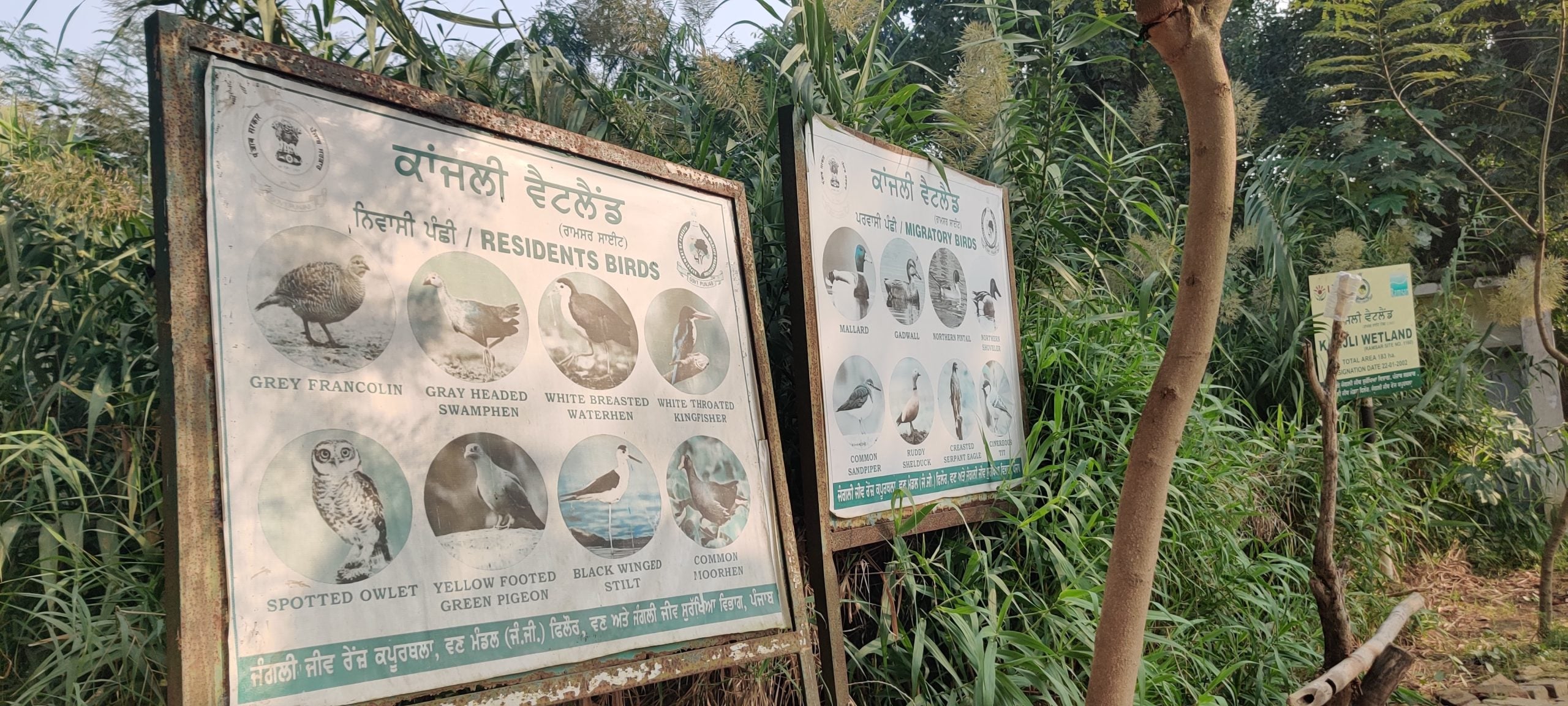
This eventually led to a decline in water quality, an increase in invasive species and a loss of biodiversity in the wetland. Birds such as the bar-headed goose, common teal and northern pintail, along with animals such as the Indian smooth-coated otter, small Indian civet and Indian pangolin, have become increasingly vulnerable in the region.
For locals in Kapurthala and Jalandhar, the decline has also been social and infrastructural. The brick-laden cycling path and the open gym, which once attracted schoolchildren and families alike, now seem unsafe to use after dark.
The road ahead
EFactors, the company now responsible for Kanjli’s redevelopment, has experience managing events such as celebrity weddings, government cultural events and an Eco-Retreat in Konark, a town in coastal Odisha.
While the contract has already been awarded, Bageshwar and other residents, including Sareen, are not ready to give up on Kanjli. They are planning to approach the National Green Tribunal (NGT), seeking a review of the proposed redevelopment project and enforcement of the Wetlands (Conservation and Management) Rules, 2017, which regulate activities affecting wetlands. They argue that the proposed construction could further undermine a wetland already struggling to survive.
For many in Kapurthala, however, Kanjli remains more than a neglected waterbody. It is a place they have grown up with and continue to feel attached to. Every afternoon, Dhot arrives on his bicycle, settles by the water and watches the few ducks paddle past, often drifting back to memories of what the wetland once looked like.
Bageshwar recently organised a drive to clear a section of the adjoining forest, only to return a week later and find it littered with garbage again. He is now preparing for a second drive and has already gathered 10 volunteers. For those determined to save Kanjli, the fight continues, one clean-up at a time.
(Edited By Raunaq Lekhi)