





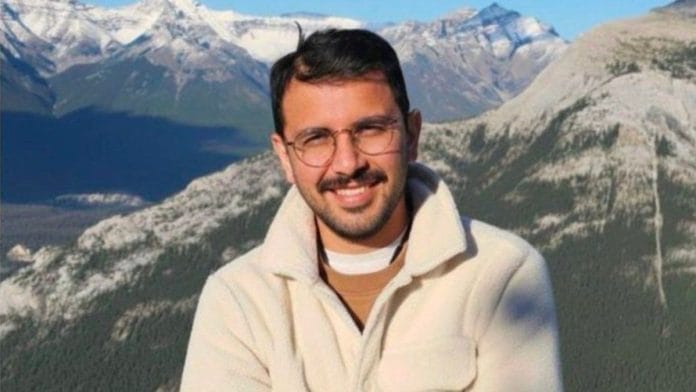



New Delhi: Canadian scholar Hamza Ahmad Khan came to Pakistan to research on human rights abuses in the country. Instead, he became a victim of the same. He was abducted by the local police and later charged under the Prevention of Electronic Crimes Act, or PECA, a controversial law enabling the government to curb online dissent. According to the FIR, his tweets posed a “significant risk” of severe reputational damage to the state of Pakistan.
Civil society and rights activists are enraged. They are calling it the “imposing of self censorship, suffocating silence through lawfare.”
Khan, 37, had arrived in Pakistan on 13 February to conduct interviews for his doctoral thesis. On 19 February, he disappeared after taking a cab in Lahore’s defence neighborhood.
According to friends who rallied for him, the University of Toronto was sponsoring his trip. He had been staying in a rented home in Lahore while its usual occupant was away.
For three days, Khan’s friends and family searched for answers. A kidnapping complaint was filed with the local police. Lawyers prepared to petition the Lahore High Court for his recovery. Rights groups warned of a troubling pattern.
Then, late at night, there was a phone call on 22 February.
Local reports said that according to Khan’s lawyer, Yousaf Rasheed, the PhD scholar told his sister that he was in the custody of Pakistan’s National Cyber Crime Investigation Agency, detained in connection with what authorities described as “defamatory posts” made online.
Khan’s last few tweets are in public support of Imran Khan, critiquing his detention. In his last tweet made on 19 February, he quote tweeted a public conference on Imran Khan’s detention, adding that it was good that PTI was finally “reaching out to global civil society, cricket fraternity, left organisations much, much earlier.”
“There’s still time. Abandon the lobbying and organise with likeminded orgs,” he wrote.
His last few posts on X are all on Imran Khan’s jailing or against Israel’s war in Gaza.
An inquisitive scholar
The revelation abruptly shifted the narrative from disappearance to detention, but left unanswered questions about why a foreign academic researching politics and human rights had seemingly vanished without any sort of acknowledgement from the state.
For now, with confirmation that Khan was in the custody of the cybercrime agency, plans to file a habeas corpus petition have been paused. There has been no public comment from the Canadian authorities.
Friends describe Khan as an inquisitive, sometimes provocative, scholar whose research had increasingly focused on questions of secularism, political Islam, and Western influence in Muslim-majority countries. In recent months, they said, he had turned his attention to the war in Gaza and what he viewed as the legacy of colonial power structures in the Indian subcontinent and the Middle East.
“He was doing exactly what he was supposed to do as a legit doctoral candidate — he was asking questions,” Ammar Ali Jan, a Leftist politician whom Khan had interviewed shortly before his disappearance, told Pakistan’s Voicepk.net.
“This regime is waging a relentless attack on dissent,” Jan wrote on X.
Khan, his friends insist, was not aligned with any political party. They told local reporters that he had criticised multiple factions in Pakistan’s polarised political landscape, including the party of former Prime Minister Imran Khan, while also condemning what he saw as human rights violations.
Jan said their conversation touched on the European Union funding for democracy and human rights initiatives in Pakistan, as well as broader debates about secularism and political Islam.
Entrepreneur Faisal Sherjan, who has known Khan since 2022 and had rented his house to him, said the scholar had engaged in wide-ranging discussions about South Asian political systems, including India’s 2014 elections, and had interviewed journalists, lawyers, and activists across ideological divides.
“He was impartial,” Sherjan was quoted as saying. “He was critical, but that is what scholarship demands.”
Also read: Who is Ania Wazir? 7-yr-old Pakistani cricket prodigy accused of being unIslamic
‘Collapse of the state’
The Human Rights Commission of Pakistan had earlier expressed alarm over Khan’s disappearance, urging authorities to trace his whereabouts and ensure his safety. On social media, commentators and former officials cast the episode as emblematic of a broader chill on dissent, citing the increasing use of the country’s cybercrime laws as a tool to police speech.
For some, the episode has underscored concerns about the vulnerability of researchers in an environment where political debate is tightly contested and online expression can carry legal risk.
“If you want global academics to come to Pakistan,” Jan told Voicepk.net, “incidents like this can be a huge hindrance.”
Farhatullah Babar, the former spokesperson to the President of Pakistan, called it “imposing self-censorship, suffocating silence through lawfare.”
“Victims are no longer only Baloch youth. Three days of disappearance must be investigated. Being a Canadian national, Hamza was fortunate to have finally surfaced at least,” he wrote on X.
Hussain Nadim, a Pakistani policy expert, called it the “collapse of the state”, calling the PMLN regime “a curse on Pakistan and its people.”
“This is the definition of a state collapse. One arm of the state has no clue of the other arm of the state. To abduct a Canadian PhD researcher for ‘defamatory posts’ and remove his existence for days without any word or explanation are the signs of peak fascism,” he wrote on X.
Nadim described Hamza Ahmad Khan as a “true academic critic who didn’t shy away from taking principled public positions on a range of issues including Gaza, Balochistan and against the Western imperialism”.
“I believe he was targeted because he represents that segment of Pakistan’s youth: overseas, educated and with the voice that the current fascist regime in Pakistan is trying to crush. His presence in Pakistan for his fieldwork gave the state an opportunity to make a lesson out of him,” Nadim told ThePrint.
On the PECA law, he said, “Such draconian laws represent not a thriving nation, but one that is despearate and failing. To me, these are all signs of the imminent collapse of the Pakistani state under the burden of its own weight”.
Pakistani professor Nida Kirmani, too, criticised the use of PECA against dissenters.
“PECA is their new weapon of choice — a sword dangling over all our heads. Hope the Canadian authorities can intervene in Hamza’s case,” she wrote on X.
Another Pakistan X user, Aimun, said, “We are just sending people to jail on the RISK embedded in their actions? Not even the actual act committed? But the potential fallout of them?”
(Edited by Aamaan Alam Khan)
Uff. Pakistan, the darling state of Indian libs, socialists and leftists, is clearly and vividly telling that they are the REAL dictator.