





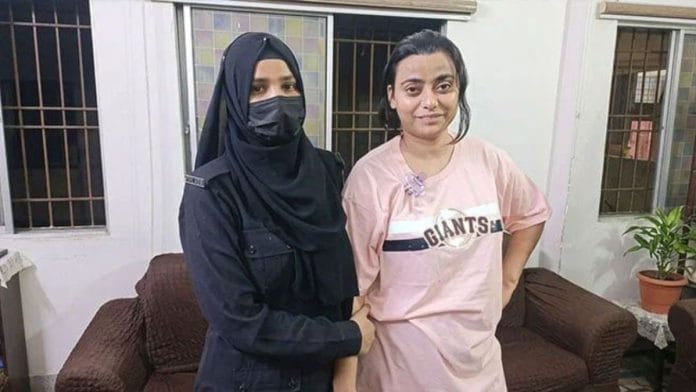


New Delhi: Karachi’s famous ‘cocaine queen’ will now have a TV series on her. The viral drug seller who caught Pakistan’s attention last month has been dubbed the country’s own Pablo Escobar. Pakistani actor Saba Qamar has reportedly been cast in the lead role, while acclaimed journalist and television host Shazaib Khanzada is penning the script for the series.
Queen Madam Pinky, alias Anmol, a resident of Karachi, captured the country’s imagination after she was arrested for selling cocaine to high-end upscale localities in Karachi, Lahore and Islamabad. For days, her antics in the court and in jail kept Pakistanis hooked.
According to investigators, Pinky allegedly supplied cocaine to affluent neighbourhoods, including Defence Housing Authority (DHA), a military-backed area in Karachi and Clifton, an upscale residential area in Karachi and marketed premium-grade narcotics to elite clientele under the slogan: “Queen Madam Pinky — the name alone is enough, enjoy.”
She has been booked under multiple charges of narcotics trafficking, illegal weapons possession, and murder.
‘An opportunistic ploy’
Now, reports state that prominent Qamar is set to essay her role in a TV drama based on the life of Anmol. Although there are no confirmed reports yet, the news of such a drama has not gone down well with many. One of the strongest criticisms came from Pakistani actor and director Shamoon Abbasi, who called it an ‘opportunistic ploy’.
The move was first reported by Pakistan’s Diva magazine, which in an Instagram post said that “a high-profile biographical drama based on the life of Anmol is being made”.
The idea was first floated by Pakistani content creator Bilal Hassan, also known on Instagram as mystapaki, who had, in a video, said that Qamar should play the role of Pinky if a movie is ever made on her.
Abbasi questioned the decision to make a drama on her in a Facebook post where he argued that Pakistan has countless inspiring women whose stories deserve the spotlight instead, while acknowledging Qamar’s ability to bring any role to life despite his grievances.
His take has led to a debate. Most Pakistanis agree with him and say they don’t want a drug dealer to be given so much attention. Others are curious—“Why can’t a movie be made on this topic?”
Pakistani Instagram user Asim Abbas thinks it will be a ‘shallow, half-baked show’.
“We never dared to take inspiration from Benazir Bhutto, Noor Jahan, Reshma gee, Perveen Shakkir but from PINKY,” Abbas added.
Also read: Pakistan defers move to restore Hindu-era names of Lahore areas. Will gather public opinion now
‘Let the Pakistani industry grow’
Not everyone agrees. “We should educate people about what is the affect of doing such criminal works. Our parents need to watch so that they can train their children well. Don’t be so jaahil. And let the Pakistani industry grow. Barzakh ko bhi esy hi ban krwaya tha. (barzakh too was banned because of this kind of response),” an Instagram user, Saba Qamar lover, added on.
Soon, even the Punjab government weighed in. In a recent interaction in Lahore, Punjab Information Minister Azma Bokhari confirmed that a drama was being made on the drug supplier and added that while it is an interesting topic, a film should instead have been made on her life.
Abbasi, meanwhile, questioned the decision to cast a widely admired actor in the role of a figure associated with alleged criminal activity, arguing that doing so risked amplifying Anmol’s notoriety.
While acknowledging that the story could be explored as a creative project, Abbasi suggested that a feature film would be a more suitable medium than a television drama. In his view, cinema audiences make a deliberate choice about what they watch, whereas television dramas often reach family audiences, including young viewers, making the subject matter more sensitive.
(Edited by Saptak Datta)