


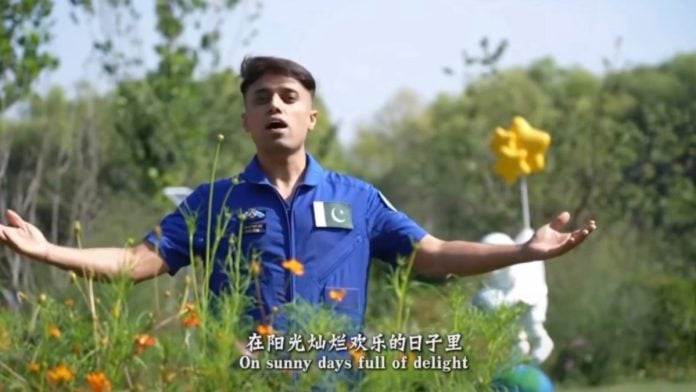
New Delhi: On Wednesday, Pakistani Air Force fighter pilot Muhammad Zeeshan Ali became the first foreign national to step foot aboard China’s Tiangong space station. But before testing his mettle in zero gravity, this 40-year-old, 5-foot-6-inch-tall military man found himself in China’s flower gardens, with his arms spread open—invoking his inner Shah Rukh Khan—singing about China-Pakistan friendship in Mandarin.
In a video released by the Pakistani Embassy in China a day before the launch, Ali, along with his backup crew member Khurram Daud, also a Pakistan Air Force pilot, was seen singing a “friendship song” in Mandarin, ahead of Wednesday’s Shenzhou 24 mission.
The video, titled ‘Chinese and Pakistani astronauts sing the same song’, opens in a flower field with a lullaby-like melody reminiscent of school hymns. The scene continues to deliver on that promise, with young children lined up, rocking in sync as they sing, “Flowers once told me how you walked through days. The earth knows every corner inside your heart.”
But this children’s song quickly changes its protagonists. Two Pakistani fighter pilots, dressed in their astronaut overalls, take centre stage.
Fighter pilots turned singers
Daud starts off the song in the video. His hands first rest on his waist, then stay crossed and finally hang awkwardly by his sides as he hums, “We crossed a thousand seas and mountains tall.”
The lead astronaut joins in soon after. “Each meeting, each smile engraved in us all.” He seems much more aligned with his inner singer. He opens his arms and then tries to match his movements to the notes he is singing.
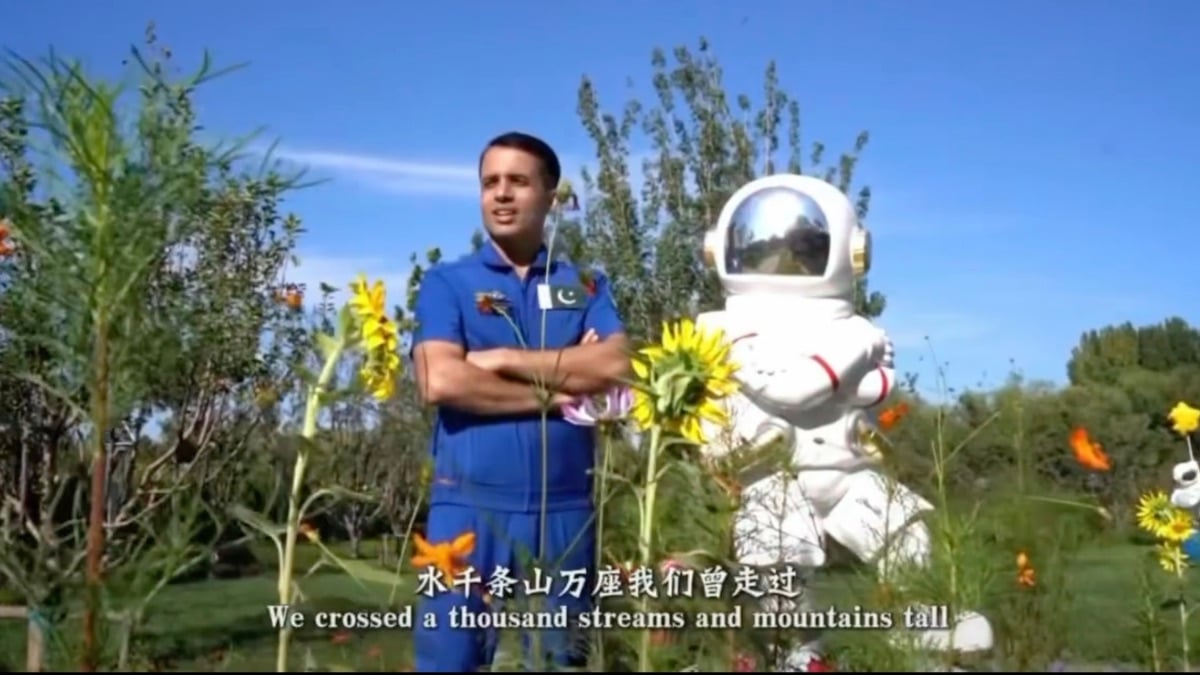
Ali and Daud’s Chinese astronaut colleagues join them, but the focus remains on the guests throughout the musical.
The Pakistan Embassy in China titled the video, “Pakistani astronauts sing in the language of their Chinese friends.”
The gesture was reciprocated by the Embassy of China in Pakistan, which called it, “One Song, One Dream!”
“From training side by side to journeying into space together, Chinese and Pakistani astronauts have come together with a shared dream,” the Embassy post said.
It added: “Shared feelings give us the same longing; shared happiness brings us together in one song. Across languages and mountains, this familiar melody celebrates the deep friendship between our two nations and our shared aspirations for peace, cooperation and a brighter future.”
Reception
Pakistani media coverage has called this performance a “special song”. To make it more accessible to local audiences, publications translated it as, “Sitaaron Se Aagay Jahan Aur Bhi Hain.”
“Its central theme reflects the message that Pakistan-China friendship has transcended geographical boundaries and is now reaching the vastness of space. The song features inspiring lyrics expressing determination, courage and the resolve to turn dreams into reality,” an article published by Radio Pakistan read.
But social media has not been very kind.
A handle on X, which goes by the name Surena Sokolov, said that Pakistan’s “bad boys” were reduced to “PG-rated entities”.
“ISPR (Inter-Services Public Relations) has always portrayed PAF pilots like untouchable bad boys but China has totally stripped them down into PG-rated entities,” the account said in a post.
Indian journalist Vishnu Som also posted the video.
“I’ve been fighting with people online for days. Then I watched Pakistani astronauts sing in Mandarin, in a field of flowers, and realised none of it ever mattered. One small step for man, one giant Bholari for mankind.”
(Edited by Prashant Dixit)