





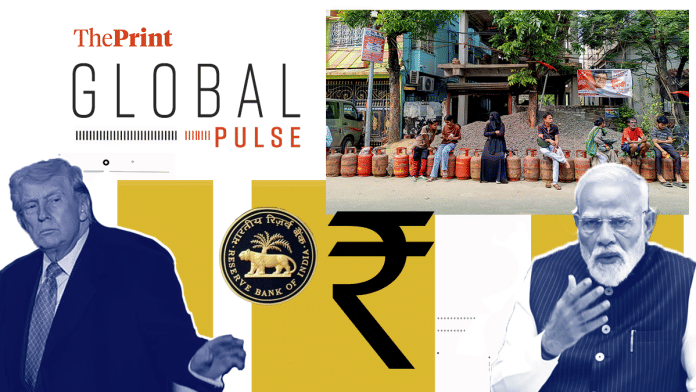



New Delhi: Trump 2.0 is testing India’s strategic resilience and negotiation tactics, writes Milan Vaishnav. He argues that the Trump administration “has adopted a more assertive and unpredictable approach to US foreign policy”, raising questions over the viability of India’s strategic autonomy and diversified partnerships.
“Over the past three decades, Indian foreign policy has been increasingly organised around a strategy of diversification—deepening cooperation with the United States and the West, while also cultivating relationships across a wide range of regions and non-US-aligned institutions,” Carnegie Endowment for International Peace senior fellow Vaishnav writes for the think tank, adding that whether this approach remains sustainable remains to be seen.
He also questions the extent to which the current US administration is “disrupting” India’s approach to global affairs, referencing India’s “hedging” strategy on Russian oil imports.
India has limited “room to manoeuvre” between the US, Russia, and China, Vaishnav argues, writing “while New Delhi has shown considerable diplomatic agility, it cannot ignore the structural constraints it faces”. The US remains indispensable as a source of technology, capital, and defence cooperation; China is India’s primary long-term competitor; and Russia plays a significant role in India’s defence and energy sector.
Trump’s tariff war in his second term has clearly demonstrated how “economic interdependence can be weaponised”. And thus, India has had to move away from “inward-oriented economic strategies” to multiple trade negotiations and deepened global economic integration. “In New Delhi, economic integration has been recast as a pillar of strategic resilience rather than merely a commercial interest,” Vaishnav writes.
He terms what Delhi is pursuing as “adjustment without realignment”. “The volatility of US leadership has both strengthened and vindicated New Delhi’s instinct to diversify its partnerships. The erosion of multilateral institutions has reinforced India’s calls for their reform and for more representative global governance.”
Digital arrest is the new buzzword in India, and it is gaining wide traction in the West as well. To illustrate this global trend, Shan Li of The Wall Street Journal reports on India’s digital arrests in ‘Fake cops, fake judges: The Hollywood-style scam poised to go global’.
“Last Christmas Eve, a 77-year-old woman in New Delhi got an unexpected call from what she thought was the police. Contacting her by WhatsApp video, the team of uniformed cops inside a police station said she was under arrest on suspicion of money laundering.” She then attended a “virtual hearing” before the “Supreme Court”. Cops told her to keep her laptop and phone cameras at all times, so she can be monitored.
Li asserts that the scam is bound to find its way to Hollywood. “The Indian scam, now common across the country, involves Hollywood-level production that mimics the machinery of the state, tricking people with fake police stations and courtrooms.”
The scams are also cropping up in US immigrant communities, says the report, adding that these, however, haven’t spread widely in Western countries, “in part because of a shortage of scammers proficient in American or other Western accents”.
Citing a statement by Chief Justice Surya Kant, the report notes that from 2021 to 2025, Indians lost nearly six billion dollars to digital arrest scams.
A few operations running the scam have been busted in India, Li highlights that police investigations reveal that elaborate digital arrest scams originate in Cambodia and Myanmar, thus “making it hard for Indian police to stop them”.
Moving on from digital threats to geopolitical upheaval—Meena Kandasamy, in The New York Times, writes: ‘Trump is setting the world on fire. The rest of us choke on the fumes’.
Kandasamy harks back to when kerosene was the staple fuel for Indian cooking, but the country made the shift to Liquefied Petroleum Gas (LPG) in 2014, paving the way for a cleaner cooking fuel. “President Trump’s war on Iran has turned the transition to LPG into a vulnerability.”
As much as 60 percent of India’s LPG is imported, and most comes through the Strait of Hormuz. “With the war slowing shipments to a trickle, millions of Indian families are scrambling to keep their kitchens running. It’s gotten so desperate that the government is even reviving use of the hated kerosene.”
She notes how it was Trump’s pressure in the first place that made India “vulnerable” to the geopolitical shockwaves. Trump last year imposed a 50 percent penalty tariff on India for buying Russian oil—essentially forcing India to shift its reliance on the Gulf for energy supplies. “Now, Mr Trump’s war is choking that route.”
“LPG rationing has begun, triggering panic, hoarding and a flourishing black market. Roadside eateries and food stalls where the working classes eat—and which run on LPG—are shutting down. Restaurants are reducing hours, modifying menus and laying off staff.”
The author emphasises the feasibility of kerosene as a fuel, as many homes do not have the necessary cooktops, following the 2014 transition. “We are being dragged back into a past for which we are no longer prepared,” she adds.
Further, the push for electric induction stoves has been futile due to frequent power outages, high electricity bills, and the inability of Indian dishes to adapt to a “single, weak induction burner”.
“This month, Prime Minister Narendra Modi told an election rally in my home state of Tamil Nadu that Indians would overcome this crisis,” writes Kandasamy. “To many of us, that sounded ominous—the last time we heard talk like that was during the pandemic, and that was followed by a lockdown that upended millions of lives.”
Anup Roy writes in Bloomberg about the RBI’s failing rupee defence in the face of the continuing war in West Asia. “The Reserve Bank of India took a dramatic step late last week to curb speculation in the foreign-exchange market and cushion the rupee as it slumped to record lows,” he reports.
The column states that the situation reflects India’s dependence on oil as the world’s third-largest crude importer. It further explains that remittances from Indians working in the Gulf are also likely to fall, which will add to the burden. “With more foreign exchange flowing out of the country than coming in, the currency is taking a beating.”
Economists say that for every 10 percent increase in the price of oil, the current account deficit would widen by approximately 0.4 percent of India’s GDP. The current account deficit was expected to reach one percent of GDP in the fiscal year ending in March. “That may widen to 2.5% in the coming fiscal year,” Roy says, citing an estimate from Standard Chartered PLC.
India’s capital account deficit is only expected to worsen with foreign investors selling millions of stocks for “safer havens”, the column points out.
(Edited by Madhurita Goswami)
Also Read: How AI may present an opportunity rather than an upset for India’s IT industry