





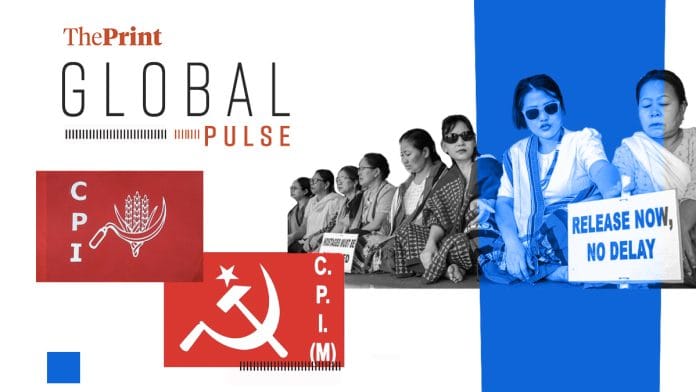


New Delhi: The fresh bout of violence in Manipur has been the deadliest since May 2023, reports Hari Kumar of The New York Times.
“More than a dozen people have been killed, including three Kuki church leaders who were shot in an ambush on May 13. Dozens have been kidnapped,” the report notes. “In the past few weeks, the fighting between the Meitei and Kuki peoples has spilled over to embroil a third ethnic group, the Nagas. Kukis have clashed with Nagas in the hills of Manipur, amid disputes over rights of residence and control of the territory.”
The NYT visited Manipur in March, prior to the violence, and found a state divided, with “buffer zones like an international border between hostile countries… Tens of thousands had settled into lives constricted by the Meitei-Kuki conflict, with the government handing out roughly a dollar a day to those registered as internally displaced. Their camps fill public buildings, subdivided by hanging bedsheets.”
Up and down India’s NH 2 to Manipur, there are countless roadblocks with armed guards, broad no-go zones between barbed-wire fences, and the “constant threat of attack”, the report notes.
The reporters, while travelling in Manipur, also discovered that “A Meitei driver cannot come to Churachandpur and a Kuki driver cannot go to Imphal without the risk of being killed.” The main buffer zone in Bishnupur divides the Meiteis in the north and the Kukis in the south. “A heavily patrolled strip of land is subdivided by at least eight official checkpoints managed by heavily armed forces answering to the government, including the army, paramilitaries and state police. Entry required proof of identity and a convincing reason. Kukis and Meiteis were not allowed to cross,” the report says.
India’s communists once ruled millions. What happened to them? Soutik Biswas of the BBC asks.
Since UDF won the Kerala assembly polls, for the first time in 50 years, no state in India has a Left-ruling government. “At their peak, India’s communist parties ruled states stretching from West Bengal to Kerala and Tripura. They impacted the lives of more than 100 million people through trade unions, peasant organisations, student wings and disciplined cadre networks,” the report states.
The BBC also says that Communist parties have always wielded political power far beyond their electoral size. In 1996, Jyoti Basu, a founding member of CPI (M) and then West Bengal’s chief minister, was only inches from becoming India’s prime minister as head of a coalition government.
“Despite economic stagnation in West Bengal and concerns over declining educational standards under Left rule, the communists continued to wield outsized influence over economic thinking and intellectual and cultural life well beyond their electoral strongholds,” says the report.
Even in Kerala today, while the LDF has lost power electorally, the Left parties remain consequential. In Bihar too, the CPI (ML) has “emerged as an energetic grassroots force in some pockets”. Left-backed student groups continue to fare well in leading universities. But the larger decline of Left parties highlights “the fading of an older political language: Class struggle and collective mobilisation have steadily given way to identity politics, nationalism, populist leaders and welfare delivery.”
Although experts say that the economic and political circumstances today—soaring inequality, chronic youth unemployment and deepening economic insecurity—are the “objective conditions” for Communists to thrive. “Still, writing obituaries for political movements is premature.”
Greg Mercer and Mike Hager of The Globe and Mail interview India’s top diplomat to Canada, who accused the Royal Canadian Mounted Police of probing “fantasy” allegations of Indian interference.
“High Commissioner Dinesh Patnaik went on the offensive, attacking the integrity of Canada’s national-security agencies, while pushing back against assertions from Canadian authorities that the Government of India has directed multiple homicide plots and foreign-interference campaigns on Canadian soil.”
Patnaik asserted that the Canadian intelligence agency has been compromised by Sikh separatists who are using Canada as a base for the Khalistani movement. Canada’s Minister of Public Safety, Gary Anandasangaree, in a mail to The Globe and Mail, rejected the allegations.
“The real threat to Canada, Mr Patnaik said, is from extreme elements of the Khalistan independence movement. He accused Ottawa of “protecting” Khalistani separatists who the Government of India alleges are linked to violence,” the report says.
David Ramli of Bloomberg reports on the Byju founder being sentenced to six months’ jail for contempt by a Singapore court. “Byju Raveendran was ordered to serve jail time after the court said he had disobeyed multiple orders related to his assets dating back to April 2024. It’s the first time a judge has threatened to imprison the once high-flying entrepreneur, who founded one of India’s highest-profile tech startups before a post-Covid slump pummeled the business,” the report notes.
Raveendran has been instructed to surrender himself to officials, pay costs of S$90,000 ($70,500) and provide documents proving his legal ownership of Beeaar Investco Pte, a corporate entity that held shares in a related company, the report says.
“The threat of jail time is the latest blow to a founder who is now facing claims from foreign investors around the world, including in the US where lenders are fighting to claw back losses from a $1.2 billion loan that soured.”
(Edited by Viny Mishra)
Also read: Rubio’s visit has global media asking—why is India ‘committing’ to buy $500-bn worth US goods