





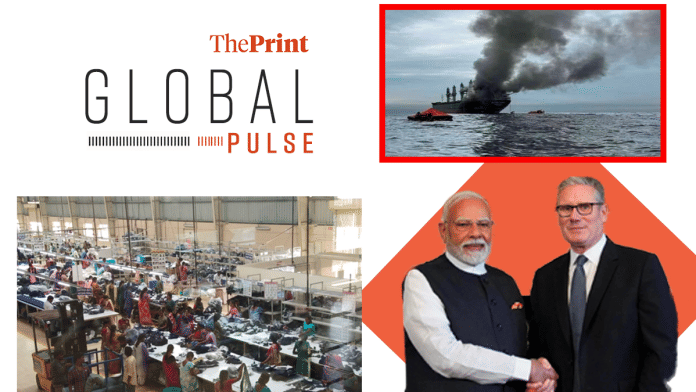


New Delhi: The historic India-UK Free Trade Agreement, signed in July last year, comes into effect Wednesday, and there is much excitement among market analysts, Indian exporters and shoppers, as captured in a BBC report by Nikhil Inamdar.
The trade deal would remove or reduce tariffs on 99 percent of Indian exports to the UK, and 90 percent of UK imports to India, the report says.
Inamder also reports that this could increase the GDP of the UK by 0.13 percent, and India’s by 0.06 percent in the long run.
In terms of tariffs applicable, the deal puts India at par with its south Asian neighbours Pakistan and Bangladesh, whose exports entered the UK duty-free through the Developing Countries Trading Scheme (DCTS), while India had to pay 12 percent tariffs.
However, as the report notes, analysts are also skeptical due to other tariffs and non-tariff barriers that the UK places on imports from India.
One such challenge that the report outlines is UK’s tariffs on steel imports above a specific quota to protect local manufacturers, Ajay Srivastava of Global Trade Research Initiative (GTRI), an India-based trade policy think tank, told the BBC.
The UK’s proposed Carbon Tax could also reduce trade deal gains, Srivastava told the BBC. Because even if the tariffs fall to zero under the deal, “carbon-related border charges could increase the effective cost of Indian exports in sectors covered by the CBAM (Carbon Border Adjustment Mechanism), creating new trade frictions,” he added.
Moreover, non-tariff barriers like lack of awareness would also end up hampering the deal’s reach. “Historically, India’s utilisation of FTAs has been low because small businesses are often unaware of the new rules. As a result, only about 20-30% of India’s eligible exports are estimated to use FTA preferences even though import-side utilisation rates are much higher,” Inamder writes.
“Overall, bilateral trade could also increase by 15% every year, higher than the current growth rate of 10-12%, according to CareEdge, with consumers from both sides broadly benefiting from improved product quality and broader choice,” Inamdar writes.
Even as Indian industry and exporters look forward to reaping the benefits of the India–UK FTA coming into force, troubling news has emerged from one of the world’s most critical shipping routes—the Strait of Hormuz.
An Iranian strike on two Emirati vessels in the Strait of Hormuz killed an Indian sailor Tuesday, prompting New Delhi to call for a de-escalation in the Strait, Ravi Mattu and Mujib Mashal report for The New York Times.
“The deadly attack has once again highlighted the vulnerability of Indian sailors, who account for about 12 percent of the global commercial shipping work force, according to the Indian government,” the report notes.
The report further notes that Indian sailors have, during the West-Asia war, suffered a disproportionate share of the violence on the seas. Since Iran effectively choked the Strait of Hormuz in February, many civilian mariners have been stranded on vessels waiting to pass through the Strait.
The report also highlights previous attacks that affected Indian sailors in the Gulf.
An Indian crew member of a Cyprus-flagged ship went missing after the vessel was hit by an Iranian strike over the weekend. Last month too, the Indian government said that a US strike on a commercial tanker in the Gulf of Oman had killed three Indian sailors. India lodged an official protest with the United States.
Martin Wolf, who writes in the Financial Times, talks about the US and Europe’s economy in his column on Wednesday, and debates which one has more teeth.
“The general view, not just in the US, is that the contemporary European economy is a dying duck.”
However, as Wolf notes, there is plenty of evidence to make arguments in Europe’s favour too.
“There is no doubt, for example, that the US has long been in another league when it comes to advanced digital technologies and, today in particular, to artificial intelligence,” he writes, adding that the US being a single country gives it “insuperable” advantage to Europe.
However, has the US really lived up to what its founding fathers set out to achieve: “life, liberty and the pursuit of happiness”? Wolf argues that answering that question is equally important in measuring economic growth.
Despite spending a far larger share of its GDP on healthcare, the US lags behind European nations on key indicators. In 2024, life expectancy stood at 76.5 years for men and 81.4 for women, compared with averages of 80.5 and 84.8 in Europe. The US also recorded a homicide rate of 5.9 per 100,000 people in 2023, versus 1.3 in France and 0.9 in Germany, while its prison population of 542 per 100,000 far exceeded France’s 130 and Germany’s 69, he notes.
Wolf’s next metric of comparison is GDP. While the US has significantly outpaced the Eurozone in overall economic growth since 2000, the gap disappears on a per-capita basis. Relative GDP per capita in the Eurozone has, in fact, improved against the US.
“The conclusion is that Europe does not suffer any disadvantage in relative welfare vis-à-vis the US. But — a crucial but — it is indeed far weaker,” he writes.
(Edited by Ajeet Tiwari)