





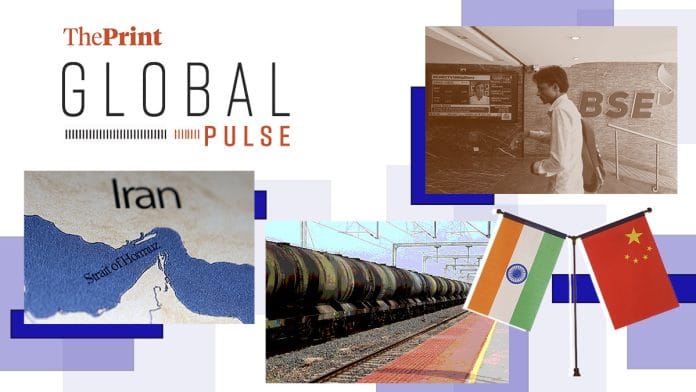



New Delhi: Global media is closely watching as India navigates the developments in the Middle East, from crude oil to Indians stranded in the Gulf, given “the US-Israeli war on Iran has exposed India’s vulnerability on multiple fronts,” Michael Stott and Chris Kay of Financial Times report.
It essentially calls the Indian economy a “Goldilocks” economy: a combination of strong growth and low inflation. “India depends on Gulf nations not only for oil and gas but for everything from flight connections to fertiliser.”
Nearly 10 million Indians live and work across the six Gulf Cooperation Council (GCC) countries, sending home more than $51 billion in annual remittances. The GCC is also India’s largest trading bloc and a key source of foreign investment, the report notes.
In such a situation, the “war also poses a pressing foreign policy challenge to New Delhi, which has previously sought to maintain close ties with all three warring nations as part of its adherence to strategic autonomy.”
The war now stands to threaten India’s “rare Goldilocks period” as well. That could weigh on India’s strong growth, which the International Monetary Fund (IMF) had forecast at 6.4 percent this year before the conflict. It may also drive inflation higher from the 2.75 percent recorded in January.
However, as the report points out, the problem goes beyond the economy, for Prime Minister Narendra Modi, “the US torpedoing of an Iranian warship off Sri Lanka that had taken part in an Indian naval exercise brought the war almost to his country’s doorstep.”
“The sinking raised uncomfortable questions for Modi’s government, which opposition politicians accuse of abandoning New Delhi’s traditions of non-alignment and hewing instead to the US and Israel.”
With the war putting pressure on India’s economy, the country has relaxed restrictions on Chinese investment, Krishn Kaushik and Chris Kay report for Financial Times.
“In a statement late on Tuesday, Prime Minister Narendra Modi’s cabinet gave the green light to investments in capital goods, electronics and solar cell sectors from neighbouring land-bordering nations.”
Although there was no direct mention of China. The release also noted that all investments by “land border-sharing countries” were subject to government approval.
“The new guidelines will provide clarity and ease of doing business in India, and facilitate investments which can contribute towards greater FDI inflows, access to new technologies, domestic value addition, expansion of domestic firms and integration with [the] global supply chain,” the government said.
The rules announced allow entities with “less than 10 percent Chinese ownership” to invest “without needing government approval”. It also sets a cap of 60 days for authorities to decide on investments in key sectors including electronics, silicon wafers and solar cells, the report says.
The report also highlights that while China is India’s second-largest trading partner, the gross FDI inflow from Beijing was just $2.67 million in the fiscal year ending in March 2025, a drop in the overall total of $50 billion.
Also Read: Global media spotlights Reliance’s Texas refinery; says India has much to lose from world in chaos
Passive euthanasia
Cherylann Mollan of the BBC reports on the Supreme Court’s landmark ruling allowing the withdrawal of life support of Harish Rana, a man who has been in a vegetative state for the last 12 years.
“This is the first instance of court-approved passive euthanasia – the act of withdrawing or withholding life-sustaining treatment – in India. The man, Harish Rana, had not left a will specifying directives for his treatment before he had an accident.”
While India legalised passive euthanasia in 2018, active euthanasia remains illegal.
Since Rana fell off a fourth-floor balcony in 2013 and entered a coma, his parents had petitioned the court several times to remove the support system. The court previously argued that Rana was not on life support and could self-sustain as is, denying his parents’ plea.
However, it is in the latest petition to the Supreme Court that the court considered the plea, ordering two independent medical boards to check whether Rana fulfilled the criteria for passive euthanasia.
“Rana’s case had sparked a debate in India around the ethics of court-approved passive euthanasia, with some noting that it goes against the principle of self-determination, which is the foundation of a living will,” Mollan writes.
“According to the law governing living wills in India, two medical boards must certify that a patient meets the necessary criteria before their life support can be withdrawn.”
(Edited by Tony Rai)
Also Read: Is India’s economy as big as it seems? Global media reads the fine print of GDP revamp