





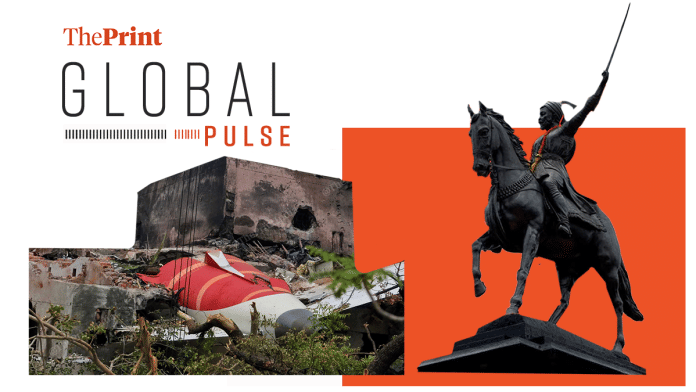


New Delhi: India’s Right wing has a new hero, the 17th century Maratha ruler, report Anupreeta Das and Suhasini Raj of The New York Times in a report on the ‘Shivaji fever’ and the warrior king emerging as an icon for India’s Hindu Right.
The report talks of 20 March 2022, when the ruler’s newly erected statue in Bodhan town in Telangana came close to triggering a full-blown communal riot. “By the time the police arrived, a few dozen men, both Hindus and Muslims, were pelting stones at each other,” states the report. The police, concerned about the situation worsening, imposed a ban on public gatherings.
“It didn’t take long to find who was responsible. Gopi Kishan, a member of an extreme Hindu right-wing group, had pulled off the brazen act—involving weeks of planning and a motorcycle convoy—out of frustration,” the report notes.
Kishan told the NYT that the authorities had informally blessed his petition to erect the statue, but did not provide him with paperwork to avoid making it a “law and order” problem.
Kishan, in his interview to the NYT, said he wanted to give Shivaji his due. “Had he not fought against the Mughals then, the word Hindu would not have existed today,” he added.
“India is in the throes of Shivaji fever,” the report says. “Across the country, hundreds of statues of the king—usually on horseback, brandishing a sword—have begun studding the broader landscape, popping up in the country’s port cities and along its disputed borders with China and Pakistan.”
The report says such tributes were earlier found mostly in textbooks in Maharashtra. But today, statues are cropping up across the country, and the report argues that these efforts are often backed by Hindu nationalists who promote Shivaji as a “self-made, pan-Indian martial hero”.
“They try to fit his story into a seamless narrative in which his defence of his land was also a defence of Hinduism against invaders—the Mughals from the east and western colonialists from the sea.”
These statues are “visual markers of the progress the Hindu-first movement has made in dismantling the secular and democratic principles India was founded on”.
It has been a year since the Ahmedabad plane crash that killed 241 people on board. The plane, bound for London, crashed only seconds after take-off from Ahmedabad. Families who lost their loved ones in the deadly crash are still struggling to make sense of the loss, the myriad investigative reports, and unanswered questions. Zoya Mateen of the BBC has written about the families.
Mateen closely looks at and interviews one family in particular which lost a son Javed, daughter-in-law, and grandchildren. Javed Ali and his family had settled in England some time ago, but would often fly back to Mumbai to visit his mother and brother.
“But after the crash, the house no longer felt quite the same. Something in it had shifted irreversibly—altered in ways the routines of ordinary life could neither explain nor repair.”
“It feels like Javed is still here,” Imtiyaz Ali, Javed’s brother, told the BBC. His mother said: “He follows me everywhere. Day and night.”
In a few weeks, investigators will release their final report on the Air India Flight AI171 crash. But for the families who lost their loved ones, many unanswered questions remain.
“What happened in the cockpit, why the aircraft lost thrust, whether the disaster was human error, mechanical failure or something else entirely?” However, Javed’s mother put it plainly: “Can any report bring my son back?”
Why, Imtiyaz asks, why do they need to wait a year for answers in a “modern country”? Nobody has opened Javed’s suitcase, which the family recovered following the crash. Imtiyaz said they don’t touch it. “Tormented by such moments, Imtiyaz became consumed by the search for answers—writing emails to airlines, hiring lawyers and trying to understand what caused the crash.”
Imtiyaz also talked about a message that Javed had sent to his older sister. “In the message, recorded before the crash, Javed described a dream: Two angels had come for him and, before taking him away, bathed him in a fragrance that smelled of roses.”
“When I woke up,” Javed said in the recording, “I could still smell it.”
Soutik Biswas of the BBC reports how India would count its people using stamps and postcards. “Long before smartphones and government apps, India used its vast postal network to persuade people to take part in one of the world’s biggest statistical exercises: The census.”
A new exhibition traces the forgotten history through stamps, postcards, and letters and how they were used for a headcount. The exhibition, curated by Vikas Kumar, an economics professor at Bengaluru’s Azim Premji University, “explores how India’s postal system became an unlikely instrument of nation-building in the decades after Independence”.
Independent India urgently needed reliable demographic statistics, but the government faced two major challenges: “How to persuade people to participate in the census, and how to maintain communication between enumerators and census officials across a vast, poor and largely rural country,” the report says.
This is where the post office came in. “In the run-up to the 1951 census—the first after Independence—the government used a bilingual pictorial postmark stamped on letters travelling across the country. The postmark showed a family of three framed by the words “Census of India” in Hindi and English.”
The campaign was particularly planned keeping in mind India’s low literacy rates. In 1961, postmarks urged Indians to get themselves and their family members counted.
Meanwhile, The Economist has a comment on India: It is a republic of the uncles, by the uncles, and for the uncles.
There are some defining features of an Indian uncle. “Let me tell you how to identify an Indian uncle. A dead giveaway is the phrase, “let me tell you”. It is inevitably followed by a thesis on what really ails the country. Another hallmark is unsolicited advice, veering from career counselling (“only girls study literature”) to dietary prescriptions (“eat five soaked almonds to build immunity”). But the defining feature of the Indian uncle is his bottomless disdain for the youth of today: “Feckless phone-addled softies, the lot of them”.
While the uncle’s opinions remain restricted to his own circles, the uncles “who run India” have no such boundaries, the column notes.
“Thus does the country produce such infantilising policies as Gujarat’s plan to require parental sign-off before adult couples can legally marry. Or Goa’s mandatory uniforms for adult students at its public colleges. Or Delhi, where adults can vote at 18 and marry at 21 but cannot enjoy a beer until they are 25,” the column says.
Calling Chief Justice Surya Kant “chief uncle”, The Economist writes about how the CJI’s remarks about unemployed youth being cockroaches started a furore on the internet. “Within a day of the chief uncle’s remarks, an Indian student in Boston had set up a joke political outfit, the Cockroach Janta Party. It swiftly drew over 22 m followers on Instagram, more than twice as many as the ruling Bharatiya Janata Party (BJP), and gave rise to an infestation of commentary on the pent-up frustration of the young.”
The column also highlights how Indian students are under immense pressure due to exam paper leaks, irregularities in national tests, and erroneous question papers.
“It is a minor miracle that the youth, faced with parental pressure, overbearing states, systemic incompetence and poor job prospects, respond only with a silly meme. Their peers in Nepal, Bangladesh and Sri Lanka have been rather more heavy-handed with their own ageing leaders.”
(Edited by Viny Mishra)
Also read: ‘Fair’ delimitation could give Indian cities a big boost, writes global media
Blah blah