





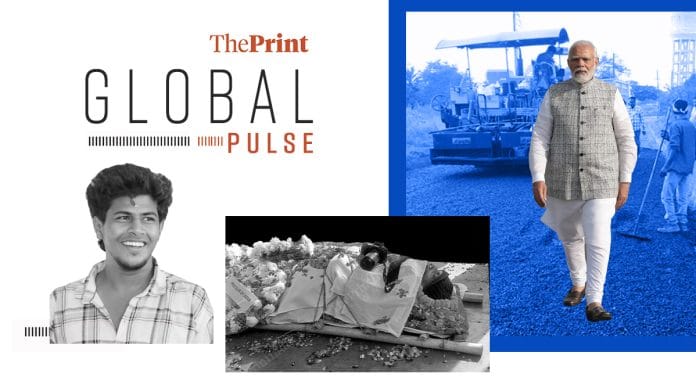


New Delhi: On 8 March, a 26-year-old man died in a hospital in Tamil Nadu, allegedly due to injuries he sustained in police custody.
However, Akash Delison’s is not the only noteworthy case. Cherylann Mollan and Muralitharan Kasiviswanathan of the BBC report on the extent of “extrajudicial killings and encounters” in India.
“Almost two months later, his body is still in a hospital morgue. His parents say that they will collect it and conduct his last rites only after the policemen responsible for their son’s death are arrested,” says the report.
Six police personnel have been arrested and suspended, and the Tamil Nadu government has ordered an investigation by the state’s top anti-crime agency, the report adds.
This is the third such case coming from Tamil Nadu this year alone.
In February, the CBI said that the death of 27-year-old Ajith Kumar, a security guard at a temple in Sivaganga district, was “due to police excesses”. In another case, nine police officers were recently sentenced to death for the killings of a father and a son in 2020.
“According to data from the federal home ministry, India recorded 170 custody death cases between 2025 and 2026 (until 15 March).”
“In its 2026 report, the Global Torture Index, a data-driven tool developed by the World Organisation Against Torture, classified India as a ‘high risk’ country for torture and ill-treatment by police and security forces, along with countries like Pakistan, Nigeria, Colombia and Mexico,” the report adds.
In February, United Nations experts also urged the Indian government to launch independent investigations into “alarming allegations of hundreds of extrajudicial killings and torture-related deaths”.
Meanwhile, the Financial Times reports on how the US/Israel-Iran war has impacted the road construction sector in India.
Chris Kay, Alice Hancock, and Amy Kazmin report on the pressure on Bitumen imports to India since the war broke out, challenging Prime Minister Narendra Modi’s promise to build 100km of highway a day.
India imports 40 percent of its bitumen, almost all of it from the Gulf. “Exports of bitumen from Gulf ports to India fell to 7,000 tonnes in March from 32,000 tonnes in the same month last year, according to Kpler data.”
The data showed that at least 17 ships were scheduled to take bitumen cargoes to India. But they were stranded in the Gulf at the beginning of the Iran conflict, though a few have since managed to leave.
The shortages, as the report notes, are coming at a “politically sensitive time” for Modi with results for four assembly elections to be announced next week.
However, India is not the only country facing a bitumen shortage. South Korea and Italy are facing a crunch too.
In South Korea, several road construction projects have been held up due to supply disruptions and rising asphalt concrete costs, including the 3-km Sindo Peace Bridge in Incheon’s western region.
In Italy, contractors have started raising concerns with local authorities over escalating costs and are seeking revisions to their contracts.
Raghu Rai, veteran Indian photographer, died this week at the age of 83. The New York Times writes about the celebrated artist and some of his pertinent works.
“Over a career spanning more than 60 years, Mr. Rai photographed Mother Teresa, the Dalai Lama and Indira Gandhi, India’s only female prime minister. He also captured daily life in images of the Taj Mahal, a Mumbai train station and other landmarks,” Jin Yu Young and Suhasini Raj write.
Rai also documented the 1971 Bangladesh liberation war, which later earned him a Padma Shri.
He also captured some of the most well-known photos of the 1984 Bhopal gas tragedy. The report cites a 2014 essay where he wrote, referring to the tragedy, “No matter how many shots I took, one couldn’t capture the scale of it.”
While Rai had originally set out to become a civil engineer, he took up photography in 1965. A year later, he began working as chief photographer for The Statesman, an English-language newspaper based in New Delhi.
In 2017, he won a lifetime achievement award from the Indian government.
In an interview with The Hindu in 2024, Rai said, “I was sent to shoot specific stories, but I would document the entire journey and take my camera out on the plane, on the train, sitting in a taxi, or even a bullock cart, photographing the people, landscape and life.”
(Edited by Ajeet Tiwari)
Also Read: ‘Modi vs Mamata’: West Bengal polls a ‘test for India’s Hindu Right’, writes global media