





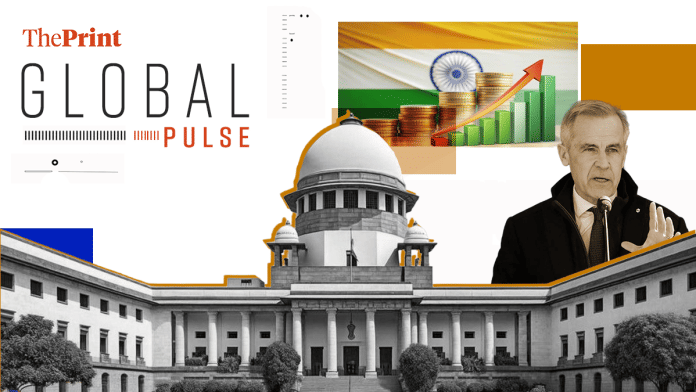



New Delhi: Canadian Prime Minister Mark Carney’s visit to India comes at a time when relations with its neighbour, the US, have been under duress. In AP, Rob Gillies reports on the significance of Carney’s visit and Canada’s efforts to restore ties with India.
“US President Donald Trump has been seen in Canada as a threat to the country’s economy and sovereignty, especially with his claims that Canada should be ‘the 51st state’,” states the report.
“Donald Trump’s rhetoric and policies are clearly pushing Canada to diversify its economic and trade relations, not only with other non-US Western countries but also countries like China and India,” a political science professor at McGill University in Montreal is quoted as saying.
India and Canada agreed to “restore diplomatic services” last year after former Canadian PM Justin Trudeau accused New Delhi in 2023 of “alleged involvement in the killing of a Sikh separatist leader, which turned into a row that placed major strains on the relations between the two countries”.
In Bloomberg, Anup Roy writes on how India’s economic growth may supersede previous estimates following a “data overhaul”.
“On Friday, the government will shift the gross domestic product base year to 2022-23 from 2011-12 and publish advance estimates for the financial year ending March,” Roy writes.
The GDP overhaul, as Roy highlights, is part of a broader effort to update India’s economic data.
“Economists will also look to the new calculation methodology for indications of when India might surpass Japan as the world’s fourth-largest economy.”
Earlier this month, the report adds, the Indian government overhauled its inflation series to reflect changing consumption trends. Expanding segments such as the digital economy and gig work are expected to feature more prominently in the updated series, while traditional sectors like agriculture and informal manufacturing could see a decline.
Abhishek Dey reports in the BBC about the Supreme Court slamming a textbook published by the National Council of Educational Research and Training (NCERT).
“India’s Supreme Court has banned a school textbook after a chapter in it made a reference to corruption in the judiciary,” it says.
Chief Justice of India Surya Kant criticised the book, saying that it could damage the reputation of the judiciary. Following this, NCERT apologised and withdrew it from distribution, it adds.
The report further notes that the top court ordered a complete halt on the book’s publication, “saying its contents were ‘extremely contemptuous’ and ‘reckless’”.
The Economist reports on how Jaipur risks losing its UNESCO World Heritage status granted in 2019. Jaipur has till the end of the year to carry out the restoration work needed to keep that status.
“Otherwise, it could join the company of Dresden, Liverpool, and Oman’s oryx sanctuary: the only three places to have won and then lost their world-heritage tag,” it says.
The report notes that in 1991, Jaipur had around 1,200 havelis, a number that has now been reduced to 800. Others have been demolished, “thanks to an unholy trinity of corruption, apathy and scarcity of cash”.
The colour code of the “Pink City” is off too. While other colours are banned, “pollution and uncoordinated painting have broken Jaipur’s visual harmony into a mess of historically inaccurate shades, some dangerously close to orange”.
More than just colour, “over 600,000 locals squeeze past rotting rubbish piles, duck under a jungle of sagging wires and breathe fumes from open drains”, writes The Economist.
However, the report adds that UNESCO’s ultimatum could be the best thing for the city.
“The prospect of officially losing the world-heritage tag may jolt authorities into enforcing heritage by-laws and having a frank chat with haveli owners about protecting what could be precious assets if, for instance, they were converted into heritage hotels,” it says.
(Edited by Nida Fatima Siddiqui)
Also Read: Global media on fragile balance underlining Modi’s Israel visit & the ‘unstoppable Hindu Right’