





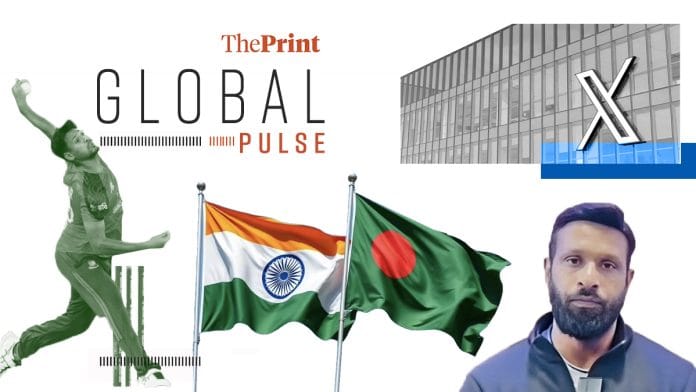



New Delhi: India watched eagerly as voters in Bangladesh elected their new government. Frosty ties between the two countries ever since Sheikh Hasina sought asylum in New Delhi, will now enter a new phase.
But these ties are not to be seen in isolation, writes Veena Venugopal in Financial Times. “Delhi is as invested in this election as Dhaka is,” she says, underlining that there is also the US angle.
While Bangladesh remains diplomatically in the peripheral vision for the US, its proximity to China and access to Bay of Bengal makes it important geopolitically. Soon after the US and India announced their trade deal, the White House announced a deal with Bangladesh that hinged on tariff-free garment imports in return for purchases of US cotton and textiles.
Explaining its significance for India, Venugopal writes, “Bangladesh’s apparel industry is already a behemoth, constituting more than 80 percent of the country’s exports, and this makes it even more difficult for Indian garment manufacturers to compete. Indian authorities are now scrambling to get a similar concession from Washington.”
The Economist looks at another key dimension of the relationship between India, Bangladesh and Pakistan—cricket.
Bangladesh is out of the ICC Men’s T20 Cricket World Cup, and Pakistan is on the fence. “What do these countries have in common? They are on bad terms with their domineering neighbour, India, they are sick of being pushed around, and they pushed back. The result has reduced a global event to a stage for South Asia’s pathologies,” argues The Economist.
In the IPL auction held last December, Mustafizur Rahman, a Bangladeshi pacer who is a fan-favourite, was effectively kicked out after an “out-of-work politician” Sangeet Som took issue with Kolkata’s purchase of a Bangladeshi player following ‘anti-India’ protests by student leaders in Dhaka.
“Bangladesh, […], asked to move its World Cup matches to Sri Lanka, arguing that if India could not guarantee the security of one player, it could hardly protect an entire squad. But the International Cricket Council (ICC), saw no merit in the argument and excluded Bangladesh from the contest, replacing it with Scotland, the next highest-ranked team,” it says.
The Bangladesh incident was followed by Pakistan announcing a boycott of matches with India in the aftermath of Operation Sindoor. “After ten tense days of furious backchannel negotiations, Pakistan said that it would play India after all, as scheduled,” the column adds.
The backdrop to all of this remains the man said to be in control of the ICC: former BCCI secretary Jay Shah. “Jay Shah, the son of India’s home minister, Amit Shah, who is Narendra Modi’s right-hand man. Mr Shah junior now runs the ICC. Pakistan’s cricket board, meanwhile, is run by the country’s interior minister,” writes The Economist.
In a separate column for Financial Times, Venugopal writes about India’s new AI rules which she terms a case of one taking “a sledgehammer to a knife fight”.
The government has tightened the noose around social media giants to takedown offensive content. From the earlier window of 36 hours, social media apps will now have to remove offensive content within three hours of being reported. This includes AI-generated content. As Venugopal writes these rules not just cover harms such as sexually explicit content, especially those featuring children, to include images and videos that have political ramifications, fake videos of election candidates making inflammatory remarks will also be restricted. “Only harmless uses of the technology, which fall under what the regulations call ‘good-faith edits’, are allowed but all content is supposed to be prominently labelled,” she writes. Elon Musk’s X has already moved court, deeming it a breach of freedom of speech.
Reporting for Associated Press, Rajesh Roy writes on the nationwide strike called Thursday by major trade unions and farmers’ groups to protest the India-US trade deal.
A union leader told the AP that the trade deal with Washington opens the Indian market to subsidised agricultural products, threatening the livelihoods of millions of small farmers. “The protesters in India also opposed Modi’s efforts to privatise state-run companies and implement new labor codes, calling the sweeping changes ‘deceptive fraud’ against workers,” writes Roy.
The report points out that an earlier version of the ‘fact sheet’ released by the White House outlined key provisions of the deal, stating that India would scrap or cut tariffs on all American industrial goods and a broad basket of US food and farm products, including dried distillers’ grains, red sorghum, tree nuts, fresh and processed fruit, certain pulses, soybean oil, wine and spirits, and other items. However, “certain pulses” was later dropped from the revised version of factsheet.
Meanwhile, Rahul Bhattacharya writes in The Guardian about the “The intimate and the epic” that are Indian trains. “In the process, one learns much about oneself. Consider sleeper travel. Is there a situation more exposing than sharing a compartment with strangers? With luck, you might fall into an invigorating company,” he writes. Regardless of common issues like lack of pantries or good quality food options at affordable prices, Bhattacharya argues that eating remains a “crucial habit”.
“Depending on the season, and your route, it is possible to pop out onto the platform during a halt and buy top-notch, farm-fresh lychees, custard apples, bananas and mangoes in places famed for them.” Adding, “After all, on the railways, as in certain novels, the intimate and the epic, the local and the national, are linked together, making the whole.”
Meanwhile, Geeta Pandey and Asif Ali write in BBC on “Mohammad Deepak”, the gym owner from Uttarakhand whose stunt last week drew all sorts of reaction on the internet. “Deepak Kumar has been praised as an ‘icon for secular India’ and a ‘posterboy for India’s pluralism’. At the same time, he has faced noisy protests, been called a traitor to his Hindu faith and received death threats,” the report says.
Deepak said he was at a friend’s neighbouring shop when he stepped in after noticing around six men harassing Vakeel Ahmed, the elderly proprietor of the clothing store Baba School Dress and Matching Centre. According to him, the group was pressuring Ahmed to remove the word “Baba” from the 30-year-old shop’s name, according to the report. The video shows Deepak asking: “Are Muslims not citizens of India?”
When the argument continued, Bajrang Dal activists asked Deepak his name. He replied: “My name is Mohammad Deepak.”
“By identifying myself as Mohammad Deepak, I wanted to tell them that I’m an Indian. That this is India and everyone has the right to stay here, regardless of their religion,” Deepak told the BBC.
(Edited by Amrtansh Arora)