





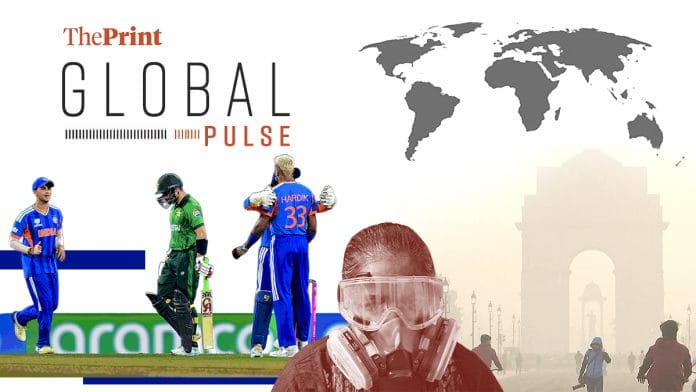



New Delhi: As Delhi welcomes the spring and a couple of weeks of blue skies, warm weather, and the pop of colour along the flower-lined curbs, Dan Strumpf reports for Bloomberg on the heavy smog that envelops the national capital since early November each year, and how it influences the Indian economy.
“Each year in early November, a familiar rhythm unfolds in New Delhi. Temperatures drop, skies darken, and a gray, choking haze descends on the Indian capital,” says the report.
And while Delhi has learnt to live with the almost morbid air pollution, Strumpf says “the ritual was interrupted” this winter.
“As smog season returned, hundreds of placard-bearing protesters gathered at India Gate—the famed monument resembling the Arc de Triomphe—to demand the government do something, anything, to address the runaway pollution crisis,” the reports says. The police cracked down on the protesters, detaining some and roughing up others.
The geographical location of Delhi also does not help, the report admits. “The winter smog is driven by a perfect storm of factors. Falling temperatures and weaker winds coincide with a spike in seasonal crop burning by farmers—compounded by already high vehicle and factory emissions, Diwali-season fireworks and construction dust. Trapped by the capital’s bowl-like geography, the pollution lingers for months.”
The measures taken by the Delhi government to curb pollution, says the report, are “band-aids”.
While Prime Minister Narendra Modi has set the goal of ‘Viksit Bharat 2047’, “yet there is no developed country in the world with air pollution levels remotely close to India’s”, it adds.
It refers to a World Bank report of 2023 that estimated that increased air pollution shaves 0.56 percentage point off India’s annual GDP growth. “For the world’s fastest-growing major economy, that amounts to billions of dollars in lost economic activity as pollution undermines worker productivity, curbs crop yields and drives up health-care costs,” says the report.
The Economist too underlines that ‘India’s pollution is becoming an economic roadblock’.
On the available pollution data for 2024, the report mentions that Delhi did not record a single day in the “good” air category and just 65 in the “satisfactory” category.
“In 2019 a report by Dalberg, a consultancy, estimated the annual economic loss attributable to air pollution at 3% of GDP. (US President) Donald Trump’s tariffs of 50%, briefly imposed but now relaxed, in contrast, would have lowered India’s growth by 0.6% over a full year, according to Goldman Sachs, a bank. Yet tariffs spark immediate policy responses; pollution does not,” says the report.
The Economist also accused the Indian government of “playing down” the health concerns arising from surging air pollution. “A junior health minister recently told Parliament that there is ‘no conclusive data’ linking pollution to death and disease, instead suggesting that the ‘health effects of air pollution are (a) synergistic manifestation of factors’.”
The Union Budget that came out on 1 February cut the funding for pollution control, adds the report.
Questioning the response (or lack thereof) of the government, it says: “Fixing the pollution problem is too difficult, its advantages too far in the future, its electoral benefit too amorphous.”
“Yet there are signs that abstract economic concerns are becoming concrete business ones.”
According to the report, Shoppers Stop attributed a slowdown in the final quarter of 2025 to pollution, citing “reduced consumer mobility and discretionary spending” in a recent filing.
“The chief executive of Vishal Mega Mart similarly said during an earnings call that ‘the air-quality issue in north India’ weighed on consumption growth in the same period. Several countries warn travellers about pollution risks in India through official advisories, a factor that has hurt tourist inflows. Each winter, poor visibility linked to pollution also forces the cancellation of hundreds of flights across north India,” the report points out.
BBC reports on how an India vs Pakistan match is never just about the game, and the rivalry is never just confined to the boundary rope.
“Arguably more interest stemmed from the pageantry of Sunday’s game than from the actual cricket. Plenty were on handshake-watch given recent history between these two. Polite formalities did not return at the toss, Suryakumar Yadav and Salman Ali Agha giving each other the silent treatment,” says the report.
And while former team captains Rohit Sharma and Wasim Akram did exchange warm greetings, taking away some of the tension piling up since Operation Sindoor last year, the playground was nothing short of a battlefield.
“The stadium certainly felt different to earlier World Cup matches at this venue. A perimeter was set multiple blocks from the ground. Bags were inspected long before the entrance. And again upon arrival. The Sri Lankan special task force, previously unseen at this tournament, was out in force, automatic weapons on full display,” the reports notes.
Although the “no-handshake” ritual continued before and after the match, the players towed the line between politics and sports well during post-match presentations. “We see them as a team – we are not thinking about this as a rivalry or whatever,” said India’s Axar Patel.
“In these games the emotions are always going to be high but we need to deal with that,” said Pakistani skipper Salman Agha.
India beat Pakistan by 61 runs in the T20 World Cup clash in Colombo Sunday.
(Edited by Nida Fatima Siddiqui)
Also Read: Global media on why Delhi is ‘invested’ in Bangladesh polls & ‘secular India’s icon Muhammed Deepak’