





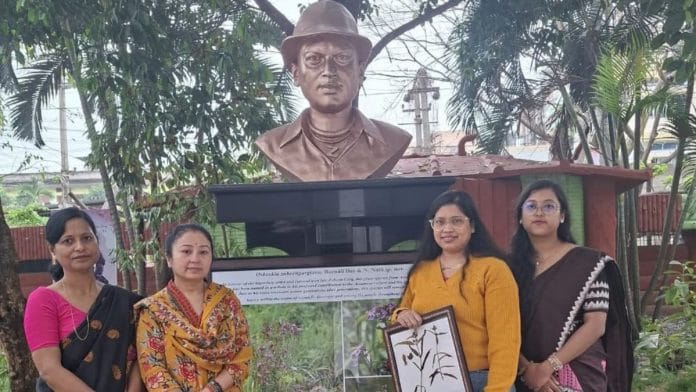



Guwahati: Six months after Zubeen Garg’s unfortunate demise from a drowning incident in Singapore, his connection with nature finally got a name—Osbeckia Zubeengargiana. A new species of plant from the Melastomataceae family discovered in Assam last year by the team of researchers- Barnali Das, Dr Namita Nath and Prashob Pulpra was named after Zubeen Garg to honour his attachment with the natural world.
This discovery was published on 13 March 2026 in Phytotaxa, a prestigious peer-reviewed scientific journal for the publication of any aspect of systematic Botany.
“A new species of Osbeckia, O. zubeengargiana, from the family Melastomataceae, is described based on collections made from Assam, India. The new species is related to O. rostrata because of its tetramerous flowers, but can be distinguished by its habit, foliar morphology, bract shape and size, morphology of the intersepalar emergences, ciliated style base, and seed size,” mentioned the paper.
The genus Osbeckia Linnaeus comprises 43 species discovered to date, most of which are found in Southeast Asia.
Discovery of a plant
Research scholar Barnali Das first encountered the plant deep inside Manas National Park in 2022. It took her and her co-researchers three years to confirm that it was, indeed, a new species.
“We found bristle-like hair in the bottom part of the style or stalk of the Gynoecium, which is the female reproductive organ of a flowering plant. This feature is absent in other plants of the genus Osbeckia found in India. Generally, if reproductive characters are different, it signifies a new species,” Das, currently an Associate Professor in the Department of Botany, Pragjyotish College, Guwahati, told ThePrint.
According to the professor, this plant flowers and fruits from mid-September to January. It is a grassland vegetation that grows mostly in the Bhutan foothills. “We have yet to study the medicinal properties of this plant. As of now, we don’t know what their numbers will be, so we didn’t collect a large number of samples from the wild.”
For 29-year-old Das, Zubeen Garg’s music played a pivotal role while growing up in the small town of Kheroni in West Karbi Anglong. “As we say in Assam, ‘sukhot o Zubeen, dukhot o Zubeen’ (in happiness there is Zubeen and in grief also there is Zubeen). Apart from his music, I was always inspired by his love for nature and trees. Trees like Nahor (Ironwood of Assam), Togor (Crape Jasmine) and Eucalyptus have come up in so many of his songs. He always spoke of planting trees. So I feel it is an honour to name the plant after him,” she said.
There are two components in the scientific name of a plant or animal. The genus name can’t be changed. In this case, it is Osbeckia. But the species can be named anything—a person, a place, the scientist who discovered the species, or a property of the species. “So, we named this plant after Zubeen Garg as a tribute to his work for nature.”
Also read: Zubeen Garg showed resistance through art. Never shy of voicing his politics
Zubeen Garg and his connection to nature
‘eucalyptus gosor dore okho hobo khujo moi
sirodin, sironton…
akax subo khujo’
‘I want to grow like an eucalyptus tree
Always, eternal…
I want to touch the sky’
The above lyrics, penned by Zubeen Garg for his popular song ‘Sobdo’ (1998), signified his love for nature and trees.
His fondness for trees and birds was well known—an inclination he displayed from an early age.
“He always had a deep attachment to nature, particularly avifauna. He was passionately involved in conservation work,” Garg’s uncle Manoj Kumar Borthakur said.
Garg’s earlier residence at Kharghuli hills, overlooking the Brahmaputra River, used to shelter a wide variety of animals. He had a pet crow, Kaku Garg, often seen around the house alongside his dogs—Iko, Diya, Rambo and Maya. He once nursed an injured monkey back to health at Kharghuli and named it Madhusudan Garg. Garg also rescued an injured stork, cared for it until recovery, and named it Udasini Garg.
In 2018, he was conferred the ‘Hero for Animals’ title by People for the Ethical Treatment of Animals (PETA) for opposing the ritual of animal sacrifice in the Kamakhya temple.
“Natural metaphors were always used in his songs. He believed we are accountable toward nature. His residence in Kharghuli only showcased his love for nature. Maybe, later his Kharghuli residence would have been made into a sanctuary,” actor and musician Arghadeep Baruah told ThePrint.
Garg joined the citizens of Guwahati on the streets in November, 2024 to protest the cutting of trees in the scenic Dighalipukhuri area.
He later shared his love for trees in a Facebook video post shot at his studio in Jonali, surrounded by greenery. In it, he again appealed to the government to halt tree felling at Dighalipukhuri and consider altering the flyover’s route, as was done in Agartala.
“He was one of the few artists who also took up activism and nature was an important part of that activism. He didn’t just sing about nature, but he actually came down on the road to protest the cutting of trees. He was not afraid to fight the system. He was aware that he had huge followers and was capable of using that for the betterment of society. He used art as a form of activism,” singer Maitreyee Patar said.
He sang 10-15 thousand folk songs and about 70 per cent of the metaphors used in them are from nature, according to singer-composer-lyricist Ibson Lal Baruah, who was Garg’s long-time collaborator. “He would always appreciate a new kid writing a folk song using natural metaphors. Even in the songs he sang in his formative years as an artist, nature played a big role. He had a tremendous fascination for the song ‘Bokul fulor dore’ (Like the Spanish Cherry), which was penned by poet Hirendranath Bhattacharya.”
Zubeen Garg would also find out the scientific names of trees and educate people about them. It is only fitting, then, that his own name becomes the scientific name of a plant.
“What those researchers did was one of the best things anybody has done for him,” Baruah.
(Edited by Ratan Priya)