



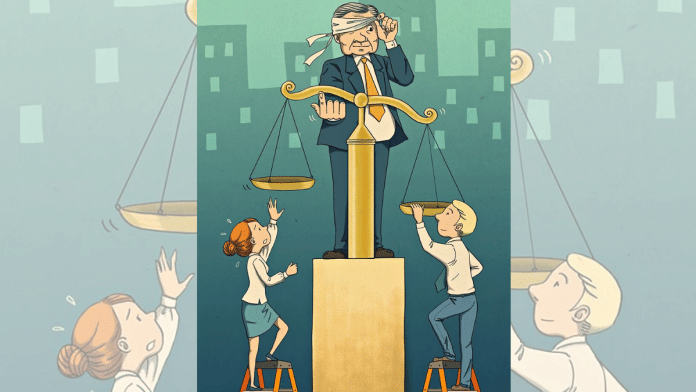
New Delhi: The world promised gender equality by 2030. At the current rate of progress, it will take until 2197.
That is the central finding of Gender Snapshot 2026, a new report by UN Women and the United Nations Department of Economic and Social Affairs. Not a single indicator under Sustainable Development Goal 5, which focuses on gender equality, is currently on track to meet its 2030 target.
The goal was never limited to getting more women into positions of power. Instead, it also called for an end to discrimination and gender-based violence, child and forced marriages, female genital mutilation, and equal economic and property rights.
However, now, the institutions meant to drive that progress are themselves losing ground. From 2020 to 2026, women’s share of parliamentary seats declined in 54 countries. One in three institutional mechanisms created to advance gender equality lost institutional power over the past two years, while around one in four saw their operating budgets cut.
The money behind the wider effort is shrinking too. Funding for gender equality fell by 13 per cent between 2023 and 2024, while funding for women’s rights organisations declined by 28 per cent. Funding is now at its lowest level since 2021, the report said. Forty-two per cent of UN entities also reported a weakening of their gender-equality efforts.
An unequal education
The consequences of who has power can be seen in something as basic as whether girls stay in school.
Research from West Bengal cited in the report found that repeated exposure to women leaders in village councils was associated with higher educational attainment and aspirations among adolescent girls, helping narrow the gender gap.
The report also cites various pieces of evidence suggesting that schools led by women principals achieve better learning outcomes than those led by men. Its broader finding is that women’s participation in decision-making can affect outcomes well beyond representation, including in education, health and social protection.
But representation alone cannot overcome the barriers girls face in getting an education. Approximately 406 million children globally attend schools without basic hygiene facilities, according to the report. Facilities for menstrual health and hygiene are particularly important: their absence has been linked to higher dropout rates among girls in Zambia and poorer attendance among menstruating girls in Gambia, India, Kenya, Nepal and Nigeria.
These gaps are particularly persistent in South Asia, where women continue to face unequal access to political and economic decision-making, resources, technology and leadership.
Technology is now adding another layer to that divide.
Also Read: Global gender gap at its narrowest in 20 years but parity still 120 years away. India in bottom 15
Technological issues
Women account for around 22 per cent of AI professionals globally, but hold fewer than 14 per cent of senior AI leadership positions. They are also around 20 per cent less likely than men to use generative AI tools.
That matters not only because women are underrepresented in an industry shaping future workplaces, but because the technology itself can reproduce existing inequalities.
AI is increasing the scale, speed and severity of technology-facilitated violence against women and girls, the report warns.
A UN Women study, published on 22 September, found that almost one in four incidents of online violence against women human-rights defenders, activists and journalists involved the use of AI.
The workplace could see another divide emerge. Occupations dominated by women are almost twice as likely to be exposed to generative AI as occupations dominated by men, according to data from the International Labour Organisation cited by UN Women.
Representation matters
The gaps in representation become clearer at the highest levels of political power. Six in seven countries are currently led by men, the report said.
Women who try to enter politics also face financial and security barriers: the cost of running for office can exceed 100 times a country’s average per-capita income, while during election campaigns, eight in 10 women candidates for parliament and six in 10 candidates for local government experience psychological, sexual, economic and/or physical violence.
And getting elected does not necessarily mean gaining access to the levers of power.
Nearly nine in 10 defence ministers and more than eight in 10 finance ministers are men. Women hold only 6 per cent of corporate chief executive positions globally and lead fewer than 20 per cent of the highest courts.
The imbalance extends into the justice system. Women make up only 29 per cent of prosecutors in cases involving gender-based violence and discrimination. Only 31 of the world’s 175 chief justices are women, the report said.
“The evidence is clear: when women lead, societies are stronger, economies are more resilient, and outcomes are better for everyone. Equality cannot be achieved without equal access to power—because equality without power is not equality at all,” UN Women Executive Director Sima Bahous said in a statement.
That lack of power also shapes women’s exposure to violence and their ability to claim basic rights.
Nearly one in five girls globally is married before the age of 18, while an estimated 230 million women and girls are survivors of female genital mutilation.
Almost one in three women have experienced domestic or sexual violence during their lifetime.
In the past 12 months alone, 316 million women experienced physical or sexual violence by an intimate partner.
Legal systems have not closed the gap either. No country has achieved full legal equality, the report found. Of the 131 countries studied, 51 per cent continue to have significant legal gaps affecting women.
Nearly two-thirds of countries provide little or no legal protection for women’s land rights, while fewer than 30 per cent ensure joint land registration or women’s participation in land governance.
The report calls for equal participation in political and economic decision-making, stronger funding for gender-equality institutions, protection for women’s rights organisations and civic space, and safeguards to ensure technology does not deepen existing inequalities.
At the current pace, the report’s 2197 projection is not simply a measure of how long it will take to close individual gender gaps. It reflects who gets to make decisions, who controls resources and whose interests shape the institutions meant to deliver equality.
(Edited by Insha Jalil Waziri)