






New Delhi, Leh: The youth in Leh are supporting the Cockroach Janta Party protesters, hoping that the NEET paper leak agitation will draw attention to Ladakh’s demand for Sixth Schedule status.
Students, youth and young entrepreneurs in Ladakh have come out in support of innovator and activist Sonam Wangchuk. On 21 July, at least hundreds of youth gathered in Leh for a candlelight march to show solidarity with CJP protesters.
“Sonam Wangchuk has been the face of the Ladakh protests, and now that he has also become a face of the CJP (Cockroach Janta Party) protest, we hope the discourse on Ladakh will also begin again,” Padma Gyatspo, a student and an entrepreneur, said.
Wangchuk sat on a hunger strike in Leh demanding the Sixth Schedule in 2024. He was arrested after a clash in September last year, which claimed four lives.
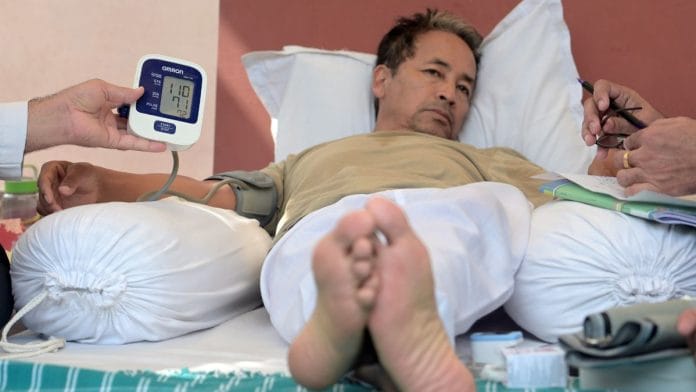
After that, Wangchuk showed his solidarity with CJP protesters and sat on a hunger strike on 28 June at Delhi’s Jantar Mantar. Since then, his health deteriorated, but he has continued his indefinite hunger strike from the hospital after he was forcibly removed from the protest site on 18 July. He was then shifted to Safdarjung Hospital in Delhi. After an appeal in Delhi High Court by his wife Geetanjali Angmo, he was shifted to a private hospital.
Hope for Ladakh
The Apex Body Leh (ABL) and Kargil Democratic Alliance (KDA) reached the protest site Tuesday to show support to the protest and Wangchuk.
KDA leaders Asgar Karbalai and Sajjad Kargili, and ABL representatives Chhering Dorjey Lakruk, Mohammadi Shafi, Ashraf Barcha and Dechan Chamba, met CJP founder Abhijeet Dipke and other protesters at the site.
After Ladakh became a Union Territory in 2019, people had hopes.
“The BJP government had made several promises to Ladakh, but by 2024 enough was not done. People became increasingly frustrated”, said Gyatspo.
Wangchuk was voicing the youth, who were struggling to find jobs. He emerged as an inspiration during the Ladakh protests in 2024.
“When people in Ladakh saw him supporting the CJP protests, our support automatically went for the students’ protest,” said 25-year-old Kunzung, a manager at a factory in Ladakh. “I do not know anything about the credibility of CJP, but we in Ladakh are tense about Wangchuk’s deteriorating health.”
During the two years of Ladakh protest, Wangchuk pointed out the ecological fragility of the region. One of the primary reasons, the demand for the Sixth Schedule took momentum among Ladakhis.
“When people from outside come here, it affects our ecosystem. We Ladakhis try to protect the region”, said Gyatspo.
The demands of the CJP protest have resonated with the youth in Ladakh, who think that these are the causes that concern every student.
“Entire India supported Ladakh during the protests; it was our time to do so as well”, said 32-year-old Ladakhi entrepreneur, Tsetan Chamba. “I do not know if there will be an indirect impact of CJP on Ladakhi issues, but it will indirectly benefit Ladakh by creating awareness and starting a discourse.”
Also read: NEET outrage reaches Bihar. Students’ protest met with lathicharge, tear gas in Patna
Hunger strike solution
With Wangchuk’s hunger strike reaching its 25th day, there is a growing concern among the Ladakhis.
Even after repeated requests from the CJP team and people in India, Wangchuk has continued to extend the hunger strike. He demanded on Wednesday compensation for the protesters who were injured on 20 July.
“We do not want to lose him; he is right in his approach”, added Kunzung.
Ladakhis, who are still waiting for an answer on the Sixth Schedule demand, see hunger strike as a probable solution.
“His hunger strike has moved the protest and brought so many people in solidarity,” said Chamba. “If not this, then what is the solution?”
In 1984, Wangchuk’s father Sonam Wangyal went on a hunger strike that continued for five days, demanding Schedule Tribe status for several communities in Ladakh.
The then Prime Minister Indira Gandhi travelled to Leh and persuaded him to end the fast.
“We are Ladakhis, we do not believe in violence”, said Kunzung.
(Edited by Saptak Datta)