



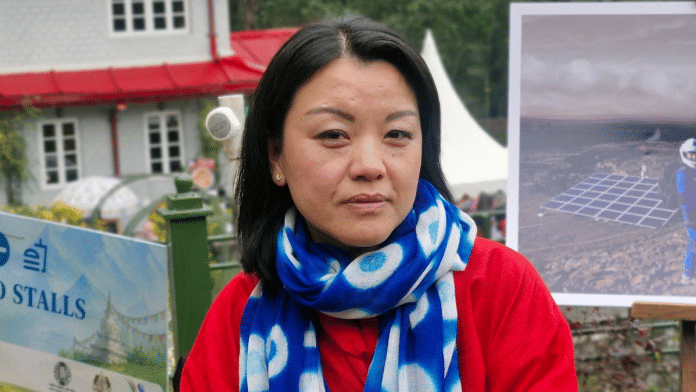
Nainital: A superhero does not always need a cape, a mask, or a glowing reactor set into his chest. In Bhutanese writer, Chador Wangmo’s imagination, she can be a 12-year-old nun, whose robes turn into capes, and gets her superpowers from prayer.
Wangmo, one of Bhutan’s best-known novelists and children’s authors, noticed that her country had no superhero of its own and decided that somebody had to fix that.
A teacher turned author, Wangmo has written 23 books and received a South Asian Association for Regional Cooperation Literary Award. Her best-known creation is Dema, a 12-year-old nun. The trilogy began with Dema: The Mystery of the Missing Egg in 2017.
“The first book was Dema: The Mystery of the Missing Egg. Then the second one was Dema in the Kingdom of Evil (2018). And the third one is Dema: The Throne of Druk Ghi Yeul (2020,” Wangmo said in a conversation with ThePrint at Himalayan Echoes, the Kumaon festival of literature and arts at Nainital.
Wangmo knew from the start that the hero would be a girl, partly because the field is so lopsided. Conventional superheroes are primarily male, she points out, and the list of women is very short.
“You might say Wonder Woman. And then the list is gone,” she said, pointing out the few female superheroes.
So deciding the gender was the easy part. The harder question was how to make a hero recognisably Bhutanese, and while she was puzzling over a costume, the answer began to take shape.
Costumes are what set superheroes apart from everyone else, but Wangmo wanted the opposite: a hero who looked like the people around her.
“I thought, why should superheroes look any different from normal human beings?”
So a nun solved two of her problems. In a largely Buddhist country, a nun’s robe is an everyday sight, and it doubles as a cape.
“When she needs to fly, she doesn’t have to be dressed any differently. She can just flap open her robe and fly around,” Wangmo said.
Meanwhile, her power does not come from a radioactive spider bite, but from Wangmo’s own routine. Bhutanese households tend to begin the day at the altar room, with water offered in seven bowls. Wangmo said that prayer has carried her through many difficult times.
“I feel that prayers have kept me alive. Prayers have kept that positivity inside me,” she said.
Dema prays to Jetsun Drolma, the Tibetan name for Tara, the female bodhisattva of compassion whose name means “she who liberates.”
But Dema is not always strong or certain of herself. She falters, feels weak, and sometimes struggles to find courage, and Wangmo wanted children to take in that vulnerability.
“You will not be strong all the time. You will not be courageous all the time. But that should not be a criterion for a superhero,” she said.
The choice of a child as the hero was deliberate too. Wangmo added that children are always told that adulthood is when everything gets sorted out, and she didn’t want her readers to believe they can do nothing until then.
Also Read: History textbooks ignore India east of Agra, south of Jaipur, says Amish Tripathi
A story of their own
Wangmo grew up on spoken stories by a grandmother who was a gifted teller, with many evenings spent around bonfires listening to old tales and fantasies. She never planned to be an author, but a classroom changed her mind. As a sixth-grade teacher, she asked her pupils whether they knew any Bhutanese folk tales.
“Sadly, out of the 38 children, not even one knew any Bhutanese folk tale,” she recalled.
When she went looking for books to fill that gap, she found that the English folk tales available in Bhutan since the early 90s were meant for adults.
Wangmo herself has spoken of growing up on Indian comics like Tinkle and Amar Chitra Katha, which says something about whose stories were reaching a Bhutanese child at the time.
She also pointed out how children in Bhutan do not all read in the same conditions.
The urban children, who are online and know their Marvel, have a very different relationship with books from rural children, who often meet stories only through imported volumes set in worlds they don’t recognise.
“They do not understand the world that is portrayed in the books that come from outside,” Wangmo added.
A story set in a village they recognise, with a female hero who prays the way their families do, is one they can step into without translation.
That is the gap Dema was written to fill.
The trilogy is now complete, its world stretching from the “hidden valley of Beyul to the land of the dragons.”
While the author, moving on to other books, has not ruled out a return for Dema, she floated a possible next destination for her.
“Who knows, maybe I will send Dema to the land of the yetis next.”
(Edited by Insha Jalil Waziri)