






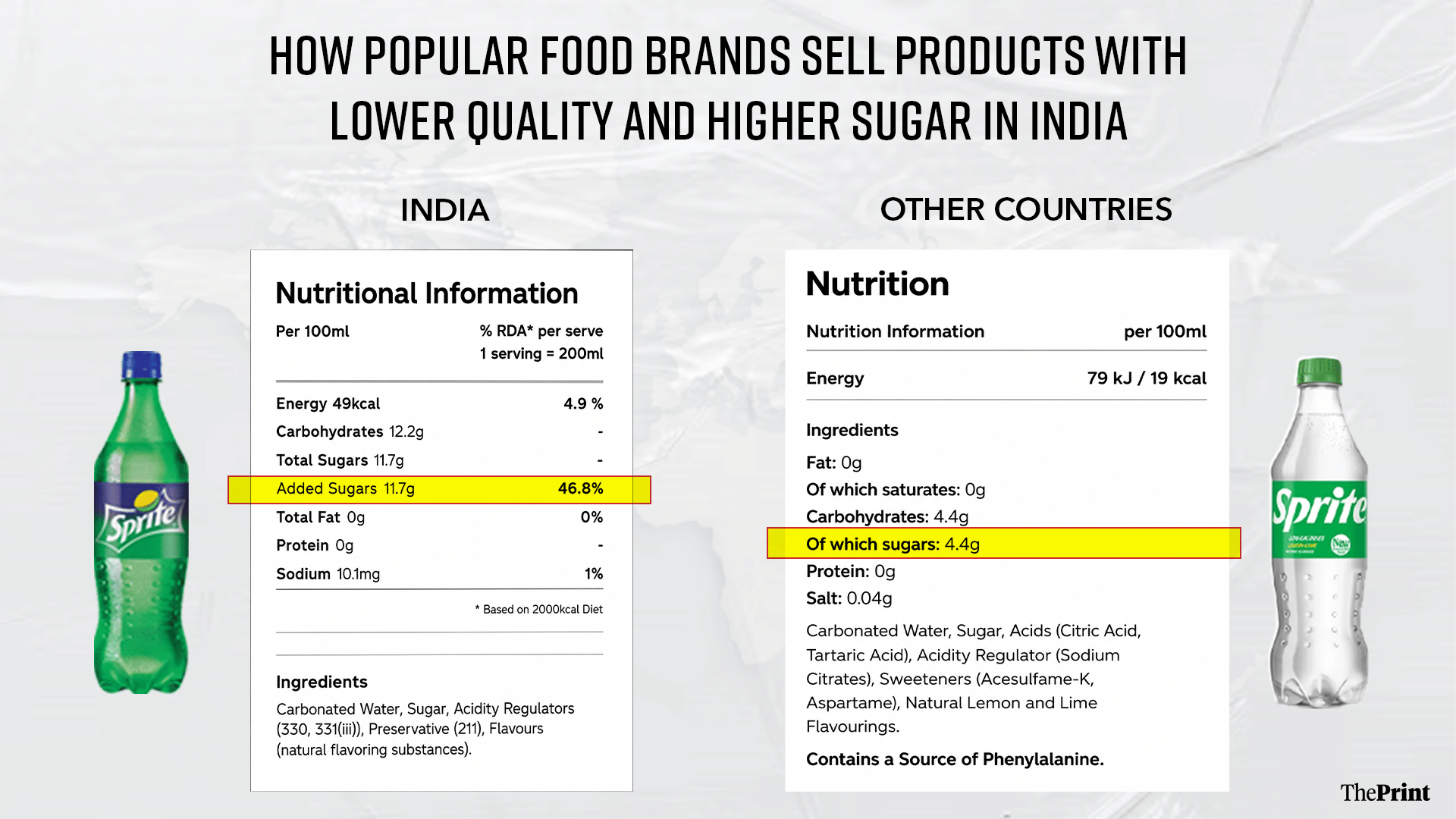
New Delhi: Pick up a bottle of Sprite in India, and it has the same fizz found anywhere in the world. But there is a less obvious difference that remains hidden in plain sight: the sugar. In India, Sprite contains 11.7 grams of sugar per 100 ml. In the European market, the same soft drink contains just 4.4 grams per 100 ml.
But Sprite is not an isolated case.
Nestle’s Cerelac, the infant cereal sold in India, contains nearly 3 grams of added sugar per serving, while the corresponding product sold in some European markets contains no added sugar.
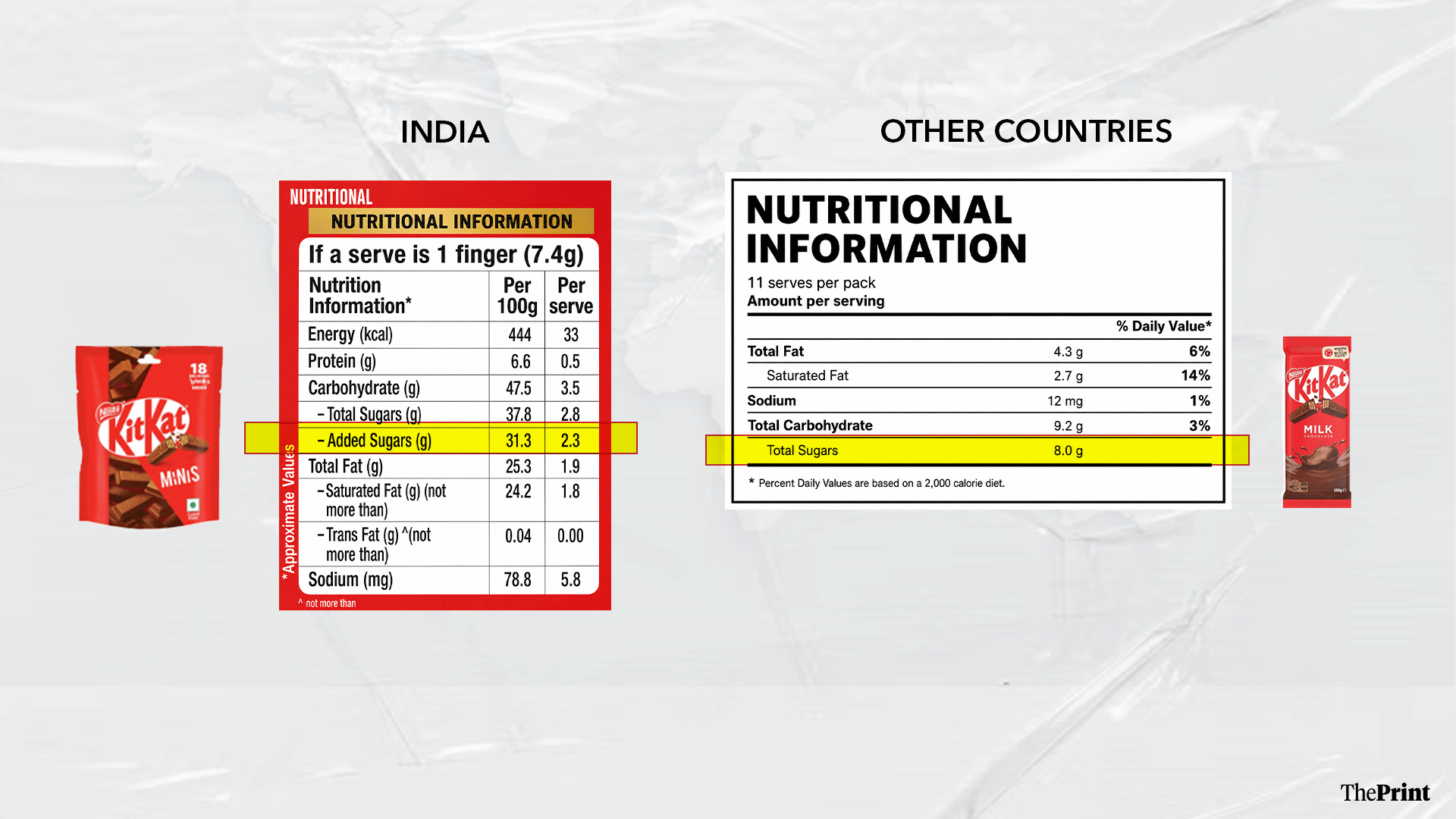
The Indian version of KitKat contains just 4.5 per cent cacao in the whole thing (including wafer and chocolate coating) and 28.9 grams of added sugar. In Australia, the same chocolate brand is sold with 22 per cent cacao in just the milk chocolate component and 21.7 grams of added sugar.
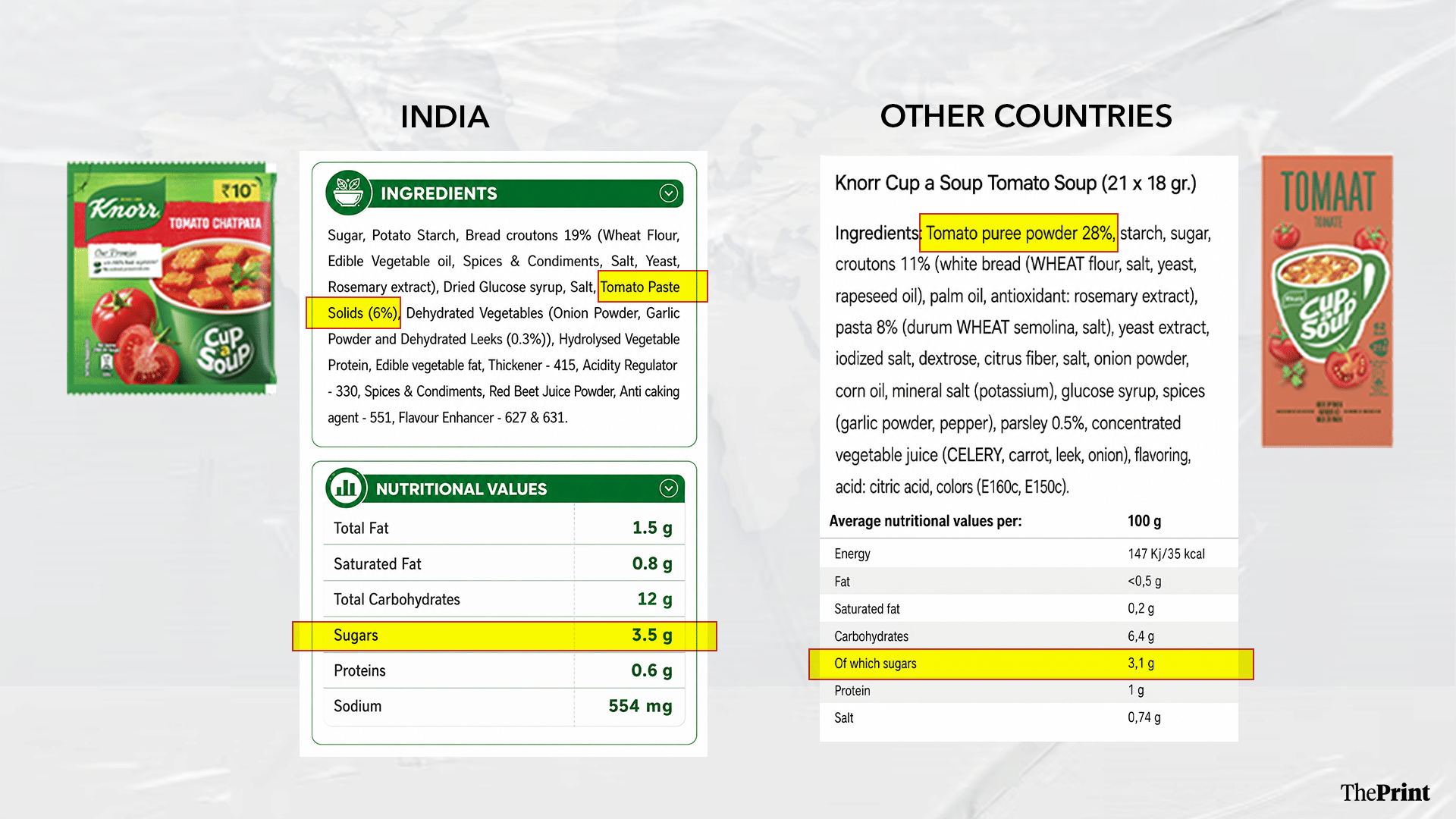
Even a packet of Knorr soup is different. In India, the tomato content is just 6.9 per cent, but in the UK, it is 28 per cent.
These are some of the biggest names in the food and beverage industry, brands that millions of Indian consumers trust.
The correct question is not why multinational companies formulate products differently for different markets. But why does India allow them to?
“We have a government which is weak on public health policy. They listen more to the industry than public health experts. As soon as these multinational brands come in, we comply with them. We let them feed us whatever,” Dr Arun Gupta, Indian pediatrician and public health activist, told ThePrint.
Indians are already paying a price. Obesity has become a major public health challenge in India. The Economic Survey 2025-26, for the first time, called it an economic risk, linking it to productivity loss, rising healthcare spending, and long-term strain on public finances. The survey stated that 24 per cent of Indian women and 23 per cent of Indian men are overweight or obese. An estimated 33 million children were obese in 2020, and the number is expected to rise to 83 million by 2035.
The survey named ultra-processed foods, which are packaged snacks, sugary beverages, ready-to-eat meals, and health drinks, as a major driver, alongside sedentary lifestyles and urbanisation. Retail sales of ultra-processed foods jumped 40-fold, from $0.9 billion in 2006 to nearly $38 billion in 2019. The Economic Survey notes this period coincides with obesity nearly doubling in India.
“Most importantly, India still does not have a clear definition of what constitutes ultra-processed food. So, our fight is not against companies, nor are we telling consumers what they should or should not eat. Our fight is with the policy makers. We need a strong policy,” Gupta explained.
The missing warning label
The smell coming from a steaming pan of almost-cooked two-minute Maggi is enough to trigger hunger pangs. For many, it’s the ultimate midnight snack. But a 100-gram serving of Maggi contains around 1,072 mg of sodium, enough to account for a significant portion of an adult’s recommended daily intake. In international markets too, Maggi variants contain almost the same levels of sodium.
The difference, however, is the missing ‘warning label’ in India.
Maggi packets manufactured in India and sold on UK shelves carry a red front-of-pack warning indicating their high salt content.
Front-of-pack traffic-light labelling in the UK has been adopted by all major supermarkets since 2013. Salt above 1.5g per 100g triggers a red “high” label. In India, as Gupta pointed out, there is currently no mandatory front-of-pack warning system at all.
Consumers like Rajib Bhattacharjee are dismissive of the ‘healthy-unhealthy’ debate. Diet Coke has been his go-to drink for over 2.5 years. He switched from drinking Thums Up and Coca-Cola, around 3-4 litres a day, to drinking Diet Coke after he was diagnosed with diabetes.
“My philosophy is simple: the more you shrug away street food and packaged food, you are weakening your immune system,” he said. “I have had healthy food; I have had the worst kind of foods from the worst places, which even smell like sewage; I am alright. It strengthens your immune system.”
FSSAI has been circling this issue since a 2013 Delhi High Court order, through a 2019 draft regulation, a 2021 stakeholder group, and a 2022 draft “Indian Nutrition Rating” (health-star style) proposal. But nothing was finalised—until recently.
The Supreme Court had to intervene.
In February, earlier this year, the Court reviewed FSSAI’s compliance affidavit and found the exercise so far had produced no positive result. Coca-Cola India’s representative reportedly called colour-coded warnings “very simplistic,” arguing they wouldn’t meaningfully change consumer behaviour. According to Coca-Cola India executive Mili Bhattacharya, consumers who don’t already read ingredient lists would suddenly improve their diet just by seeing a label. She also argued the warning labels were pointless since they wouldn’t stop people from eating sugary or salty food anyway, and unnecessary because Indian doctors were already doing a good job educating patients on what to avoid.
Following this pressure, FSSAI dropped the red/amber/green colour-coded approach and instead proposed simply printing the recommended daily limits (25g sugar, 10g saturated fat, 5g salt) on the label, leaving consumers to do their own math.
In the 13 August hearing, the Court strongly rebuked FSSAI, calling the daily-limits proposal inadequate since it still requires consumers to hunt for figures and calculate for themselves, defeating the entire point of an at-a-glance warning. The bench asked whether FSSAI was caving to industry pressure, and whether India intended to “remain underdeveloped” by rejecting international norms.
It rejected the government’s argument that international standards can’t apply to India, and gave the Centre a final two-week deadline, warning that if the government didn’t act, the Court would dictate the judgment itself.
On 29 August, FSSAI filed a new compliance affidavit, proposing red hexagonal warning labels reading “High Fat,” “High Sugar,” “High Salt,” or “Highly Sweetened Beverage,” triggered when a product is high in two or more of: added saturated fat, added sugar, or salt (thresholds set by the 2024 ICMR-NIN Dietary Guidelines).
Former food safety commissioner Jitendra Jain welcomed the Court’s decision, saying it is “need of the hour” to control the consumption of junk food.
“Food companies definitely wouldn’t like it… their making expenses increase, so naturally the price of the product also increases,” Jain said, highlighting the recent order by the Rajasthan Court to prohibit the sale of junk food in school canteens and within a 50-metre radius of all schools across the state on 25 August.
Jain said that within 11 days, almost 50 per cent of these vendors’ sales have plummeted.
Jain, who now serves as Spl Commissioner Food Supplies & Consumer Affairs, Delhi, said that to prevent loopholes in the policy, decision-makers must evaluate a product in its entirety rather than assessing sugar and salt content piece by piece.
“Food companies typically defend themselves by pointing out that a single chocolate cube doesn’t contain an alarming amount of sugar, but what child actually stops at just one piece?” he said.
Public health activists like Gupta are demanding a strong policy for ultra-processed foods as well. They want clear, visible warning labels that tell consumers what they are buying, so they can make an informed decision.
“We need to construct a policy which protects people from the onslaught of aggressive marketing and advertising. Look at cigarette packets. They carry prominent health warnings, yet people who smoke continue to smoke. The warning does not take away their choice, it simply ensures that they are making that choice with the right information,” Gupta said.
India is having a sugar rush
On days when Bhattacharjee goes for a run, he treats himself with a bottle of Lahori Jeera. He is very much aware that it is loaded with sugar.
“I like it. I drink it on days when my sugar level doesn’t spike,” said Bhattacharjee, who is dependent on insulin injections.
While much of the public debate focuses on foreign food giants, India’s own home-grown brands are far from innocent. From namkeens to biscuits to soft beverages, desi companies too have flooded shelves with products loaded with sugar, salt and fat.
Recently, on Independence Day, there was a full front-and-back-page ad of Lahori Jeera in a leading newspaper.
“Celebrating 80th year of Independence and the rise of an Indian brand …Har koi peera, Lahori Jeera,” read the text on the front page, and the advertisement even labelled it as the “thanda of India.”
If one drinks the full bottle, which is just 160ml, one is gulping down 18.9 grams of sugar. Not to forget, the World Health Organisation (WHO) recommends only 25 grams per day.
Haldiram’s Nut Cracker was found to contain salt at 7.9 times the FSSAI threshold, with fat exceeding the permissible limit by 5.6 times.
Even a cricketer-endorsed “smart snack,” Too Yumm Multigrain Chips, had 1 g of salt in just 30g of chips, against a recommended daily snack-salt limit of only 0.5g.
Patanjali’s Atta Noodles was also found to contain salt 6.2 times the FSSAI threshold, putting even the atta-based product in the same league.
Even the health-oriented product wasn’t any better. Britannia’s NutriChoice Digestive High Fibre Biscuit, marketed around World Health Day, was found to contain 12.1 g of added sugar, 20.8g of total fat, and 362mg of sodium per 100g.
India’s oldest and best-selling biscuit brand, Parle-G, long marketed as a “healthy, energy-giving biscuit”, contains around 27 g of sugar per 100g, along with 76g of refined carbohydrates, and 462 calories per 100g.
“High amounts of added sugar in products such as Dairy Milk, Parle-G and Lahori Zeera can have a significant impact on the body. Since sugar is rapidly absorbed, regular consumption of such products, particularly when they are low in protein, fibre and healthy fats, can contribute to long-term health problems,” said nutritionist Nida Fatima Hazari.
That said, natural sugar isn’t the villain here. Sugar in whole foods like fruit comes packaged with fiber, which slows absorption, while added sugar lacks fiber, so it’s absorbed much faster, which can cause blood sugar levels to spike and trigger an insulin surge that increases hunger.
Excess sugar also affects the heart in several indirect ways. High sugar intake overloads the liver, which converts carbohydrates to fat; over time, this can lead to fatty liver disease, raise blood pressure, and increase chronic inflammation, all of which raise heart disease risk.
A Harvard study even links excess added sugar to a higher risk of autoimmune inflammatory disorders like Crohn’s disease and ulcerative colitis.
“The long-term consequences of excessive sugar consumption can be significant, ranging from insulin resistance and metabolic syndrome to abdominal obesity, all of which can increase the risk of cardiovascular disease,” Hazari added.
“Another concern is that sugary foods can gradually displace healthier, nutrient-rich foods from the diet, leaving people with fewer essential nutrients over the long term.”
Also read: Gurugram’s trash has outlasted every firm hired to clear it—Ecogreen to new stopgap vendors
India even permits synthetic dyes
India’s battle with packaged food doesn’t really end at salt, sugar and fat. A popular chocolate in the Indian market, M&M, contains E171 (titanium dioxide), which was banned by the EU in 2022, over genotoxicity concerns.
Even Skittles aren’t permitted to use titanium dioxide, tartrazine, allura red, and sunset yellow in the candies sold in the European market.
The UK version has swapped the four synthetic dyes for plant-derived colourants like beetroot, anthocyanins, carotene, and turmeric extract, while keeping two (indigo carmine, brilliant blue) that remain EU-approved. However, India’s version of Skittles still uses the full synthetic dye set.
Synthetic dyes still account for almost 57 per cent of India’s food colourants market by revenue, dominating candies, beverages, and baked goods specifically because they’re cheaper and give stronger, more uniform colour than natural alternatives.
A 2010 Indian study found children’s exposure to sunset yellow and tartrazine through everyday food products exceeded permitted standard amounts in some cases.
The study analyzed 478 food samples across Uttar Pradesh. Of the foods using permitted colours (mainly Sunset Yellow FCF and Tartrazine), 59 per cent exceeded the maximum allowable limit of 100 mg/kg.
Beyond the legally permitted dyes used in M&M, Skittles, and even Fanta, India has a documented problem with illegal dyes like Rhodamine Ba and Metanil Yellow turning up in food like candy floss, sweets and snacks, despite being banned outright.
But Gupta doesn’t blame businesses because in the end, their objective is to make profits.
“The quality is compromised in India because the policies aren’t strong. Here, the regulations can be bent every now and then. India is a big, lucrative market, especially because Europe and the US have become saturated,” Gupta said.
U.S. Department of Health and Human Services Secretary Robert F Kennedy Jr, who has been driving the MAHA (Make America Healthy Again) push on food additive reform like the titanium dioxide/dye phase-outs, is making a case for stronger regulations in the US.
The EU operates on the precautionary principle: a substance must be proven safe before use, rather than assumed safe until proven harmful. Titanium dioxide (E171) was banned outright as a food additive starting in 2022, and France has banned all E171-containing products from its domestic market as of January 1, 2026. Dyes like Tartrazine and Sunset Yellow FCF, still common in US snacks, require mandatory hyperactivity warning labels in Europe.
Health Canada has recently authorized natural alternatives like jagua blue as a food coloring, part of a broader pattern of encouraging reformulation toward plant-derived dyes rather than blanket synthetic-dye bans.
Meanwhile, the Bangladesh Food Safety Authority (BFSA) is actively building out its regulatory framework. It was the first Bangladeshi agency to notify draft food-safety regulations to the WTO, and in 2025 it sought public comment on revised Food Safety (Use of Food Additives) Regulations and Chemical Contaminants and Toxins Regulations.
Separately, the Bangladesh Standards and Testing Institution (BSTI) is revising standards like its artificial-flavoured drinks standard (draft released June 2026) and already caps caffeine limits in energy drinks under BDS 2043:2025.
Therefore, many packaged and ultra-processed food brands have turned to countries like India.
The common pushback Gupta faces when going after brands is: why doesn’t he call out the halwais?
“I have never seen a halwai advertising or running campaigns to sell samosas and jalebis,” Gupta added.
(Edited by Ratan Priya)