





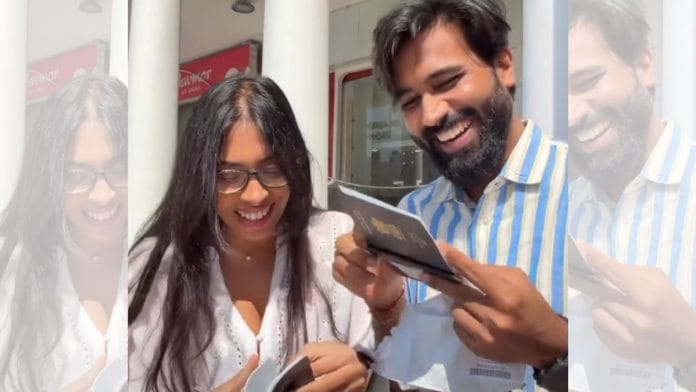


An anxious traveller hurriedly takes out the passport from a torn manila envelope. He’s saved up for months for his first international trip. He starts flicking through the pages. The buildup is surreal as he struggles to find the sticker visa. And every emotion is filmed and posted on Instagram.
These “visa unboxing” reels are the latest sub-genre of Indian travel content. The reactions might be exaggerated, but millions of views and comments tell the story of middle-class India’s travel aspirations.
Shivkant Gupta’s reel is a bit different. No manila envelope. No visa reveal.
The 28-year-old mobile repair shop owner from Bhadohi, Uttar Pradesh, is the first person from either side of his family to ever step inside an airport.
Gupta’s journey to Thailand was not sponsored by legacy wealth or brand collaborations. He earned his first international trip as an incentive for successfully selling a quota of mobile accessories over a period of three years. It is a performance-based incentive used by corporations to boost their on-ground sales in hinterland India.
The ticket was the easy part. Acquiring a passport required something beyond his skill set—navigating Indian bureaucracy. Gupta approached an internet cafe near Badohi station that specialises in filling government applications on digital platforms. He made sure all the documents were scanned and attached to his application.
The successful passport appointment was followed by a mandatory police verification. He negotiated an informal fee to smooth out the process. Twenty days later, the first-ever passport in his family arrived via Speed Post.
Gupta began the first leg of his journey on an overnight sleeper train to Lucknow, 300 km away from Badohi. At the airport, he navigated the duty-free shops with sheer wonder and the security gates with crippling anxiety. He wondered if a security guard would stop him, or worse, an immigration official would start questioning him in English.
He hurriedly unzipped three different hand-stitched pouches, each tucked inside the other. His air ticket is folded between the pages of his most prized possession—his passport. It is even more precious to him than the Thai Baht he purchased from a forex shop in Varanasi.
He films a reel with the backdrop of the boarding gate and posts it on his Instagram. It is a public declaration and a digital record of his achievement. Gupta has arrived even before he’s reached his destination.

Gupta’s journey is a desire across Tier-2 and Tier-3 India. According to Business Standard, there’s been a 32 per cent jump in first-time traveller visa applications from small-town India. The tourist visa—a bureaucratic inconvenience for the privileged class—has become a marker of credibility for aspirational travellers.
These class anxieties get further magnified when it comes to visa approvals. Systemic chokepoints like rising visa volumes and sheer opaqueness of the visa approval systems turns this process into a simulated lottery for first-time travellers.
Indian travel influencers are capitalising on this. “The visa is a great hook. It’s excitement and fear. No matter who you are, you have to go through this process,” says Raja Ghosh, from Raiganj, West Bengal, who has visited 126 countries. He’s also a first-generation traveller. For Ghosh, a visa unboxing reel is just the first step of a monetisable marketing funnel.

Dress code catalogues
Aspirational travellers are lining up to play this lottery. Everyone wants the money shot for Instagram.
“They are looking to find a method to navigate this visa madness,” said Shachi Mall, who runs a travel agency.
She specialises in visa consultation for premium countries and has a front-row seat to the anxiety. What to wear to a visa interview is the most common query. So much so, she has prepared a downloadable dress code catalogue for the US visa interview.
The US tourist visa interview is a high-stakes game—it comes with a 16.32 per cent rejection rate for Indians and a non-refundable fee of Rs 17,000 ($185). There are also year-long wait times for visa interview appointments and endless paperwork.
A US/Schengen visa is a strategic upgrade that could unlock access to major travel destinations. It acts as a ‘pre-credibility check’ for Indian passport holders, granting seamless e-visa or visa-on-arrival to various Latin American countries, as well as Turkey and South Korea.
“Thailand, the UAE, Bali and Sri Lanka are the most preferred starter destinations for first-time travellers,” said Mall.

She added that once people build a travel history, they aim for premium destinations like Europe, the USA, and Australia.
Most aspirational travellers are also interacting with a foreigner for the first time in their lives. Comprehension of a visa officer’s accent is also a legitimate reason to worry. But Mall pushes back against the “bichara” or helpless trope of Tier-2 or 3 travellers.
According to her, everyone is in the same boat. They all come with queries that sound odd to everyone except those who have gone through the process.
“Would I look married enough is the most common question from our female clients,” sighed Mall.
A spouse, dependent parents, children, a stable job, and land title deeds are the proofs required to demonstrate “ties-back-home”. It is a litmus test in the eyes of a visa officer.
Also read: India’s small-town sushi story. Maki rolls in Meerut, nigiri in Jabalpur
Digital garlands
An advocate of slow and immersive travel, Rekha Khandelwal has been travelling since the late 1970s.
“In the 70s, neighbours would come with garlands to the airport when someone was travelling abroad,” said Khandelwal
A sprawling collection of souvenir travel plates mounted on the walls is her visa stamp alternative. There were no algorithmic distractions during travel and no trending reel ideas to recreate. The airport garlands were the emotional architecture of that era. Now, it’s WhatsApp groups and Instagram feeds.

The first destination of the US/Schengen sticker visa is the family WhatsApp group. It’s the first ritual of the new-age celebration.
But visa unboxing is just the teaser—the full story is revealed in the consecutive reels. These reels, which give viewers a glimpse into the process, tips and tricks, follow a similar grammar of suspense, armed with trending Instagram audio and performative, over-the-top expressions. Then comes reels from the trip itself—the real fruit of their labour.
Anu Sharma and Anhad Mathur run @Thevirgocompass, an Instagram account with 212k followers providing practical travelling tips. Sharma left her Rs 32-lakh-per-year corporate job last year to become a full time travel content creator. Mathur followed suit.
A reel featuring visuals from Turkey is accompanied by the story of Mathur’s visa rejection. The solution—Mathur waited for his US visa and then applied for an e-visa. The caption was a trailer for a later reel in which Sharma detailed tips for a Turkey trip. Their setback was reframed into the ultimate comeback content: The visa rejection arc.
They identified a critical information gap that exists in the Indian travel market—crisp & concise visa guides. “Our future plan will revolve around digital products targeted toward Indian travellers going to niche destinations like Yakutsk in Russia,” said Sharma.

Raja Ghosh of @ExplorerRaja says his biggest flex at the immigration counter and on Instagram is his immigration stamps and sticker visas from 125 countries.
The unpredictability of the visa process guarantees one thing for content creators—monetisable engagement.

‘Foreign return’
Gaurav Kamra took his first foreign trip to Thailand in 2010, when he was 21. A native of Sirsa, Haryana, he saved for a year for what he calls a “psychological milestone”.
“My first foreign trip unlocked something in me. It freed me from the middle-class mindset,” said Kamra, who heads the operations of a global travel agency in India.
The middle-class mindset he wants to shed would’ve considered a foreign trip as a financial indiscretion, especially for an early-age earner.
The discovery of budget-friendly youth hostels combined with attractive EMIs discounts on travel websites have shifted the perception. But sky-high interest rates remain. Predatory NBFCs (Non- Banking Financial Corporations) are aggressively marketing “vacation loans” with minimal credit history checks.
It’s why Kamra’s parents generation sees this quest for a visa stamp as a barrier to a financially secure future, fueled by glitzy posts on Instagram.

“I still remember the phone call with my parents when I told them about my tripk. Their response was: Why do you want to travel this far?” he said.
When he returned, his parents asked what he saw there that he couldn’t see in India.
But for a generation that grew up after the 1991 economic liberalisation, a foreign trip is a checklist item. A US/Schengen visa is a Mercedes Benz—a status symbol, a marker of success. It’s their entry into conversation with their tier-1 peers.
Back in Bhadohi, Gupta’s social standing has quietly changed after his first trip abroad. The 28-year-old has received three marriage proposals now that he’s “foreign returned.”
Varun Sharma is a commentator and private equity professional from Tokyo. He explores the intersectionality of food, culture, class and economics.
(Edited by Theres Sudeep)
Varun, what I loved most about this piece is how you noticed emotions most people would overlook. The way you described the passport, the airport anxiety, and the pride behind that first reel made the story feel incredibly personal and real. Beautifully written.
“Varun’s piece is a masterclass in cultural observation. He didn’t just look at the ‘what’—people opening envelopes—but he dove deep into the ‘why,’ capturing that unique blend of Indian aspiration and digital exhibitionism. His ability to connect the dots between the democratization of travel and the specific psyche of Tier 2 and Tier 3 India is brilliant. He treats the subject with exactly the right amount of wit and sociological depth, proving that sometimes the most profound shifts in our society are hidden in a 30-second Instagram Reel. It’s easily one of the most insightful takes on the ‘New India’ digital landscape I’ve read recently.”
Great piece, Varun. I especially find how you’ve portrayed the class dichotomy despite the visa process being the same for everyone quite insightful. It is interesting to note that although the gaps in accessibility, digital literacy, and financial proposition of visa processes are closing, but the mental models remain – these are important barriers to break